
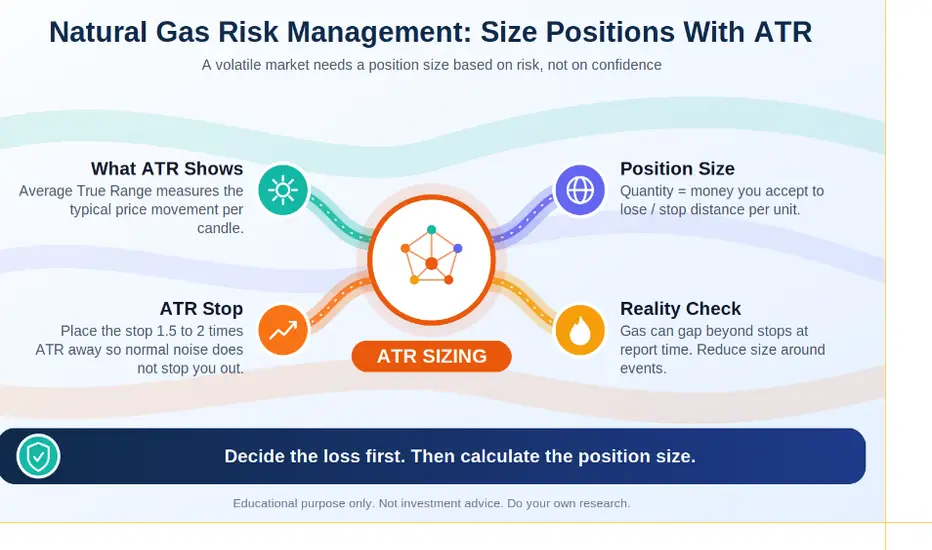
Natural Gas Does Not Care About Your Confidence. A Position Sized on Conviction Will Eventually Be Punished.
Use one indicator and one formula to decide how many units you can trade before you enter.
Natural gas is one of the most volatile commodities. Candles can be large, and moves around data releases can be sudden and violent. In such a market, the real question is not only “where do I enter?” but “how much can I afford to lose if I am wrong?”
Step 1 — Measure volatility with ATR
Add the Average True Range (ATR, period 14) on your chart. It measures the average size of recent candles. A higher ATR means the market is moving more per candle.
Step 2 — Set a volatility-based stop
Place the stop-loss 1.5× to 2× ATR away from your entry. This gives the trade room to breathe so normal noise does not stop you out.
Step 3 — Decide how much you will risk
Decide a fixed percentage of your capital that you are willing to risk per trade — preferably 0.5% to 1% for highly volatile instruments like natural gas.
Step 4 — Calculate position size
Quantity = Amount you are willing to lose ÷ Stop distance per unit
Illustrative example (made-up numbers):
Important reality checks:
Decide the loss first. Then calculate the position size.
Question for you: How do you decide your position size in volatile markets? Share your method.
Educational content only. Not investment advice. Commodity trading involves a high risk of loss.
Use one indicator and one formula to decide how many units you can trade before you enter.
Natural gas is one of the most volatile commodities. Candles can be large, and moves around data releases can be sudden and violent. In such a market, the real question is not only “where do I enter?” but “how much can I afford to lose if I am wrong?”
Step 1 — Measure volatility with ATR
Add the Average True Range (ATR, period 14) on your chart. It measures the average size of recent candles. A higher ATR means the market is moving more per candle.
Step 2 — Set a volatility-based stop
Place the stop-loss 1.5× to 2× ATR away from your entry. This gives the trade room to breathe so normal noise does not stop you out.
Step 3 — Decide how much you will risk
Decide a fixed percentage of your capital that you are willing to risk per trade — preferably 0.5% to 1% for highly volatile instruments like natural gas.
Step 4 — Calculate position size
Quantity = Amount you are willing to lose ÷ Stop distance per unit
Illustrative example (made-up numbers):
- Trading capital: ₹5,00,000
- Risk per trade: 1% = ₹5,000
- ATR (14): ₹4 per unit → stop distance at 2× ATR = ₹8
- Quantity = ₹5,000 ÷ ₹8 = 625 units
- Adjust to the nearest allowed lot size and always check the current MCX contract size & margin before trading.
Important reality checks:
- Natural gas can gap beyond your stop around the Thursday storage report. Your actual loss can be larger than the planned risk.
- Reduce size or stay flat around the Thursday storage report and major weather events.
- ATR changes with time — recalculate regularly.
- Check the current MCX contract size and margin before applying any formula.
Decide the loss first. Then calculate the position size.
Question for you: How do you decide your position size in volatile markets? Share your method.
Educational content only. Not investment advice. Commodity trading involves a high risk of loss.
Note
Interesting fact: Natural Gas is one of the few markets where a single weather forecast or storage report can move the price 5–10% in a day. This is exactly why fixed position sizing (without ATR) becomes dangerous here.
Disclaimer
The information and publications are not meant to be, and do not constitute, financial, investment, trading, or other types of advice or recommendations supplied or endorsed by TradingView. Read more in the Terms of Use.
Disclaimer
The information and publications are not meant to be, and do not constitute, financial, investment, trading, or other types of advice or recommendations supplied or endorsed by TradingView. Read more in the Terms of Use.