
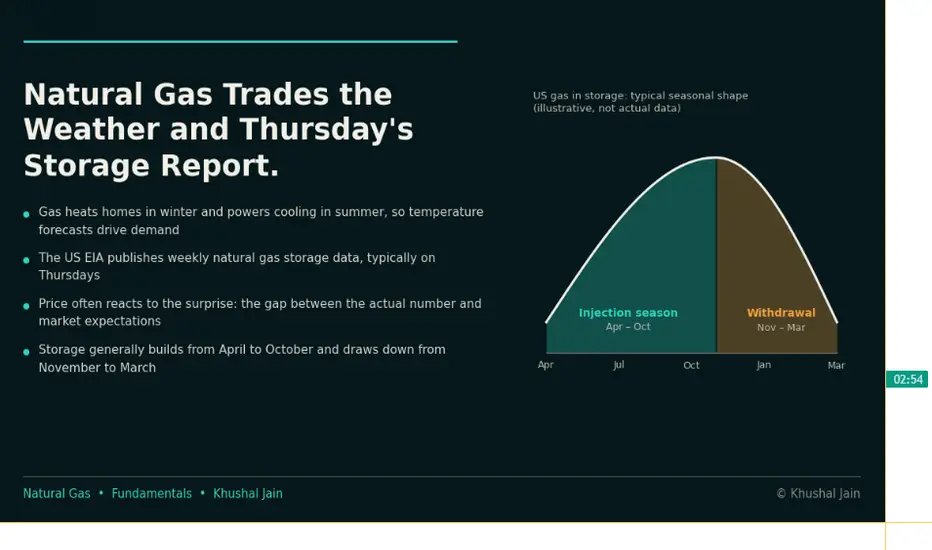
Natural Gas Trades the Weather and One Weekly Report. Miss Either and You Are Trading Blind.
Few markets react as sharply to a forecast and a single number as natural gas does.
Natural gas is used for heating homes in winter and generating power for cooling in summer. So demand expectations shift with temperature forecasts, and the market moves before the weather actually arrives.
The Weekly Storage Report
The US Energy Information Administration (EIA) publishes a weekly natural gas storage report, typically on Thursdays at 10:30 a.m. US Eastern time (8:00 p.m. IST during US daylight saving time, 9:00 p.m. IST otherwise). It shows how much gas was added to or withdrawn from underground storage in the previous week. Holidays can shift the date. It shows the net change in underground storage for the week ending the previous Friday.
It Is the Surprise That Moves Price
Markets form expectations before the release. Price often reacts to the difference between the reported number and that expectation, not to the number by itself. A large build or draw can be "neutral" if it was already expected.
The Seasonal Storage Cycle
Other Drivers to Know
On MCX, natural gas is quoted in ₹ per mmBtu, so the rupee also plays a role, as with crude.
Important caveat: Natural gas is among the most volatile commodities, and leveraged positions can move against you quickly around scheduled data. The seasonal pattern is a general tendency, not a rule for every year. This is educational content, not a recommendation.
Few markets react as sharply to a forecast and a single number as natural gas does.
Natural gas is used for heating homes in winter and generating power for cooling in summer. So demand expectations shift with temperature forecasts, and the market moves before the weather actually arrives.
The Weekly Storage Report
The US Energy Information Administration (EIA) publishes a weekly natural gas storage report, typically on Thursdays at 10:30 a.m. US Eastern time (8:00 p.m. IST during US daylight saving time, 9:00 p.m. IST otherwise). It shows how much gas was added to or withdrawn from underground storage in the previous week. Holidays can shift the date. It shows the net change in underground storage for the week ending the previous Friday.
It Is the Surprise That Moves Price
Markets form expectations before the release. Price often reacts to the difference between the reported number and that expectation, not to the number by itself. A large build or draw can be "neutral" if it was already expected.
The Seasonal Storage Cycle
- April to October (injection season): Lower demand → storage usually builds
- November to March (withdrawal season): Heating demand rises → storage usually draws down
- Traders closely watch how current storage compares with the five-year average to judge if supply is comfortable or tight.
Other Drivers to Know
- Production levels in the US
- LNG export demand
- Weather events that disrupt supply or spike demand
On MCX, natural gas is quoted in ₹ per mmBtu, so the rupee also plays a role, as with crude.
Important caveat: Natural gas is among the most volatile commodities, and leveraged positions can move against you quickly around scheduled data. The seasonal pattern is a general tendency, not a rule for every year. This is educational content, not a recommendation.
Note
📌 Quick Tip for Indian Traders:Always check the EIA number vs consensus + 5-year average.
Even a big build/draw can be neutral if it was already expected.
Also watch USDINR — since MCX Natural Gas is quoted in ₹/mmBtu, rupee movement adds extra volatility on top of the US gas move.
Save this idea for Thursday reference.
Questions? Drop them below 👇

Disclaimer
The information and publications are not meant to be, and do not constitute, financial, investment, trading, or other types of advice or recommendations supplied or endorsed by TradingView. Read more in the Terms of Use.
Disclaimer
The information and publications are not meant to be, and do not constitute, financial, investment, trading, or other types of advice or recommendations supplied or endorsed by TradingView. Read more in the Terms of Use.