
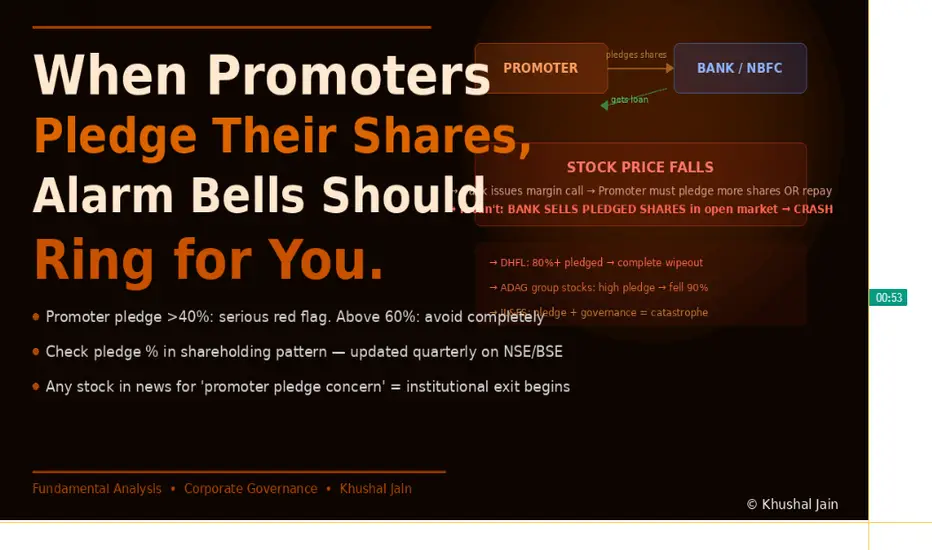
When Promoters Pledge Their Shares, You Should Be Getting Ready to Exit
Promoter pledging is hidden in plain sight in every quarterly shareholding report. Almost no retail investor checks it. It has preceded some of the biggest stock collapses in Indian market history.
The promoter of a company is its founder, controlling family, or original owner. They typically hold 40–75% of shares. When a promoter needs cash for personal reasons or business expansion but does not want to sell shares (which would signal confidence loss and trigger an immediate crash), they do something else: they pledge their shares to a bank as collateral for a loan.
This creates a time bomb inside the stock.
How the Pledge Trap Works — Step by Step
Step 1 — Promoter pledges shares:
Promoter holds 60% of a company at ₹500/share. Total holding value: ₹3,000 crore. They pledge 50% of their shares (₹1,500 crore of shares) to get a loan of ₹900 crore (typical 60% LTV).
Step 2 — Stock price falls:
For any reason — market correction, sector weakness, bad quarterly results — the stock falls from ₹500 to ₹380. The pledged shares are now worth ₹1,140 crore. The bank's LTV limit has been breached.
Step 3 — Margin call:
The bank issues a margin call: "Pledge more shares, or repay part of the loan." If the promoter has cash, they do so. If not — and often they do not, because they took the loan precisely because they needed cash — the bank moves to Step 4.
Step 4 — Bank sells in open market:
The bank begins selling the pledged shares in the open market to recover its loan. This selling pushes the stock price down further. Which triggers more margin calls. Which triggers more selling.
The downward spiral can be catastrophic and fast.
Real Indian Examples:
How to Check Promoter Pledge Instantly
Every quarter, companies file shareholding pattern data with NSE and BSE. This data is publicly available and shows:
The Rules:
Do you hold any stock in your portfolio where the Promoter Pledge is above 20%? Let’s analyze it together and see if it's sitting in the Red Flag Zone or if it's safe.
Promoter pledging is hidden in plain sight in every quarterly shareholding report. Almost no retail investor checks it. It has preceded some of the biggest stock collapses in Indian market history.
The promoter of a company is its founder, controlling family, or original owner. They typically hold 40–75% of shares. When a promoter needs cash for personal reasons or business expansion but does not want to sell shares (which would signal confidence loss and trigger an immediate crash), they do something else: they pledge their shares to a bank as collateral for a loan.
This creates a time bomb inside the stock.
How the Pledge Trap Works — Step by Step
Step 1 — Promoter pledges shares:
Promoter holds 60% of a company at ₹500/share. Total holding value: ₹3,000 crore. They pledge 50% of their shares (₹1,500 crore of shares) to get a loan of ₹900 crore (typical 60% LTV).
Step 2 — Stock price falls:
For any reason — market correction, sector weakness, bad quarterly results — the stock falls from ₹500 to ₹380. The pledged shares are now worth ₹1,140 crore. The bank's LTV limit has been breached.
Step 3 — Margin call:
The bank issues a margin call: "Pledge more shares, or repay part of the loan." If the promoter has cash, they do so. If not — and often they do not, because they took the loan precisely because they needed cash — the bank moves to Step 4.
Step 4 — Bank sells in open market:
The bank begins selling the pledged shares in the open market to recover its loan. This selling pushes the stock price down further. Which triggers more margin calls. Which triggers more selling.
The downward spiral can be catastrophic and fast.
Real Indian Examples:
- DHFL (2018–2019): Promoter pledge concerns triggered a crash from ₹690 to ₹17. Near-total wipeout.
- Essel/Zee (2019): Promoter pledging concerns triggered a 50% crash.
- ADAG group stocks (Reliance Comm, R-Power): High promoter pledge, cascading collateral calls, near-zero prices.
- IL&FS: Complex pledge and debt structures contributed to system-wide NBFC crisis.
How to Check Promoter Pledge Instantly
Every quarter, companies file shareholding pattern data with NSE and BSE. This data is publicly available and shows:
- Total promoter holding %
- Pledged shares as a % of total promoter holding
- Pledged shares as a % of total company shares
The Rules:
- Pledge below 10%: Normal, no concern.
- Pledge 10–40%: Monitor quarterly. Understand why.
- Pledge above 40%: Serious yellow flag. Do extra due diligence.
- Pledge above 60%: Significant risk. Most experienced investors avoid completely.
- Pledge rising quarter-on-quarter: Danger signal regardless of absolute level.
Do you hold any stock in your portfolio where the Promoter Pledge is above 20%? Let’s analyze it together and see if it's sitting in the Red Flag Zone or if it's safe.
Note
The next time you analyze a stock, run it through this 5-step Pledge Risk Checklist before buying. Don't let high promoter pledging wipe out your capital!
Disclaimer
The information and publications are not meant to be, and do not constitute, financial, investment, trading, or other types of advice or recommendations supplied or endorsed by TradingView. Read more in the Terms of Use.
Disclaimer
The information and publications are not meant to be, and do not constitute, financial, investment, trading, or other types of advice or recommendations supplied or endorsed by TradingView. Read more in the Terms of Use.