
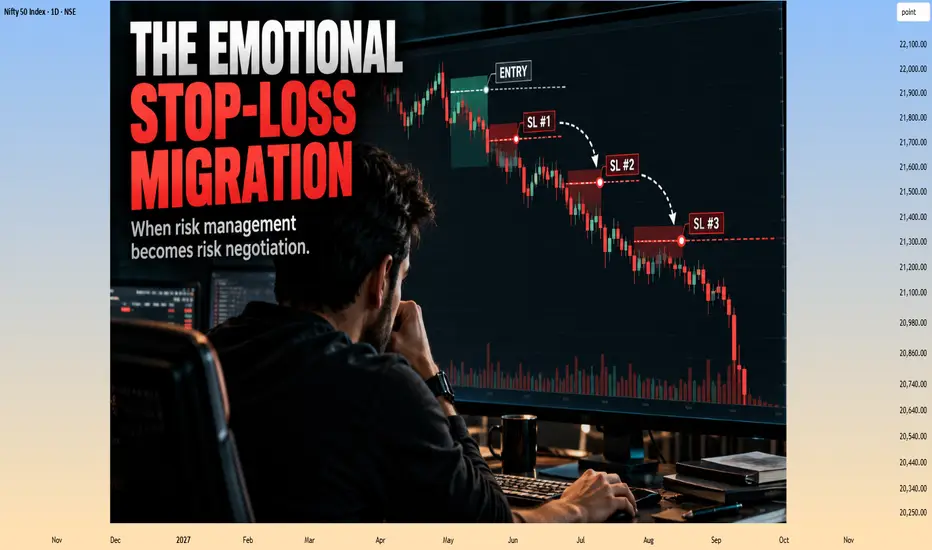
Most traders don't break their stop loss rule at the beginning of the trade.
They break it when the market gets close to the stop.
That's where the negotiation begins.
"I'll give it a little more room."
Price gets closer again.
"The setup is still valid."
Again.
"It will probably reverse from here."
And suddenly, the stop-loss that was supposed to define your risk has become a moving target.
THE PROBLEM ISN'T ALWAYS LACK OF KNOWLEDGE
You already knew where the technical invalidation was.
You placed the stop there because your trade idea becomes wrong beyond that point.
But when price approaches it, something changes.
You're no longer analysing the chart.
You're trying to avoid being wrong.
That's a completely different game.
WHAT IS ACTUALLY HAPPENING?
The trader starts negotiating with uncertainty.
The original question was:
"Where is my trade idea invalidated?"
After entering, the question quietly becomes:
"How much more loss can I tolerate before I accept that I'm wrong?"
That shift is dangerous.
Because now the chart is no longer controlling the decision.
Your P&L is.
THE MIGRATION USUALLY LOOKS LIKE THIS
And the worst part?
The trader often feels like they are being patient.
They aren't.
They're avoiding the emotional cost of accepting a wrong trade.
A BETTER WAY TO THINK ABOUT STOP LOSS
Your stop-loss is not there to tell the market where you want price to reverse.
It is there to tell you where your original thesis is no longer valid.
That's a major difference.
If the structure changes and your original invalidation level genuinely needs to change, the trade can be reassessed.
But moving the stop simply because you don't want to take the loss?
That's not trade management.
That's emotional risk expansion.
THE RULE I PERSONALLY LIKE
Before entering a trade, define three things:
Once you're in the position, don't answer those questions based on your current P&L.
Answer them based on price behaviour.
WATCH YOURSELF THE NEXT TIME THIS HAPPENS
When your price gets close to the stop, don't immediately move it.
Pause.
Look at the chart and ask:
"If I wasn't already in this trade, would I still take this setup right now?"
If the answer is no, you probably aren't managing the trade.
You're managing your emotions.
THE REAL LESSON
A disciplined trader isn't someone who never takes losses.
A disciplined trader is someone who can accept a predefined loss without turning a trading decision into an emotional negotiation.
The stop loss is supposed to end the argument.
If you keep moving it, you're simply postponing the decision.
They break it when the market gets close to the stop.
That's where the negotiation begins.
"I'll give it a little more room."
Price gets closer again.
"The setup is still valid."
Again.
"It will probably reverse from here."
And suddenly, the stop-loss that was supposed to define your risk has become a moving target.
THE PROBLEM ISN'T ALWAYS LACK OF KNOWLEDGE
You already knew where the technical invalidation was.
You placed the stop there because your trade idea becomes wrong beyond that point.
But when price approaches it, something changes.
You're no longer analysing the chart.
You're trying to avoid being wrong.
That's a completely different game.
WHAT IS ACTUALLY HAPPENING?
The trader starts negotiating with uncertainty.
The original question was:
"Where is my trade idea invalidated?"
After entering, the question quietly becomes:
"How much more loss can I tolerate before I accept that I'm wrong?"
That shift is dangerous.
Because now the chart is no longer controlling the decision.
Your P&L is.
THE MIGRATION USUALLY LOOKS LIKE THIS
- Technical stop-loss is placed at the logical invalidation level.
- Price moves against the position.
- Price approaches the stop.
- Trader moves the stop further away.
- Price approaches the new stop.
- Trader creates another reason to move it.
- The small planned loss becomes a much larger uncontrolled loss.
And the worst part?
The trader often feels like they are being patient.
They aren't.
They're avoiding the emotional cost of accepting a wrong trade.
A BETTER WAY TO THINK ABOUT STOP LOSS
Your stop-loss is not there to tell the market where you want price to reverse.
It is there to tell you where your original thesis is no longer valid.
That's a major difference.
If the structure changes and your original invalidation level genuinely needs to change, the trade can be reassessed.
But moving the stop simply because you don't want to take the loss?
That's not trade management.
That's emotional risk expansion.
THE RULE I PERSONALLY LIKE
Before entering a trade, define three things:
- Where is my thesis invalidated?
- How much am I willing to lose if I'm wrong?
- What would need to happen for me to legitimately change the trade thesis?
Once you're in the position, don't answer those questions based on your current P&L.
Answer them based on price behaviour.
WATCH YOURSELF THE NEXT TIME THIS HAPPENS
When your price gets close to the stop, don't immediately move it.
Pause.
Look at the chart and ask:
"If I wasn't already in this trade, would I still take this setup right now?"
If the answer is no, you probably aren't managing the trade.
You're managing your emotions.
THE REAL LESSON
A disciplined trader isn't someone who never takes losses.
A disciplined trader is someone who can accept a predefined loss without turning a trading decision into an emotional negotiation.
The stop loss is supposed to end the argument.
If you keep moving it, you're simply postponing the decision.

Related publications
Disclaimer
The information and publications are not meant to be, and do not constitute, financial, investment, trading, or other types of advice or recommendations supplied or endorsed by TradingView. Read more in the Terms of Use.
Related publications
Disclaimer
The information and publications are not meant to be, and do not constitute, financial, investment, trading, or other types of advice or recommendations supplied or endorsed by TradingView. Read more in the Terms of Use.