
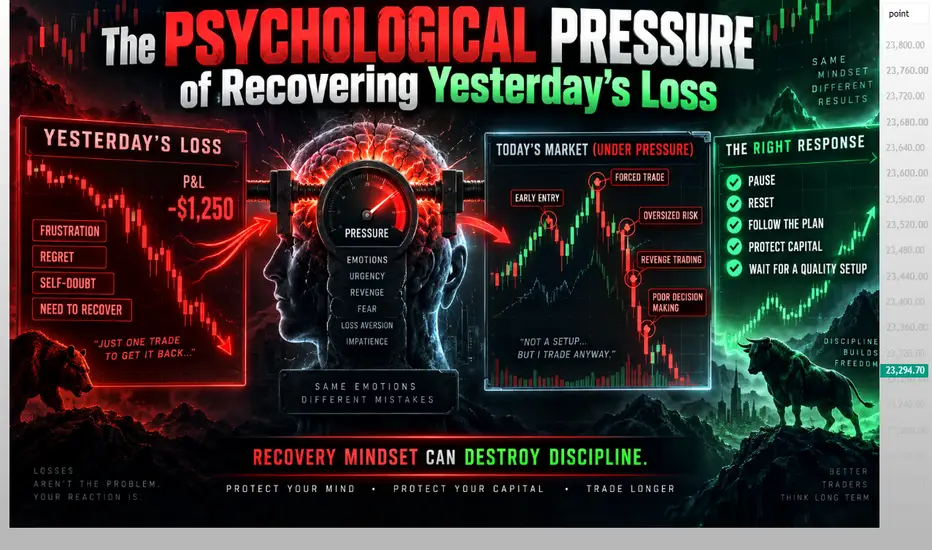
📊 The Psychological Pressure of Recovering Yesterday's Loss
A losing day often creates a hidden objective for the next session:
“I need to make it back.”
That thought may sound harmless. But it can completely change how you trade today.
You may:
• Increase quantity
• Enter earlier
• Lower setup standards
• Take more trades
• Book profits too quickly
• Refuse another stop-loss
Yesterday's P&L starts controlling today's decisions.
---------------------------------
📊 The Market Does Not Know Your Loss
Suppose yesterday ended at: −1R
Today, the market does not know that.
It does not owe you: +1R
and the next trade is not responsible for recovering anything.
The next trade has only one job:
**Qualify under today's trading plan.**
---------------------------------
📊 Recovery Pressure Changes Risk
Your normal risk may be 0.5%.
But after a loss you think:
“If I increase size, I can recover faster.”
Now another normal loss creates much more damage.
Position size should never become a recovery tool. Use the same risk methodology unless your predefined drawdown plan says otherwise.
---------------------------------
📊 Losses Can Lower Setup Quality
Normally you wait for:
• Structure
• Confirmation
• VWAP alignment
• Volume
• Good R:R
But recovery pressure creates:
“Good enough.”
That is where mediocre trades begin. Yesterday's loss should never reduce today's entry standards.
---------------------------------
📊 Fear Can Distort You Too
Not every trader becomes aggressive. Some become too defensive:
• Stop becomes too tight
• Entry becomes late
• Valid setups are skipped
• Winners are booked quickly
So yesterday's loss can create:
Revenge or Fear.
Both interfere with normal execution.
---------------------------------
📊 Be Careful With Daily P&L Anchoring
Yesterday: −₹10,000
Today: +₹8,000 open profit
You may think:
“I am almost back to even. Let me exit.”
But today's trade should be managed using:
• Today's structure
• Today's target
• Today's invalidation
Not yesterday's P&L.
---------------------------------
📊 Use One Powerful Question
Before taking a trade today, ask:
**“Would I take this exact setup if yesterday had been profitable?”**
If yes:
Continue evaluating it normally.
If no:
Yesterday's loss may still be controlling your decision.
---------------------------------
📊 Recovery Mindset vs Reset Mindset
Recovery mindset:
“I need to make the money back.”
This creates pressure.
Reset mindset:
“Today is a new trading sample.”
This creates discipline.
A better sequence after a losing day is:
**Accept → Review → Reset → Reassess → Execute Fresh**
---------------------------------
📊 Recovery Should Come From Expectancy
You do not need one huge trade.
If your system has an edge, recovery can happen naturally through a sequence of normal trades.
Do not turn: −1R
into: −3R
because you tried to recover too quickly.
---------------------------------
📊 Simple Formula
Yesterday's Loss + Recovery Pressure + Larger Risk
= Emotional Trading
But:
Yesterday's Loss + Review + Reset + Normal Risk
= Professional Continuation
---------------------------------
📊 Finally, the important point to note is:
Yesterday's loss belongs to yesterday. Today's market deserves a fresh decision.
Do not ask:
“How do I recover yesterday?”
Ask:
“What is the best valid setup available today?”
**Recover Less. Reset More.**
Follow today's process and let consistency do the recovering.
---------------------------------
Educational Purpose Only. Start your learning journey today ! Because Learning is the only way to become consistent in the markets !!

⭐For Live Trading Courses And Trading Community 📈
Contact ⬇️
📱wa.me/919322295961
📱t.me/+UgF9lES_XxA0MTk9
⭐Advanced courses
⭐Fully Automated Algo Trading
⭐Daily F&O Trade tips
📱 t.me/+UgF9lES_XxA0MTk9
Contact ⬇️
📱wa.me/919322295961
📱t.me/+UgF9lES_XxA0MTk9
⭐Advanced courses
⭐Fully Automated Algo Trading
⭐Daily F&O Trade tips
📱 t.me/+UgF9lES_XxA0MTk9
Related publications
Disclaimer
The information and publications are not meant to be, and do not constitute, financial, investment, trading, or other types of advice or recommendations supplied or endorsed by TradingView. Read more in the Terms of Use.