
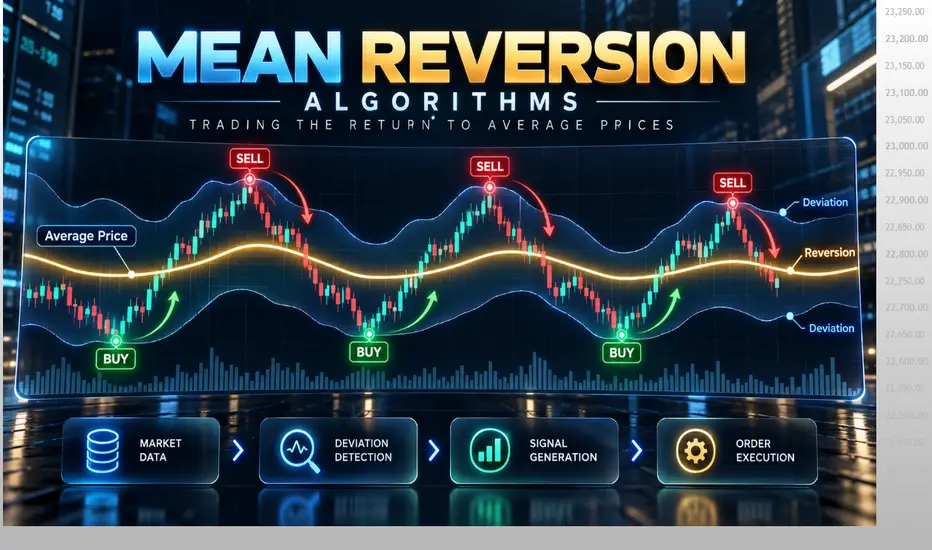
📊 Mean Reversion Algorithms: Trading the Return to Average Prices
Mean reversion is based on a simple idea:
When price moves unusually far away from its normal or average value, it may eventually move back toward that mean.
But there is an important difference between:
**Price temporarily stretched from its average**
and
**Price starting a genuine new trend.**
A good mean-reversion algorithm must identify that difference.
---------------------------------
📊 What Is the “Mean”?
The reference mean could be:
• Moving Average
• VWAP
• Bollinger Band Midline
• Rolling Statistical Average
• Anchored VWAP
The algo then measures how far current price has moved away from that reference.
---------------------------------
📊 Measuring the Deviation
Suppose:
20 EMA = 500
Price = 485
Price is 15 points below its mean.
But raw distance alone is not enough.
Algorithms may normalize the move using:
• Standard deviation
• Z-score
• ATR
This helps determine whether the move is actually unusual.
---------------------------------
📊 Z-Score Is Common in Mean Reversion
A Z-score measures how far price is from its average relative to normal variability.
Conceptually:
Z near 0 = Price near average
Z near +2 = Unusually high
Z near −2 = Unusually low
But:
**Z = −2 does not automatically mean BUY.**
Strong trends can remain statistically stretched for a long time.
---------------------------------
📊 Mean Reversion Works Better in the Right Regime
Better environment:
✅ Flat or stable VWAP
✅ Moderate volatility
✅ Range-bound structure
✅ Repeated oscillation around the mean
Dangerous environment:
❌ Strong breakout
❌ Rapidly sloping VWAP
❌ Expanding ATR
❌ Strong directional volume
The same “oversold” reading can behave very differently in these two conditions.
---------------------------------
📊 Wait for Reversal Confirmation
Instead of:
Extreme → Immediate Entry
a stronger process is:
**Extreme → Stabilization → Reversal Confirmation → Entry**
Possible confirmation:
• Failed breakdown
• Rejection candle
• Higher low
• VWAP reclaim
• Momentum weakening
The algo should see evidence that the extreme is actually failing.
---------------------------------
📊 Example Bullish Setup
Suppose price is:
• 1.8 ATR below the mean
• Z-score below −2
• RSI oversold
• Near support
• ADX low
• Bullish rejection appears
Now the system may look for a move back toward:
**VWAP / Moving Average / Midline**
with a structural stop below invalidation.
---------------------------------
📊 Do Not Confuse Mean Reversion With Averaging
A dangerous thought is:
“Price is even cheaper now, so I should add more.”
If a genuine trend is developing, uncontrolled averaging can create large losses.
If scaling is part of the system, define:
• Maximum entries
• Maximum exposure
• Hard stop
• Total risk
Mean reversion still needs strict risk management.
---------------------------------
📊 Mean Reversion vs Trend Following
Trend following says:
“Price is moving away from the mean because a trend is developing.”
Mean reversion says:
“Price has moved too far and may return.”
Neither approach works in every market.
That is why **regime detection** is so important.
---------------------------------
📊 Simple Formula
Stable Mean + Extreme Deviation + Reversal Confirmation
= Potential Mean-Reversion Setup
But:
Extreme Deviation + Strong Trend + Expanding Volatility
= Possible Trend Continuation
---------------------------------
📊 Finally, the important point to note is:
Mean-reversion algorithms do not blindly buy every dip or short every rally.
They ask:
“Is price unusually far from its normal value?”
“Is the market suitable for reversion?”
“Is the extreme beginning to fail?”
The professional process is:
**Define Mean → Measure Deviation → Identify Regime → Confirm Reversal → Define Risk → Trade the Return**
The real edge is not finding an extreme.
It is identifying **which extremes are likely to revert.**
---------------------------------
Educational Purpose Only.

⭐For Live Trading Courses And Trading Community 📈
Contact ⬇️
📱wa.me/919322295961
📱t.me/+UgF9lES_XxA0MTk9
⭐Advanced courses
⭐Fully Automated Algo Trading
⭐Daily F&O Trade tips
📱 t.me/+UgF9lES_XxA0MTk9
Contact ⬇️
📱wa.me/919322295961
📱t.me/+UgF9lES_XxA0MTk9
⭐Advanced courses
⭐Fully Automated Algo Trading
⭐Daily F&O Trade tips
📱 t.me/+UgF9lES_XxA0MTk9
Related publications
Disclaimer
The information and publications are not meant to be, and do not constitute, financial, investment, trading, or other types of advice or recommendations supplied or endorsed by TradingView. Read more in the Terms of Use.