
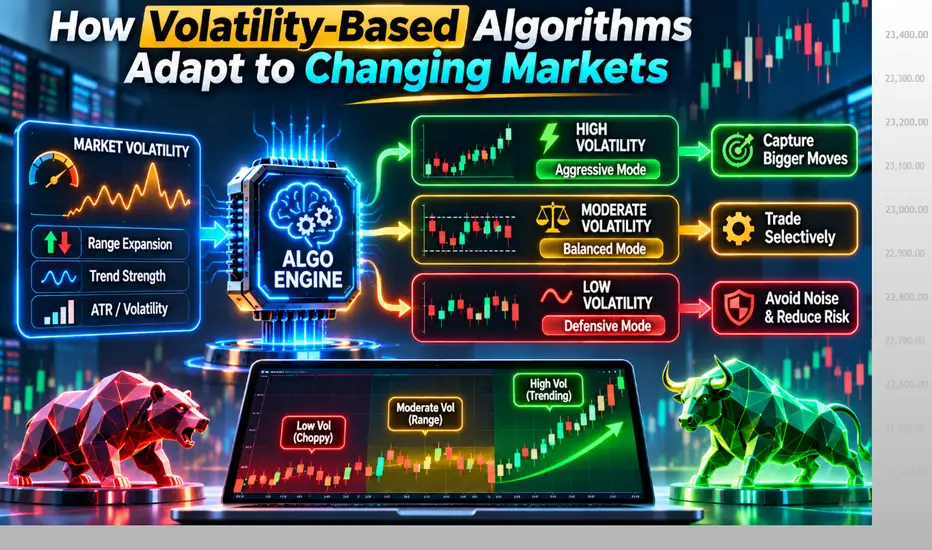
📊 How Volatility-Based Algorithms Adapt to Changing Markets
Markets do not move with the same speed every day.
Some sessions are quiet.
Some suddenly become explosive.
That is why a good algorithm should not always use the same stop, target, entry buffer and position size.
A volatility-based algorithm first asks:
**“How much is the market moving right now?”**
Then it adapts.
---------------------------------
📊 What Does Volatility Tell the Algo?
Volatility measures how aggressively price is moving.
Low volatility may show:
• Small candles
• Tight ranges
• Low ATR
• Weak follow-through
High volatility may show:
• Large candles
• Wider ranges
• Fast price movement
• Bigger intraday swings
Volatility tells us movement intensity — not direction.
---------------------------------
⚙️ ATR-Based Adaptation
ATR is one common way to measure current movement.
Instead of:
Fixed SL = 10 points
an algorithm may use:
**Stop = Structure + ATR Buffer**
When volatility rises:
• Stop distance may expand
• Target potential may expand
• Entry buffer may increase
But position size should usually reduce so account risk remains controlled.
---------------------------------
🛡️ Higher Volatility Should Not Mean Higher Risk
Suppose maximum risk per trade is fixed.
Low-volatility setup:
Stop = 10
Quantity = 200
High-volatility setup:
Stop = 20
Quantity = 100
The stop became wider.
The quantity became smaller.
Account risk stayed similar.
This is how adaptive risk control should work.
---------------------------------
📈 Volatility Regimes
A system can classify the market as:
🟢 LOW
Compression, small ranges, weak momentum.
🔵 NORMAL
Standard strategy parameters.
🟠 HIGH
Larger movement, wider buffers, smaller size.
🔴 EXTREME
Reduce exposure significantly or avoid trading.
Now the algorithm is reacting to the environment instead of assuming every session is identical.
---------------------------------
⚡ Compression → Expansion
Many breakout algorithms look for:
Low ATR
→ Tight range
→ Volatility expansion
→ Volume expansion
→ Breakout
This can help identify when the market is transitioning from quiet conditions into momentum.
---------------------------------
📊 Strategy Logic Can Also Change
Low volatility may favour:
• Range logic
• Mean reversion
• Compression monitoring
Rising volatility may favour:
• Breakout trading
• Momentum continuation
Extreme volatility may require:
• Smaller position size
• More confirmation
• Fewer trades
The algorithm adapts strategy permission — not just the stop-loss.
---------------------------------
📊 For Option Traders
Volatility matters even more because option premiums are affected by both:
• Actual underlying movement
• Implied Volatility
Option buyers may struggle when movement is too low.
Option sellers may face major risk when volatility suddenly expands.
So volatility should be analysed with:
**Price Structure + IV + Liquidity + Defined Risk**
---------------------------------
⚠️ Avoid Fixed Parameters Everywhere
A 10-point stop can be reasonable in one market regime...
and completely unsuitable in another.
Likewise, a fixed 30-point target may be unrealistic when volatility collapses.
Adaptive systems allow market conditions to influence the parameters.
---------------------------------
📊 Simple Formula
Volatility Measurement
→ Regime Detection
→ Parameter Adaptation
→ Risk Control
→ Execution
And remember:
**Higher Volatility ≠ Permission to Take Higher Risk**
Often:
**Higher Volatility → Smaller Position Size**
---------------------------------
📊 Finally, the important point to note is:
Volatility-based algorithms do not need to predict every market move.
They simply recognise:
**The market environment has changed.**
Then they adapt:
Stops.
Targets.
Entry thresholds.
Position size.
Trade frequency.
Strategy selection.
A professional algorithm should not force yesterday's parameters onto today's market.
---------------------------------
Educational Purpose Only.

⭐For Live Trading Courses And Trading Community 📈
Contact ⬇️
📱wa.me/919322295961
📱t.me/+UgF9lES_XxA0MTk9
⭐Advanced courses
⭐Fully Automated Algo Trading
⭐Daily F&O Trade tips
📱 t.me/+UgF9lES_XxA0MTk9
Contact ⬇️
📱wa.me/919322295961
📱t.me/+UgF9lES_XxA0MTk9
⭐Advanced courses
⭐Fully Automated Algo Trading
⭐Daily F&O Trade tips
📱 t.me/+UgF9lES_XxA0MTk9
Related publications
Disclaimer
The information and publications are not meant to be, and do not constitute, financial, investment, trading, or other types of advice or recommendations supplied or endorsed by TradingView. Read more in the Terms of Use.