
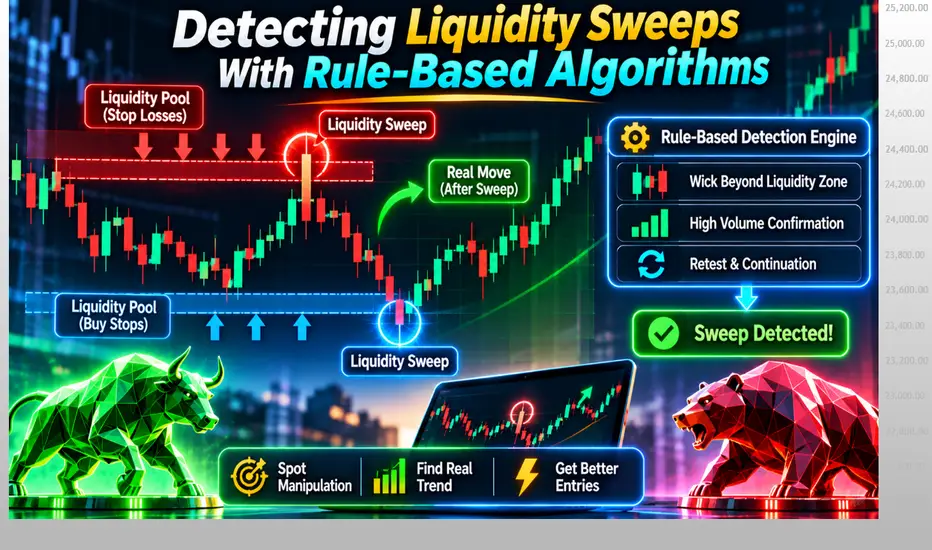
📊 Detecting Liquidity Sweeps With Rule-Based Algorithms
A liquidity sweep happens when price moves beyond an obvious high or low, triggers orders around that level, and then fails to stay beyond it.
But an algorithm should not treat every wick as a sweep.
The real question is:
**Did price take liquidity and then reject the level with confirmation?**
---------------------------------
📊 Step 1: Define the Liquidity Level
A rule-based system can monitor:
• Previous swing highs / lows
• Equal highs / equal lows
• Previous day high / low
• Opening range
• Session high / low
The level must be objective before the algorithm can detect a sweep.
---------------------------------
🔴 Buy-Side Liquidity Sweep
Example:
Price trades above resistance...
but then:
✅ Closes back below the level
✅ Leaves an upper rejection wick
✅ Bearish momentum appears
✅ Follow-through develops
This may indicate that buy-side liquidity was taken before price rejected.
---------------------------------
🟢 Sell-Side Liquidity Sweep
Price moves below support...
then:
✅ Reclaims the level
✅ Closes back above
✅ Leaves a lower wick
✅ Bullish momentum develops
This may indicate a sell-side liquidity sweep.
---------------------------------
⚠️ Sweep vs Breakout
Possible Sweep:
**Level Break → Reclaim → Rejection**
Possible Breakout:
**Level Break → Acceptance → Retest Hold → Continuation**
That distinction is critical.
A wick beyond a level is not enough.
---------------------------------
📊 Use a Minimum Break Buffer
Tiny breaks can create noise.
A stronger system may require price to move beyond the liquidity level by an ATR-based distance before considering the event meaningful.
This helps avoid treating every one-tick break as liquidity activity.
---------------------------------
⚡ Look for Displacement
After a genuine sweep, price may move strongly in the opposite direction.
The algorithm can measure:
• Candle range
• Body size
• ATR expansion
• Volume
Strong displacement makes the rejection more meaningful.
---------------------------------
🔄 Combine Sweep + CHoCH
One powerful sequence is:
**Liquidity Sweep → Reclaim → CHoCH → Retest → Entry**
The sweep shows that liquidity may have been taken.
The CHoCH shows that market structure may actually be changing.
This is stronger than entering immediately after the wick.
---------------------------------
📊 VWAP Can Add Context
For a bearish sweep:
• Price sweeps a high
• Reclaims below it
• VWAP is lost
• Bearish structure develops
For a bullish sweep:
• Price sweeps a low
• Reclaims support
• VWAP is regained
• Bullish structure develops
Now the algorithm has both:
**Liquidity Event + Intraday Flow Confirmation**
---------------------------------
📊 For Option Traders
Let the underlying generate the liquidity signal.
Example bullish setup:
Underlying:
✅ Sell-side sweep
✅ Reclaim
✅ Bullish CHoCH
✅ VWAP reclaim
CE Premium:
✅ Above premium VWAP
✅ Fresh swing-high breakout
✅ Good liquidity
**Underlying identifies the structural event.**
**Option premium confirms execution.**
---------------------------------
🛡️ Risk Still Comes First
A logical stop usually sits beyond the sweep extreme.
Targets can use:
• VWAP
• Opposite range boundary
• Next structural level
• R-multiples
Do not use arbitrary fixed stops.
---------------------------------
📊 Simple Formula
Important Liquidity Level + Sweep + Reclaim + Displacement + Structural Confirmation
= Higher-Quality Sweep Setup
But:
Minor Level + Small Wick + No Reclaim + No Follow-Through
= Likely Noise
---------------------------------
📊 Finally, the important point to note is:
A liquidity-sweep algorithm should not ask only:
“Did price cross the high or low?”
It should ask:
**“Did price take liquidity, fail to hold beyond the level, and then show evidence that control is shifting?”**
The professional sequence is:
**Liquidity → Sweep → Reclaim → Confirmation → Retest → Risk → Execution**
---------------------------------
Educational Purpose Only.

⭐For Live Trading Courses And Trading Community 📈
Contact ⬇️
📱wa.me/919322295961
📱t.me/+UgF9lES_XxA0MTk9
⭐Advanced courses
⭐Fully Automated Algo Trading
⭐Daily F&O Trade tips
📱 t.me/+UgF9lES_XxA0MTk9
Contact ⬇️
📱wa.me/919322295961
📱t.me/+UgF9lES_XxA0MTk9
⭐Advanced courses
⭐Fully Automated Algo Trading
⭐Daily F&O Trade tips
📱 t.me/+UgF9lES_XxA0MTk9
Related publications
Disclaimer
The information and publications are not meant to be, and do not constitute, financial, investment, trading, or other types of advice or recommendations supplied or endorsed by TradingView. Read more in the Terms of Use.