
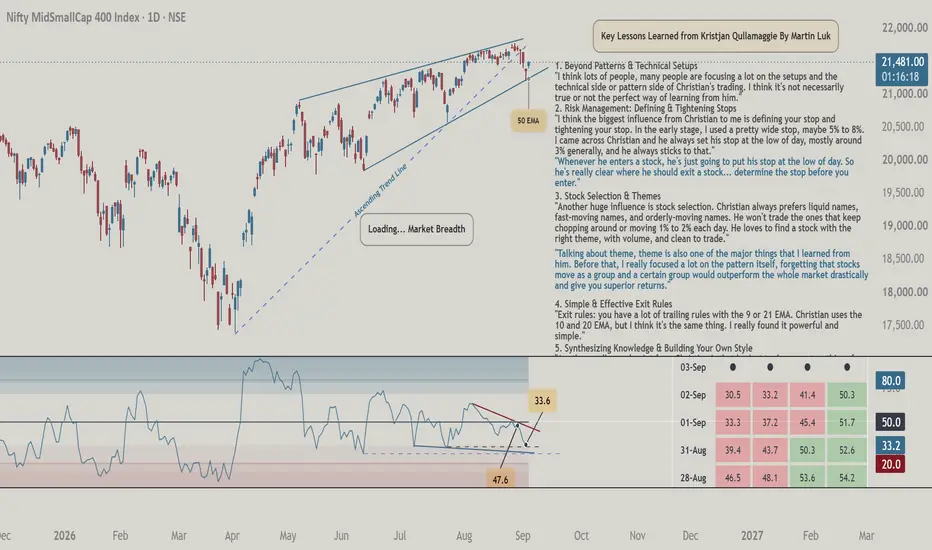
1. Beyond Patterns & Technical Setups
"I think lots of people, many people are focusing a lot on the setups and the technical side or pattern side of Christian's trading. I think it's not necessarily true or not the perfect way of learning from him."
2. Risk Management: Defining & Tightening Stops
"I think the biggest influence from Christian to me is defining your stop and tightening your stop. In the early stage, I used a pretty wide stop, maybe 5% to 8%. I came across Christian and he always set his stop at the low of day, mostly around 3% generally, and he always sticks to that."
"Whenever he enters a stock, he's just going to put his stop at the low of day. So he's really clear where he should exit a stock... determine the stop before you enter."
3. Stock Selection & Themes
"Another huge influence is stock selection. Christian always prefers liquid names, fast-moving names, and orderly-moving names. He won't trade the ones that keep chopping around or moving 1% to 2% each day. He loves to find a stock with the right theme, with volume, and clean to trade."
"Talking about theme, theme is also one of the major things that I learned from him. Before that, I really focused a lot on the pattern itself, forgetting that stocks move as a group and a certain group would outperform the whole market drastically and give you superior returns."
4. Simple & Effective Exit Rules
"Exit rules: you have a lot of trailing rules with the 9 or 21 EMA. Christian uses the 10 and 20 EMA, but I think it's the same thing. I really found it powerful and simple."
5. Mindset & Thinking in Percentages (Account Scaling)
"There's a lot on the mental side of trading. For example, I learned to always think in percentage of your accounts instead of absolute numbers. Christian brought this out and emphasized it a lot. He said what really separates a good trader from a great trader is the ability to scale up his account."
"The reason why those traders cannot scale up their accounts is they focus too much on the absolute numbers—like making $100K or $1 million—but that's not important at all. You should always think in percentages, and I really think it elevated my trading by a lot."
"My answer is just focus only on the percentage of your account, or the number of risk multiples—how many R's you earned in this trade instead of how much money you earned."
6. Synthesizing Knowledge & Building Your Own Style
"Another really good point from Christian is that he just took one or two things from this trader, learned one or two from that guy, but not completely copying them 100%. I really agree and resonate with his points."
"A lot of people are just trying to copy a certain trader, setup, rule, or stock-picking technique completely, but you need to form your own style."
"I think lots of people, many people are focusing a lot on the setups and the technical side or pattern side of Christian's trading. I think it's not necessarily true or not the perfect way of learning from him."
2. Risk Management: Defining & Tightening Stops
"I think the biggest influence from Christian to me is defining your stop and tightening your stop. In the early stage, I used a pretty wide stop, maybe 5% to 8%. I came across Christian and he always set his stop at the low of day, mostly around 3% generally, and he always sticks to that."
"Whenever he enters a stock, he's just going to put his stop at the low of day. So he's really clear where he should exit a stock... determine the stop before you enter."
3. Stock Selection & Themes
"Another huge influence is stock selection. Christian always prefers liquid names, fast-moving names, and orderly-moving names. He won't trade the ones that keep chopping around or moving 1% to 2% each day. He loves to find a stock with the right theme, with volume, and clean to trade."
"Talking about theme, theme is also one of the major things that I learned from him. Before that, I really focused a lot on the pattern itself, forgetting that stocks move as a group and a certain group would outperform the whole market drastically and give you superior returns."
4. Simple & Effective Exit Rules
"Exit rules: you have a lot of trailing rules with the 9 or 21 EMA. Christian uses the 10 and 20 EMA, but I think it's the same thing. I really found it powerful and simple."
5. Mindset & Thinking in Percentages (Account Scaling)
"There's a lot on the mental side of trading. For example, I learned to always think in percentage of your accounts instead of absolute numbers. Christian brought this out and emphasized it a lot. He said what really separates a good trader from a great trader is the ability to scale up his account."
"The reason why those traders cannot scale up their accounts is they focus too much on the absolute numbers—like making $100K or $1 million—but that's not important at all. You should always think in percentages, and I really think it elevated my trading by a lot."
"My answer is just focus only on the percentage of your account, or the number of risk multiples—how many R's you earned in this trade instead of how much money you earned."
6. Synthesizing Knowledge & Building Your Own Style
"Another really good point from Christian is that he just took one or two things from this trader, learned one or two from that guy, but not completely copying them 100%. I really agree and resonate with his points."
"A lot of people are just trying to copy a certain trader, setup, rule, or stock-picking technique completely, but you need to form your own style."

Disclaimer
The information and publications are not meant to be, and do not constitute, financial, investment, trading, or other types of advice or recommendations supplied or endorsed by TradingView. Read more in the Terms of Use.
Disclaimer
The information and publications are not meant to be, and do not constitute, financial, investment, trading, or other types of advice or recommendations supplied or endorsed by TradingView. Read more in the Terms of Use.