
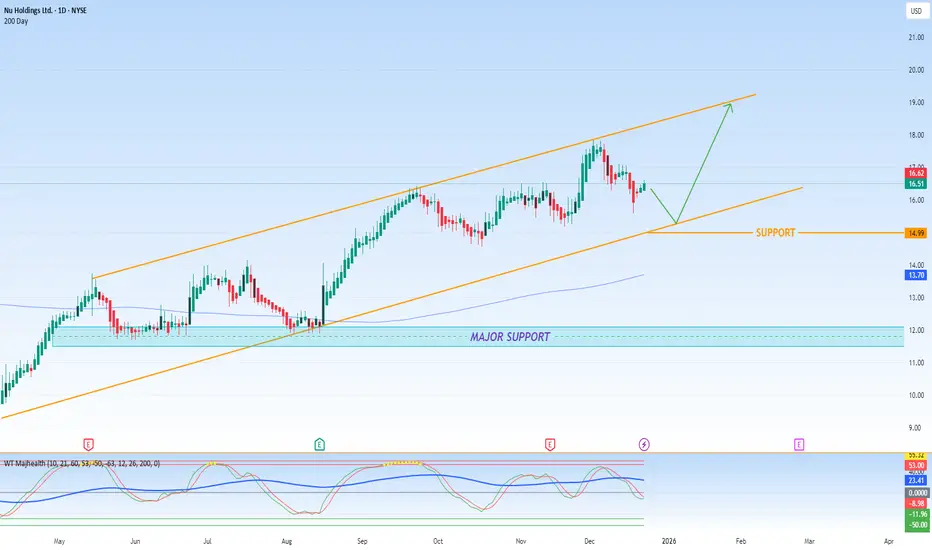
Nu Holdings (NYSE: NU) has firmly established itself as a standout performer in the fintech investment landscape, capturing significant investor attention with its dramatic 58% year-to-date surge in share price. This exceptional performance is not merely speculative hype but is fundamentally rooted in the company's proven ability to execute a disruptive digital banking model across Latin America—a region historically plagued by financial exclusion and concentrated, high-cost traditional banking. By leveraging a smartphone-native platform, Nu has successfully addressed a massive, underserved market, connecting with tens of millions of customers and building a powerful, scalable business poised for the next phase of monetization and geographic expansion.
1. The Brazilian Disruption: A Blueprint for Success
Nu's origin story is one of radical market transformation. For decades, the Brazilian financial system was an oligopoly, dominated by five major banks that engaged in practices former Finance Minister Paulo Guedes famously labeled a "cartel." This concentration led to exorbitant costs for consumers, with credit card interest rates soaring as high as 160%, effectively locking a significant portion of the population out of affordable financial services.
Nu's neobank model dismantled this status quo. By launching as a digital-only platform, the company bypassed the immense overhead of physical branches and passed the savings directly to customers. Its initial offering of free digital checking accounts and credit cards with no annual fees was revolutionary, rapidly attracting tens of millions of Brazilians who were either unbanked or dissatisfied with incumbent options. Today, Nu serves an astonishing 110 million customers in Brazil, representing approximately 60% of the country's adult population.
The company's evolution from a simple payments facilitator to a full-spectrum financial ecosystem is key to its maturity. It now holds multiple regulatory licenses, allowing it to offer a comprehensive suite of products in payments, credit, investments, and insurance. A pivotal forthcoming milestone is its pursuit of a full Brazilian banking license, which it plans to acquire via the purchase of a small bank in 2025. This license will confer enhanced consumer trust, solidify its brand legitimacy, and, crucially, grant access to interbank markets and more stable funding sources, thereby lowering its overall cost of capital and strengthening its competitive moat.
2. The Monetization Engine: Scaling Profitability Through Cross-Selling
Acquiring a massive customer base is only the first step; the core of Nu's investment thesis lies in its ability to monetize this base efficiently. With 127 million customers across its three markets, Nu views each relationship as a platform for deepening financial engagement. Its strategy centers on cross-selling a broadening portfolio of services, which enhances customer lifetime value and transforms the business from a high-growth user acquisition story into a sustainable, profitable enterprise.
The effectiveness of this strategy is vividly captured by the metric of Average Revenue Per Active Customer (ARPAC). As customers adopt more products—moving from a free account to a credit card, a personal loan, an investment product, or even non-financial services like travel or cellular plans—the ARPAC climbs. In Q3, Nu's overall ARPAC reached $13.40, marking a robust 20% year-over-year increase on a foreign-exchange-neutral basis. The monetization trajectory is even more impressive for mature cohorts: for customers with eight or more years on the platform, the ARPAC was $27.30 as of Q2.
This growing ARPAC demonstrates a powerful flywheel effect: a superior, low-cost user experience attracts customers; trust is built through core products; and that trust then facilitates the efficient introduction of higher-margin services. This internal monetization engine allows Nu to grow profitably without perpetually relying on expensive external marketing for new customer acquisition.
3. The Growth Trajectory: Geographic and Product Expansion
Nu's future growth is supported by powerful secular trends and strategic market expansion:
The Digital Tailwind: The foundational trend across Latin America is the relentless rise in smartphone adoption, projected to reach 400 million users. This digitally native generation increasingly prefers the convenience of mobile apps over the inconvenience of physical branches, perfectly aligning with Nu's low-cost, scalable operating model.
International Expansion – Mexico and Colombia: Having saturated a dominant position in Brazil, Nu is methodically replicating its playbook in Latin America's other major economies. In Mexico, it has already attracted over 13 million customers (about 14% of the adult population) and is on the verge of a major regulatory upgrade: the conversion of its SOFIPO (Popular Financial Society) license into a full banking license. This will enable Nu Mexico to offer a broader portfolio, including payroll accounts, and increase deposit insurance coverage sixteen-fold, making it competitive for attracting higher-value customers. In Colombia, it is approaching 4 million customers, laying the groundwork for similar growth.
The Ambitious U.S. Foray: In a bold strategic move, Nu applied in September for a de novo national bank charter from the U.S. Office of the Comptroller of the Currency. While the competitive landscape is vastly different, a U.S. charter would provide a regulated platform to offer products to the large Latin American diaspora and potentially explore new verticals like digital asset custody, all under a single federal regulator.
Investment Conclusion: A Compelling Blend of Growth and Value
In summary, Nu Holdings presents a compelling investment case that combines a proven disruptive model, a massive and engaged customer base, and a clear path to enhanced profitability through product depth and geographic breadth. The company has moved beyond the initial user-growth phase and is now demonstrating its ability to systematically increase the financial value of each customer relationship.
From a valuation perspective, the stock trades at approximately 20 times next-year earnings estimates. For a company growing its top line at over 50% annually while significantly improving its profit margins, this multiple can be considered attractive relative to its growth profile and the vast, ongoing financial digitization opportunity across Latin America. While execution risks remain in newer markets and regulatory processes, Nu's track record in Brazil provides a credible blueprint. For investors seeking an attractively priced growth stock with a durable competitive advantage in an underpenetrated market, Nu Holdings stands out as a formidable contender.
1. The Brazilian Disruption: A Blueprint for Success
Nu's origin story is one of radical market transformation. For decades, the Brazilian financial system was an oligopoly, dominated by five major banks that engaged in practices former Finance Minister Paulo Guedes famously labeled a "cartel." This concentration led to exorbitant costs for consumers, with credit card interest rates soaring as high as 160%, effectively locking a significant portion of the population out of affordable financial services.
Nu's neobank model dismantled this status quo. By launching as a digital-only platform, the company bypassed the immense overhead of physical branches and passed the savings directly to customers. Its initial offering of free digital checking accounts and credit cards with no annual fees was revolutionary, rapidly attracting tens of millions of Brazilians who were either unbanked or dissatisfied with incumbent options. Today, Nu serves an astonishing 110 million customers in Brazil, representing approximately 60% of the country's adult population.
The company's evolution from a simple payments facilitator to a full-spectrum financial ecosystem is key to its maturity. It now holds multiple regulatory licenses, allowing it to offer a comprehensive suite of products in payments, credit, investments, and insurance. A pivotal forthcoming milestone is its pursuit of a full Brazilian banking license, which it plans to acquire via the purchase of a small bank in 2025. This license will confer enhanced consumer trust, solidify its brand legitimacy, and, crucially, grant access to interbank markets and more stable funding sources, thereby lowering its overall cost of capital and strengthening its competitive moat.
2. The Monetization Engine: Scaling Profitability Through Cross-Selling
Acquiring a massive customer base is only the first step; the core of Nu's investment thesis lies in its ability to monetize this base efficiently. With 127 million customers across its three markets, Nu views each relationship as a platform for deepening financial engagement. Its strategy centers on cross-selling a broadening portfolio of services, which enhances customer lifetime value and transforms the business from a high-growth user acquisition story into a sustainable, profitable enterprise.
The effectiveness of this strategy is vividly captured by the metric of Average Revenue Per Active Customer (ARPAC). As customers adopt more products—moving from a free account to a credit card, a personal loan, an investment product, or even non-financial services like travel or cellular plans—the ARPAC climbs. In Q3, Nu's overall ARPAC reached $13.40, marking a robust 20% year-over-year increase on a foreign-exchange-neutral basis. The monetization trajectory is even more impressive for mature cohorts: for customers with eight or more years on the platform, the ARPAC was $27.30 as of Q2.
This growing ARPAC demonstrates a powerful flywheel effect: a superior, low-cost user experience attracts customers; trust is built through core products; and that trust then facilitates the efficient introduction of higher-margin services. This internal monetization engine allows Nu to grow profitably without perpetually relying on expensive external marketing for new customer acquisition.
3. The Growth Trajectory: Geographic and Product Expansion
Nu's future growth is supported by powerful secular trends and strategic market expansion:
The Digital Tailwind: The foundational trend across Latin America is the relentless rise in smartphone adoption, projected to reach 400 million users. This digitally native generation increasingly prefers the convenience of mobile apps over the inconvenience of physical branches, perfectly aligning with Nu's low-cost, scalable operating model.
International Expansion – Mexico and Colombia: Having saturated a dominant position in Brazil, Nu is methodically replicating its playbook in Latin America's other major economies. In Mexico, it has already attracted over 13 million customers (about 14% of the adult population) and is on the verge of a major regulatory upgrade: the conversion of its SOFIPO (Popular Financial Society) license into a full banking license. This will enable Nu Mexico to offer a broader portfolio, including payroll accounts, and increase deposit insurance coverage sixteen-fold, making it competitive for attracting higher-value customers. In Colombia, it is approaching 4 million customers, laying the groundwork for similar growth.
The Ambitious U.S. Foray: In a bold strategic move, Nu applied in September for a de novo national bank charter from the U.S. Office of the Comptroller of the Currency. While the competitive landscape is vastly different, a U.S. charter would provide a regulated platform to offer products to the large Latin American diaspora and potentially explore new verticals like digital asset custody, all under a single federal regulator.
Investment Conclusion: A Compelling Blend of Growth and Value
In summary, Nu Holdings presents a compelling investment case that combines a proven disruptive model, a massive and engaged customer base, and a clear path to enhanced profitability through product depth and geographic breadth. The company has moved beyond the initial user-growth phase and is now demonstrating its ability to systematically increase the financial value of each customer relationship.
From a valuation perspective, the stock trades at approximately 20 times next-year earnings estimates. For a company growing its top line at over 50% annually while significantly improving its profit margins, this multiple can be considered attractive relative to its growth profile and the vast, ongoing financial digitization opportunity across Latin America. While execution risks remain in newer markets and regulatory processes, Nu's track record in Brazil provides a credible blueprint. For investors seeking an attractively priced growth stock with a durable competitive advantage in an underpenetrated market, Nu Holdings stands out as a formidable contender.

Disclaimer
The information and publications are not meant to be, and do not constitute, financial, investment, trading, or other types of advice or recommendations supplied or endorsed by TradingView. Read more in the Terms of Use.
Disclaimer
The information and publications are not meant to be, and do not constitute, financial, investment, trading, or other types of advice or recommendations supplied or endorsed by TradingView. Read more in the Terms of Use.