
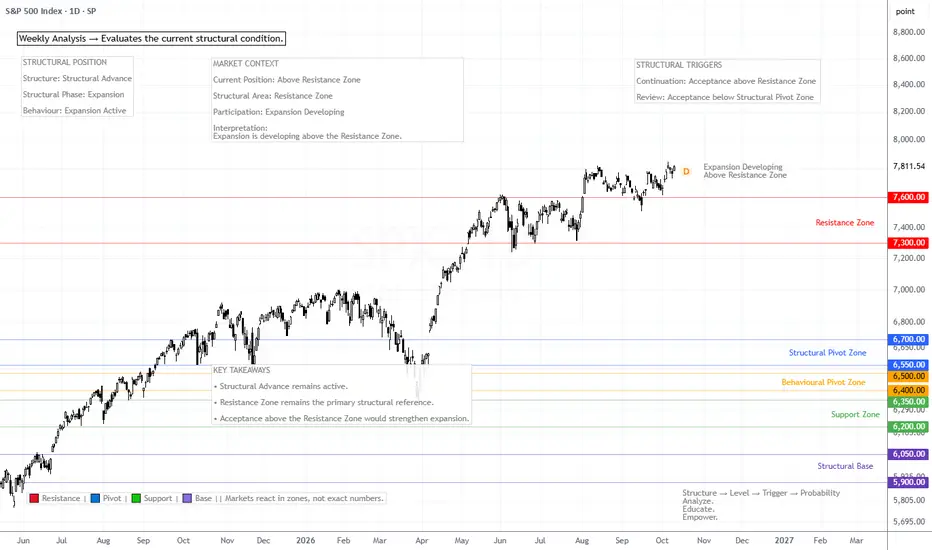
S&P 500 — Week 41 Structural Analysis | Structural Advance Above Resistance
LTP/CMP: 7,811.54
Introduction
The S&P 500 maintains its Structural Advance above the established Resistance Zone. The latest displayed price remains above the 7,300–7,600 range, while expansion participation continues to develop.
The current position is structurally constructive within the chart's framework. The key consideration is whether acceptance above Resistance continues to hold, rather than assuming that the advance must continue indefinitely.
Structure / Structural Phase
Structure: Structural Advance
Structural Phase: Expansion
Behaviour: Expansion Active
The chart continues to classify the market as a Structural Advance, with expansion active above Resistance. This classification describes the observed structural condition; it is not a forecast of future performance.
Market Context
At 7,811.54, the index is above the Resistance Zone of 7,300–7,600.
Resistance remains the primary structural reference. Price is positioned above the zone, and expansion participation continues to develop. Acceptance above Resistance would support the continuation of the current structural interpretation.
The Structural Pivot Zone below remains relevant if the broader position requires reassessment.
Key Levels
Resistance Zone: 7,300–7,600
Structural Pivot Zone: 6,550–6,700
Behavioural Pivot Zone: 6,400–6,500
Support Zone: 6,200–6,350
Structural Base: 5,900–6,050
These are structural reference zones, not projected targets.
Structural Triggers
Continuation: Acceptance above the Resistance Zone would strengthen the expansion interpretation.
Review: Acceptance below the Structural Pivot Zone would require reassessment of the broader structural position.
Structural Interpretation
The S&P 500 remains in a Structural Advance above Resistance. Expansion participation is active, and the market continues to hold its position beyond the established Resistance Zone.
The structural assessment remains conditional on price behaviour. A position above Resistance is meaningful, but continued acceptance—not the label alone—determines whether the current interpretation remains valid.
Educational Insight
A Structural Advance describes the market's position relative to its established structure. It does not remove uncertainty. Even when expansion remains active, structural references continue to matter for evaluating changes in behaviour and position.
Closing Thought
The S&P 500 maintains its Structural Advance above Resistance. The Resistance Zone remains the primary reference for evaluating the current expansion condition.
Structure → Level → Trigger → Probability
Educational analysis only. This is not investment advice, a trade signal, or a prediction of future index direction. Structural interpretations can change as price behaviour evolves.
#SP500 #SPX #USMarkets #MarketStructure #StructuralAnalysis #TechnicalAnalysis #RiskAwareness

Disclaimer
The information and publications are not meant to be, and do not constitute, financial, investment, trading, or other types of advice or recommendations supplied or endorsed by TradingView. Read more in the Terms of Use.
Disclaimer
The information and publications are not meant to be, and do not constitute, financial, investment, trading, or other types of advice or recommendations supplied or endorsed by TradingView. Read more in the Terms of Use.