 STABLE / TetherUS PERPETUAL CONTRACT
Education
MARAL — Long & Short Permission | Liquidity Print + Entry Window
MARAL — Long & Short Permission | Liquidity Print + Entry Window
A Structured Execution Framework for Liquidity-Driven Markets
This is a new Trading View tool built under the MARAL Execution Workflow system:
MARAL — Long & Short Permission.
In modern markets—especially high-liquidity pairs—price does not move randomly.
It typically moves from liquidity to liquidity.
Breakouts fail.
Highs get swept.
Lows get reclaimed.
Chop destroys R:R.
The problem is rarely the market.
The problem is unstructured execution—late entries, impulse trades, and decision-making without a consistent workflow.
That is why MARAL — Long & Short Permission was built:
to help traders standardize execution using a rule-based, permission-driven process.
Not a Signal Tool.
Not an Auto-Trading Bot.
Not Financial Advice.
MARAL is designed to support disciplined decision-making by aligning context, confirmation, timing, and risk structure—so execution becomes repeatable, auditable, and less emotional.
MARAL is a permission-based execution framework designed to standardize decision-making using a rule-governed workflow.
It does not predict price.
It controls participation.
The Core Philosophy
Most traders ask:
“Where should I enter?”
MARAL asks:
“Is participation even permitted?”
That shift alone changes behavior.
Instead of chasing candles, the trader waits for:
HTF Context → H1 Liquidity Print → M15 Timed Trigger → Structured Risk Planning
Only then does permission open.
The Architecture of MARAL
The system is built around a structured multi-timeframe logic engine.
A) HTF Context (Higher Timeframe Authority)
Default: H4
Determines:
• Bias (LONG / SHORT / NEUTRAL)
• Regime (TREND / RANGE)
• Premium / Discount location
• PDH / PDL reference levels
This prevents trading against structural flow.
No HTF alignment → No permission.
B) H1 Liquidity Print (Trigger Layer)
Crypto and high-liquidity markets respect liquidity pools.
MARAL monitors:
• Previous Day High (PDH)
• Previous Day Low (PDL)
A valid “print” requires:
• Sweep beyond liquidity
• Reclaim or rejection
• Close confirmation
This filters:
• False breakouts
• Emotional expansion entries
• Late momentum chasing
No confirmed print → No permission.
C) Noise Control Engine (Chop Filter)
Most losses occur in chop.
MARAL uses:
• ADX
• Efficiency Ratio
Classifies environment:
LOW / MED / HIGH Chop
Policy options:
• Auto
• Block
• Warn
• Ignore
When set to Block, high chop conditions disable entries.
This protects R:R before execution even begins.
D) M15 Timed Execution Window
After H1 confirmation, MARAL opens a controlled execution window (limited number of bars).
Only during this window can valid triggers occur:
• Sweep + Reclaim
• CHoCH + Retest
• Structured Pullback
If the window expires:
Permission closes.
No chasing.
No emotional entries.
E) Structured SL / TP Planning
Before entry, MARAL builds structured preview levels:
• SL1 based on swing + ATR buffer
• TP1 / TP2 using R-multiple logic
• Optional liquidity magnet alignment
Optional LIVE latch mode:
Locks entry + SL/TP during active trade.
This enforces execution discipline.
note : Note (Permission + Planning, Not Signals):
SL1 (Stop Level 1): A risk boundary derived from structure + buffer logic. If reached, the trade idea is treated as invalid within this workflow.
TP1 (Target Level 1): A first planned management zone where partial profit-taking or risk reduction may be considered as part of a structured plan.
TP2 (Target Level 2): A second planned management zone for extended continuation, used only if market conditions remain aligned.
Example levels shown are for demonstration of the planning engine only and are not trade recommendations.
What You See on the Panel
The dashboard provides clear state outputs:
• WAIT
• PERMIT LONG
• PERMIT SHORT
• BLOCK
• IN-TRADE
With diagnostics:
• HTF alignment
• Liquidity status
• Chop classification
• Entry window state
• R:R validation
• Active level mode
This makes the decision process visible and auditable.
Why It Works Well in Liquidity pair
• Liquidity-driven
• Highly reactive to PDH / PDL
• Expansion-prone after compression (GOLD/USD,CRYPTO Pairs)
Most traders lose in:
• Breakout traps
• High chop
• Late entries
• Emotional reversals
MARAL enforces:
Liquidity → Confirmation → Timed Execution → Structured Risk
That alignment suits high-liquidity crypto pairs particularly well.
Who This Tool Is For
• Traders who overtrade
• Traders who chase breakouts
• Traders seeking execution structure
• Futures traders
• High-liquidity crypto participants
• Traders building discipline
This tool is not designed for:
• Random scalping
• Blind indicator stacking
• Automated signal copying
The MARAL Mindset
Signals attempt to predict.
Permission systems control participation.
Prediction is uncertain.
Participation can be structured.
MARAL’s objective is simple:
Make execution rule-based.
Reduce emotional drift.
Standardize entry timing.
Structure risk before commitment.
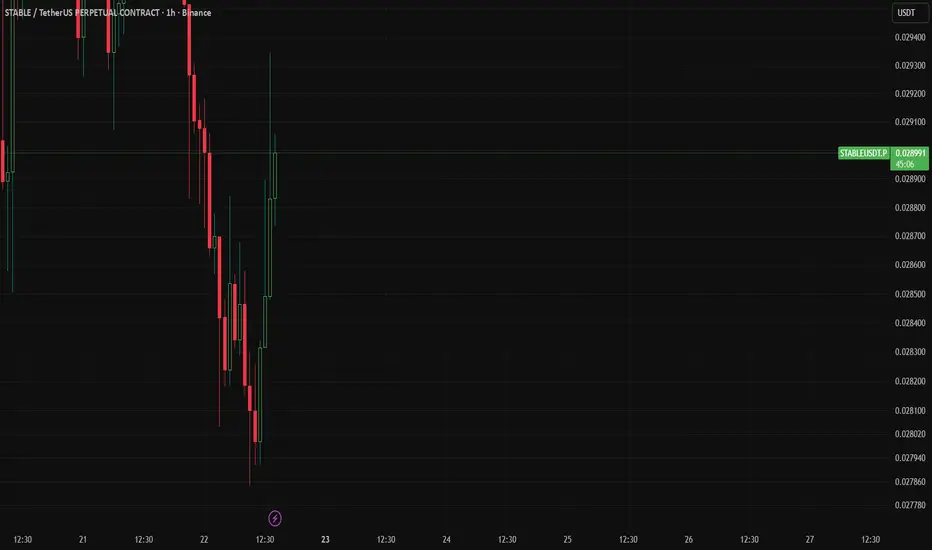
Live Chart Breakdown (STABLEUSDT Perpetual | 1H |)
The attached chart demonstrates how MARAL — Long & Short Permission structures execution using liquidity logic and multi-timeframe control.

This is not hindsight labeling.
This is state-based permission architecture.
Let’s break down exactly what the panel is showing.
1️⃣ Market Context (HTF Layer)
On the right dashboard under A) CONTEXT (HTF):
• Bias / Regime: LONG | RANGE
• Location: DISCOUNT (MID)
• PDH / PDL: 0.030675 / 0.028045
What this means:
The higher timeframe structure is aligned long, but the regime is classified as RANGE — not trending expansion.
This immediately changes behavior.
In RANGE regime:
Aggressive breakout entries are avoided.
Liquidity sweep logic becomes more important.
Mean reversion behavior is more likely.
Price is currently positioned in the discount half of the range.
That creates structural long potential — but not automatic permission.
2️⃣ H1 Liquidity Trigger (Print Logic)
Under B) TRIGGER (H1):
• Print / Status: WAIT
• BSL / SSL Sweeps: 0 / 0
• Response / Magnet: —
This means:
There is currently no confirmed H1 liquidity print.
Even though HTF bias is LONG, MARAL refuses to open permission because:
No sweep + reclaim confirmation occurred at PDH or PDL.
This prevents:
• Blind continuation entries
• Range breakout traps
• Emotional buying during expansion
No Print → No Permission.
3️⃣ Noise Control (Chop Filter)
Under C) NOISE CONTROL:
• Chop: MED | Block
• ADX (H1): 23.50
• ER: 0.33
This indicates moderate chop conditions.
Since the policy is set to Block, permission is actively disabled during unstable structure.
Even if a trigger appears,
Block overrides execution.
This layer protects R:R.
Most retail traders ignore this environment filter.
MARAL does not.
4️⃣ Permission Status
Under D) PERMISSION:
• Long / Short: ❌ | ❌
• Block Reason: NO PRINT
Even though higher timeframe bias is long:
Permission is denied.
Because:
No H1 liquidity print
Chop filter active
Entry window inactive
This is execution discipline.
5️⃣ M15 Execution Layer
Under E) EXECUTION (M15):
• M15 Trigger: WAIT
• Entry Window: INACTIVE
This confirms:
Even if price moves quickly,
MARAL does not chase.
Only after a confirmed H1 print does a timed M15 execution window open.
That window is limited.
Once expired → permission closes.
6️⃣ Level Structure (Risk Planning)
Under F) LEVELS:
• Levels Mode: LIVE 🔒
• SL1: 0.027788
• TP1: 0.029136
• TP2: 0.031662
These levels are calculated using:
• Structure-based swing logic
• ATR buffer
• R-multiple alignment
• Liquidity magnet targeting
When LIVE latch is active,
Entry + SL + TP are locked.
This prevents emotional stop shifting.
7️⃣ What Happened on This Chart
You can see the label:
“PERMIT LONG ENTRY”
This occurred after:
• Liquidity interaction
• Structural reclaim
• Timed execution trigger
Not before.
The entry was structured.
Not emotional.
After entry:
State shifted to:
IN TRADE
And levels were activated.
Why This Matters in High liquidity pair
Its moves aggressively after liquidity sweeps.
Most traders:
• Enter during expansion
• Get trapped in range
• Ignore chop
• Move stops emotionally
MARAL enforces:
HTF Alignment
→ Liquidity Confirmation
→ Chop Filter
→ Timed Execution
→ Structured Risk
No shortcut.
The Core Difference
Signals predict.
MARAL controls participation.
This chart shows something important:
Even when bias is LONG,
MARAL still blocks entries until conditions align.
That is execution governance.
Important Note
This tool does not guarantee outcomes.
It does not provide financial advice.
It structures decision flow.
Note (Permission + Planning, Not Signals):
SL1 (Stop Level 1): A risk boundary derived from structure + buffer logic. If reached, the trade idea is treated as invalid within this workflow.
TP1 (Target Level 1): A first planned management zone where partial profit-taking or risk reduction may be considered as part of a structured plan.
TP2 (Target Level 2): A second planned management zone for extended continuation, used only if market conditions remain aligned.
Example levels shown are for demonstration of the planning engine only and are not trade recommendations.
All trading involves risk.
The purpose of MARAL is to reduce impulsive participation and standardize execution logic.
Final Thought
On this STABLEUSDT example,
the tool did not rush.
It waited for structure.
It blocked during chop.
It opened permission only when liquidity and timing aligned.
That is the difference between reacting to candles and executing with a framework.
Important Disclaimer
MARAL — Long & Short Permission is an analytical and execution-structuring tool.
It does not provide financial advice.
It does not guarantee outcomes.
It does not automate trading.
All trading involves risk.
The purpose of MARAL is to improve decision discipline — not to promise profit.
This article is for education purpose and not trade call or any profit promise
Final Thought
Markets reward consistency.
Consistency requires structure.
Structure requires permission.
Permission requires rules.
MARAL enforces those rules visually and systematically.
If you are serious about execution discipline in liquidity-driven markets, structured participation matters more than prediction.
A Structured Execution Framework for Liquidity-Driven Markets
This is a new Trading View tool built under the MARAL Execution Workflow system:
MARAL — Long & Short Permission.
In modern markets—especially high-liquidity pairs—price does not move randomly.
It typically moves from liquidity to liquidity.
Breakouts fail.
Highs get swept.
Lows get reclaimed.
Chop destroys R:R.
The problem is rarely the market.
The problem is unstructured execution—late entries, impulse trades, and decision-making without a consistent workflow.
That is why MARAL — Long & Short Permission was built:
to help traders standardize execution using a rule-based, permission-driven process.
Not a Signal Tool.
Not an Auto-Trading Bot.
Not Financial Advice.
MARAL is designed to support disciplined decision-making by aligning context, confirmation, timing, and risk structure—so execution becomes repeatable, auditable, and less emotional.
MARAL is a permission-based execution framework designed to standardize decision-making using a rule-governed workflow.
It does not predict price.
It controls participation.
The Core Philosophy
Most traders ask:
“Where should I enter?”
MARAL asks:
“Is participation even permitted?”
That shift alone changes behavior.
Instead of chasing candles, the trader waits for:
HTF Context → H1 Liquidity Print → M15 Timed Trigger → Structured Risk Planning
Only then does permission open.
The Architecture of MARAL
The system is built around a structured multi-timeframe logic engine.
A) HTF Context (Higher Timeframe Authority)
Default: H4
Determines:
• Bias (LONG / SHORT / NEUTRAL)
• Regime (TREND / RANGE)
• Premium / Discount location
• PDH / PDL reference levels
This prevents trading against structural flow.
No HTF alignment → No permission.
B) H1 Liquidity Print (Trigger Layer)
Crypto and high-liquidity markets respect liquidity pools.
MARAL monitors:
• Previous Day High (PDH)
• Previous Day Low (PDL)
A valid “print” requires:
• Sweep beyond liquidity
• Reclaim or rejection
• Close confirmation
This filters:
• False breakouts
• Emotional expansion entries
• Late momentum chasing
No confirmed print → No permission.
C) Noise Control Engine (Chop Filter)
Most losses occur in chop.
MARAL uses:
• ADX
• Efficiency Ratio
Classifies environment:
LOW / MED / HIGH Chop
Policy options:
• Auto
• Block
• Warn
• Ignore
When set to Block, high chop conditions disable entries.
This protects R:R before execution even begins.
D) M15 Timed Execution Window
After H1 confirmation, MARAL opens a controlled execution window (limited number of bars).
Only during this window can valid triggers occur:
• Sweep + Reclaim
• CHoCH + Retest
• Structured Pullback
If the window expires:
Permission closes.
No chasing.
No emotional entries.
E) Structured SL / TP Planning
Before entry, MARAL builds structured preview levels:
• SL1 based on swing + ATR buffer
• TP1 / TP2 using R-multiple logic
• Optional liquidity magnet alignment
Optional LIVE latch mode:
Locks entry + SL/TP during active trade.
This enforces execution discipline.
note : Note (Permission + Planning, Not Signals):
SL1 (Stop Level 1): A risk boundary derived from structure + buffer logic. If reached, the trade idea is treated as invalid within this workflow.
TP1 (Target Level 1): A first planned management zone where partial profit-taking or risk reduction may be considered as part of a structured plan.
TP2 (Target Level 2): A second planned management zone for extended continuation, used only if market conditions remain aligned.
Example levels shown are for demonstration of the planning engine only and are not trade recommendations.
What You See on the Panel
The dashboard provides clear state outputs:
• WAIT
• PERMIT LONG
• PERMIT SHORT
• BLOCK
• IN-TRADE
With diagnostics:
• HTF alignment
• Liquidity status
• Chop classification
• Entry window state
• R:R validation
• Active level mode
This makes the decision process visible and auditable.
Why It Works Well in Liquidity pair
• Liquidity-driven
• Highly reactive to PDH / PDL
• Expansion-prone after compression (GOLD/USD,CRYPTO Pairs)
Most traders lose in:
• Breakout traps
• High chop
• Late entries
• Emotional reversals
MARAL enforces:
Liquidity → Confirmation → Timed Execution → Structured Risk
That alignment suits high-liquidity crypto pairs particularly well.
Who This Tool Is For
• Traders who overtrade
• Traders who chase breakouts
• Traders seeking execution structure
• Futures traders
• High-liquidity crypto participants
• Traders building discipline
This tool is not designed for:
• Random scalping
• Blind indicator stacking
• Automated signal copying
The MARAL Mindset
Signals attempt to predict.
Permission systems control participation.
Prediction is uncertain.
Participation can be structured.
MARAL’s objective is simple:
Make execution rule-based.
Reduce emotional drift.
Standardize entry timing.
Structure risk before commitment.
Live Chart Breakdown (STABLEUSDT Perpetual | 1H |)
The attached chart demonstrates how MARAL — Long & Short Permission structures execution using liquidity logic and multi-timeframe control.
This is not hindsight labeling.
This is state-based permission architecture.
Let’s break down exactly what the panel is showing.
1️⃣ Market Context (HTF Layer)
On the right dashboard under A) CONTEXT (HTF):
• Bias / Regime: LONG | RANGE
• Location: DISCOUNT (MID)
• PDH / PDL: 0.030675 / 0.028045
What this means:
The higher timeframe structure is aligned long, but the regime is classified as RANGE — not trending expansion.
This immediately changes behavior.
In RANGE regime:
Aggressive breakout entries are avoided.
Liquidity sweep logic becomes more important.
Mean reversion behavior is more likely.
Price is currently positioned in the discount half of the range.
That creates structural long potential — but not automatic permission.
2️⃣ H1 Liquidity Trigger (Print Logic)
Under B) TRIGGER (H1):
• Print / Status: WAIT
• BSL / SSL Sweeps: 0 / 0
• Response / Magnet: —
This means:
There is currently no confirmed H1 liquidity print.
Even though HTF bias is LONG, MARAL refuses to open permission because:
No sweep + reclaim confirmation occurred at PDH or PDL.
This prevents:
• Blind continuation entries
• Range breakout traps
• Emotional buying during expansion
No Print → No Permission.
3️⃣ Noise Control (Chop Filter)
Under C) NOISE CONTROL:
• Chop: MED | Block
• ADX (H1): 23.50
• ER: 0.33
This indicates moderate chop conditions.
Since the policy is set to Block, permission is actively disabled during unstable structure.
Even if a trigger appears,
Block overrides execution.
This layer protects R:R.
Most retail traders ignore this environment filter.
MARAL does not.
4️⃣ Permission Status
Under D) PERMISSION:
• Long / Short: ❌ | ❌
• Block Reason: NO PRINT
Even though higher timeframe bias is long:
Permission is denied.
Because:
No H1 liquidity print
Chop filter active
Entry window inactive
This is execution discipline.
5️⃣ M15 Execution Layer
Under E) EXECUTION (M15):
• M15 Trigger: WAIT
• Entry Window: INACTIVE
This confirms:
Even if price moves quickly,
MARAL does not chase.
Only after a confirmed H1 print does a timed M15 execution window open.
That window is limited.
Once expired → permission closes.
6️⃣ Level Structure (Risk Planning)
Under F) LEVELS:
• Levels Mode: LIVE 🔒
• SL1: 0.027788
• TP1: 0.029136
• TP2: 0.031662
These levels are calculated using:
• Structure-based swing logic
• ATR buffer
• R-multiple alignment
• Liquidity magnet targeting
When LIVE latch is active,
Entry + SL + TP are locked.
This prevents emotional stop shifting.
7️⃣ What Happened on This Chart
You can see the label:
“PERMIT LONG ENTRY”
This occurred after:
• Liquidity interaction
• Structural reclaim
• Timed execution trigger
Not before.
The entry was structured.
Not emotional.
After entry:
State shifted to:
IN TRADE
And levels were activated.
Why This Matters in High liquidity pair
Its moves aggressively after liquidity sweeps.
Most traders:
• Enter during expansion
• Get trapped in range
• Ignore chop
• Move stops emotionally
MARAL enforces:
HTF Alignment
→ Liquidity Confirmation
→ Chop Filter
→ Timed Execution
→ Structured Risk
No shortcut.
The Core Difference
Signals predict.
MARAL controls participation.
This chart shows something important:
Even when bias is LONG,
MARAL still blocks entries until conditions align.
That is execution governance.
Important Note
This tool does not guarantee outcomes.
It does not provide financial advice.
It structures decision flow.
Note (Permission + Planning, Not Signals):
SL1 (Stop Level 1): A risk boundary derived from structure + buffer logic. If reached, the trade idea is treated as invalid within this workflow.
TP1 (Target Level 1): A first planned management zone where partial profit-taking or risk reduction may be considered as part of a structured plan.
TP2 (Target Level 2): A second planned management zone for extended continuation, used only if market conditions remain aligned.
Example levels shown are for demonstration of the planning engine only and are not trade recommendations.
All trading involves risk.
The purpose of MARAL is to reduce impulsive participation and standardize execution logic.
Final Thought
On this STABLEUSDT example,
the tool did not rush.
It waited for structure.
It blocked during chop.
It opened permission only when liquidity and timing aligned.
That is the difference between reacting to candles and executing with a framework.
Important Disclaimer
MARAL — Long & Short Permission is an analytical and execution-structuring tool.
It does not provide financial advice.
It does not guarantee outcomes.
It does not automate trading.
All trading involves risk.
The purpose of MARAL is to improve decision discipline — not to promise profit.
This article is for education purpose and not trade call or any profit promise
Final Thought
Markets reward consistency.
Consistency requires structure.
Structure requires permission.
Permission requires rules.
MARAL enforces those rules visually and systematically.
If you are serious about execution discipline in liquidity-driven markets, structured participation matters more than prediction.

MARAL Execution Workflow, Long & Short Permission , Dynamic risk mapper & Deep Candle Intelligence
Context → Liquidity Event → Displacement → Structure Shift → POI Confirmation → Risk Clearance (Discretionary | Educational)
Context → Liquidity Event → Displacement → Structure Shift → POI Confirmation → Risk Clearance (Discretionary | Educational)
Related publications
Disclaimer
The information and publications are not meant to be, and do not constitute, financial, investment, trading, or other types of advice or recommendations supplied or endorsed by TradingView. Read more in the Terms of Use.