
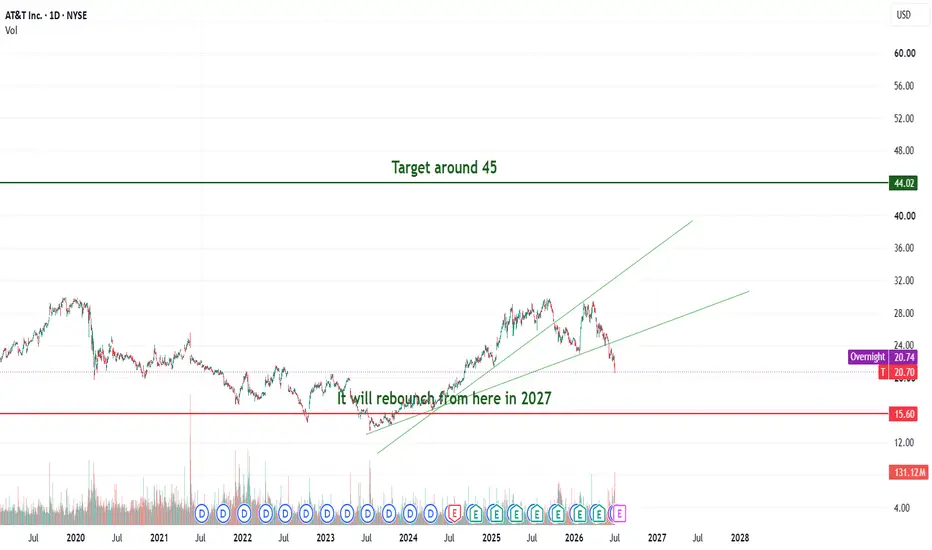
you can learn more here medium.com/@rushichavan-74205/the-rise-fall-and-rebirth-of-at-t-surviving-a-190-billion-identity-crisis-20ae1447caa2
# **AT&T: The Rise, Fall, and Rebirth**
### A Long-Term Investor's View of One of America's Most Important Companies
For decades, **AT&T (NYSE: T)** has been one of the world's most recognizable telecommunications companies. While many investors remember the company for its high dividend and recent debt problems, the full story is far more interesting. It is a story of innovation, aggressive expansion, painful restructuring, and a return to its core business.
---
## 1. A 150-Year Legacy
AT&T's history begins with **Alexander Graham Bell's invention of the telephone in 1876**. Over the following century, the company became the backbone of telecommunications in the United States.
Today, AT&T has simplified its business and focuses on two core segments:
* **Mobility** – 5G wireless services
* **Fiber Connectivity** – High-speed fiber broadband
Rather than trying to be a media company, AT&T is once again focused on building and operating communication infrastructure.
---
## 2. The Costly Media Expansion
Around 2015, management believed telecommunications companies risked becoming nothing more than the infrastructure carrying other companies' content.
To change that, AT&T pursued two massive acquisitions:
| Year | Event |
| ---- | ----------------------------------------------- |
| 2015 | Acquired DirecTV for approximately **$48.5B** |
| 2018 | Acquired Time Warner for approximately **$85B** |
The vision was to combine content with distribution.
Unfortunately, the strategy failed.
The rise of streaming competition, changing consumer behavior, and the enormous acquisition costs pushed AT&T's debt to nearly **$190 billion**, making it one of the most indebted non-financial companies in the world.
---
## 3. The Great Reset
Management eventually reversed course.
Between 2021 and 2022, AT&T unwound most of its media ambitions.
* DirecTV was spun off.
* WarnerMedia was separated and merged with Discovery.
* The company returned to being a telecommunications business.
To strengthen the balance sheet, management also made one of the most controversial decisions in company history:
**AT&T reduced its dividend by nearly 50% in 2022.**
While painful for income investors, the move freed billions of dollars annually to reduce debt.
---
## 4. The Financial Turnaround
Today, AT&T's financial strategy is straightforward:
1. Invest in wireless and fiber expansion.
2. Pay a sustainable dividend.
3. Use remaining free cash flow to aggressively reduce debt.
### Key Financial Metrics
| Metric | Current Position |
| ----------------------- | ------------------------------ |
| Peak Debt | Nearly **$190B** |
| Current Net Debt | Approximately **$126.4B** |
| Annual Dividend | **$1.11 per share** |
| Dividend Cost | Approximately **$8B annually** |
| Expected Free Cash Flow | **$18B+ (2025–2026)** |
| Leverage Target | **2.5× Net Debt / EBITDA** |
The company continues directing excess cash toward bond repayment and deleveraging rather than pursuing major acquisitions.
---
## 5. Who Owns AT&T?
AT&T is primarily owned by large institutional investors, including:
* Vanguard
* BlackRock
* State Street
These firms generally view AT&T as a stable income-producing investment.
Debt financing comes largely from:
* Corporate bond investors
* Pension funds
* Insurance companies
* Syndicated bank loans
* Vendor financing agreements
---
## 6. Bell Labs: One of the Greatest Innovation Engines Ever Created
Although recent headlines have focused on debt and restructuring, it's easy to forget AT&T's extraordinary history of innovation.
Its research division, **Bell Labs**, helped shape modern technology.
Some of its achievements include:
* The transistor
* Solar cells
* The laser
* Telstar communication satellites
* UNIX operating system
* C programming language
* C++ programming language
Researchers from Bell Labs have been awarded **10 Nobel Prizes**, making it one of the most influential industrial research organizations in history.
---
## 7. Where AT&T Is Investing Today
AT&T's current investments are centered on expanding network infrastructure rather than media assets.
Key initiatives include:
* Nationwide 5G expansion
* Open RAN (Open Radio Access Network)
* Satellite-to-cell partnerships to reduce coverage gaps
* Large-scale fiber network expansion
* Multi-gigabit symmetrical internet services
These investments are intended to improve long-term competitiveness while generating stable recurring cash flows.
---
# Final Thoughts
AT&T's journey over the past decade offers a valuable lesson in corporate strategy.
The company attempted to transform itself into a media powerhouse, accumulated enormous debt, and ultimately reversed course after the strategy proved unsuccessful.
Today, management appears focused on a much simpler objective:
* Build the best wireless network.
* Expand fiber connectivity.
* Generate strong free cash flow.
* Reduce debt.
* Maintain a sustainable dividend.
For long-term investors, the key question is no longer whether AT&T can become a media giant. Instead, it is whether a disciplined, infrastructure-focused telecommunications business can continue creating shareholder value while steadily strengthening its balance sheet.
**What do you think? Is AT&T's turnaround just beginning, or is it already fully reflected in the stock price?**
# **AT&T: The Rise, Fall, and Rebirth**
### A Long-Term Investor's View of One of America's Most Important Companies
For decades, **AT&T (NYSE: T)** has been one of the world's most recognizable telecommunications companies. While many investors remember the company for its high dividend and recent debt problems, the full story is far more interesting. It is a story of innovation, aggressive expansion, painful restructuring, and a return to its core business.
---
## 1. A 150-Year Legacy
AT&T's history begins with **Alexander Graham Bell's invention of the telephone in 1876**. Over the following century, the company became the backbone of telecommunications in the United States.
Today, AT&T has simplified its business and focuses on two core segments:
* **Mobility** – 5G wireless services
* **Fiber Connectivity** – High-speed fiber broadband
Rather than trying to be a media company, AT&T is once again focused on building and operating communication infrastructure.
---
## 2. The Costly Media Expansion
Around 2015, management believed telecommunications companies risked becoming nothing more than the infrastructure carrying other companies' content.
To change that, AT&T pursued two massive acquisitions:
| Year | Event |
| ---- | ----------------------------------------------- |
| 2015 | Acquired DirecTV for approximately **$48.5B** |
| 2018 | Acquired Time Warner for approximately **$85B** |
The vision was to combine content with distribution.
Unfortunately, the strategy failed.
The rise of streaming competition, changing consumer behavior, and the enormous acquisition costs pushed AT&T's debt to nearly **$190 billion**, making it one of the most indebted non-financial companies in the world.
---
## 3. The Great Reset
Management eventually reversed course.
Between 2021 and 2022, AT&T unwound most of its media ambitions.
* DirecTV was spun off.
* WarnerMedia was separated and merged with Discovery.
* The company returned to being a telecommunications business.
To strengthen the balance sheet, management also made one of the most controversial decisions in company history:
**AT&T reduced its dividend by nearly 50% in 2022.**
While painful for income investors, the move freed billions of dollars annually to reduce debt.
---
## 4. The Financial Turnaround
Today, AT&T's financial strategy is straightforward:
1. Invest in wireless and fiber expansion.
2. Pay a sustainable dividend.
3. Use remaining free cash flow to aggressively reduce debt.
### Key Financial Metrics
| Metric | Current Position |
| ----------------------- | ------------------------------ |
| Peak Debt | Nearly **$190B** |
| Current Net Debt | Approximately **$126.4B** |
| Annual Dividend | **$1.11 per share** |
| Dividend Cost | Approximately **$8B annually** |
| Expected Free Cash Flow | **$18B+ (2025–2026)** |
| Leverage Target | **2.5× Net Debt / EBITDA** |
The company continues directing excess cash toward bond repayment and deleveraging rather than pursuing major acquisitions.
---
## 5. Who Owns AT&T?
AT&T is primarily owned by large institutional investors, including:
* Vanguard
* BlackRock
* State Street
These firms generally view AT&T as a stable income-producing investment.
Debt financing comes largely from:
* Corporate bond investors
* Pension funds
* Insurance companies
* Syndicated bank loans
* Vendor financing agreements
---
## 6. Bell Labs: One of the Greatest Innovation Engines Ever Created
Although recent headlines have focused on debt and restructuring, it's easy to forget AT&T's extraordinary history of innovation.
Its research division, **Bell Labs**, helped shape modern technology.
Some of its achievements include:
* The transistor
* Solar cells
* The laser
* Telstar communication satellites
* UNIX operating system
* C programming language
* C++ programming language
Researchers from Bell Labs have been awarded **10 Nobel Prizes**, making it one of the most influential industrial research organizations in history.
---
## 7. Where AT&T Is Investing Today
AT&T's current investments are centered on expanding network infrastructure rather than media assets.
Key initiatives include:
* Nationwide 5G expansion
* Open RAN (Open Radio Access Network)
* Satellite-to-cell partnerships to reduce coverage gaps
* Large-scale fiber network expansion
* Multi-gigabit symmetrical internet services
These investments are intended to improve long-term competitiveness while generating stable recurring cash flows.
---
# Final Thoughts
AT&T's journey over the past decade offers a valuable lesson in corporate strategy.
The company attempted to transform itself into a media powerhouse, accumulated enormous debt, and ultimately reversed course after the strategy proved unsuccessful.
Today, management appears focused on a much simpler objective:
* Build the best wireless network.
* Expand fiber connectivity.
* Generate strong free cash flow.
* Reduce debt.
* Maintain a sustainable dividend.
For long-term investors, the key question is no longer whether AT&T can become a media giant. Instead, it is whether a disciplined, infrastructure-focused telecommunications business can continue creating shareholder value while steadily strengthening its balance sheet.
**What do you think? Is AT&T's turnaround just beginning, or is it already fully reflected in the stock price?**

Disclaimer
The information and publications are not meant to be, and do not constitute, financial, investment, trading, or other types of advice or recommendations supplied or endorsed by TradingView. Read more in the Terms of Use.
Disclaimer
The information and publications are not meant to be, and do not constitute, financial, investment, trading, or other types of advice or recommendations supplied or endorsed by TradingView. Read more in the Terms of Use.