
Futures tied to the world’s benchmark interest rate sit at a pivotal level, reflecting a market clouded by extraordinary uncertainty. Political risk, legal challenges, and shifting global policy expectations are colliding with technical signals to create a backdrop where directional conviction is scarce. With the Federal Reserve’s decision looming and structural questions about U.S. fiscal and trade policy unresolved, the next move in U.S. 10-year Treasury futures could prove highly consequential.
While the latest unwind is partially being driven by a global repricing of medium-term interest rate expectations as several central banks signal the next move in policy rates is likely to be higher, the steepening of the curve may also reflect concern about the FOMC being compromised politically next year through the potential appointment of close Trump ally Kevin Hassett as chair, along with the future of current governor Lisa Cook. She was dismissed by Donald Trump earlier this year only to see her reappointed by a court order. A final ruling from the U.S. Supreme Court is expected early in the new year.
If rates at the front of the curve are cut for political rather than economic reasons, you’d expect to see curves react to the prospect of stronger nominal growth expectations. Throw in uncertainty as to whether Trump’s reciprocal tariffs will be ruled legal in a separate court case—an outcome that could significantly widen the U.S. primary deficit and open the door to litigation proceedings against the government—and it makes the price action in this contract so interesting as we move towards 2026.
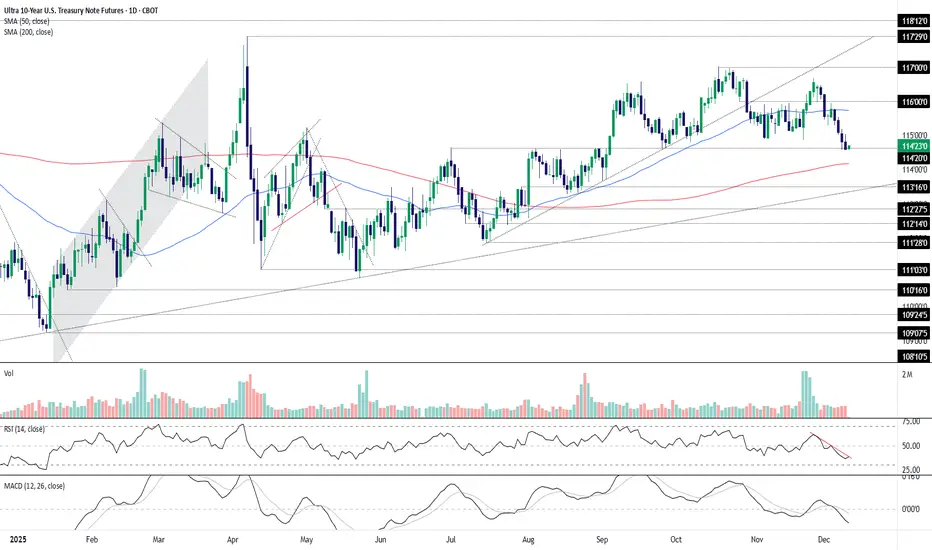
Rejected comprehensively at the influential 50DMA last week, U.S. 10-year Treasury note futures have spent the period since sliding lower, leaving the contract teetering at 114’20’0 less than 24 hours out from the Federal Reserve’s December FOMC meeting, where it’s widely expected to deliver a third consecutive 25-basis point rate cut, taking the funds rate to a range of between 3.5–3.75%.
114’20’0 has acted as support and resistance for lengthy periods in 2025, underlining its importance when it comes to medium-term directional risks. With RSI (14) pushing lower below 50, it favours downside over upside, especially with MACD confirming the bearish signal.
Should we see an extension of the unwind through 114’20’0, it would put a retest of the 200DMA on the radar and, beyond that, the intersection of 113’16’0 support and the uptrend running from the lows set in January.
If the bearish move stalls at 114’20’0, the 50DMA may be targeted by bulls looking for a retracement, although price action beneath 115’00’0 should be monitored given there were buyers lurking beneath it for periods in November.
Beyond technicals, I’m not entirely convinced we’ll see an overly hawkish cut from the Fed on Wednesday—something that may temporarily relieve downside pressure on the price. Unless a significant proportion of FOMC members no longer deem a funds rate of 3% as neutral for economic activity, it still lends itself to the median member signalling one cut in both 2026 and 2027, even though there has been an extra one added to the 2025 profile relative to the prior dot plot forecasts released three months ago.
If that does eventuate and we don’t see a significant minority of members dissent in favour of keeping rates steady at this meeting, it would not surprise to see a bid across the curve as traders price in the prospect of more than two cuts over that period, as was the case earlier this month.
Good luck!
DS
While the latest unwind is partially being driven by a global repricing of medium-term interest rate expectations as several central banks signal the next move in policy rates is likely to be higher, the steepening of the curve may also reflect concern about the FOMC being compromised politically next year through the potential appointment of close Trump ally Kevin Hassett as chair, along with the future of current governor Lisa Cook. She was dismissed by Donald Trump earlier this year only to see her reappointed by a court order. A final ruling from the U.S. Supreme Court is expected early in the new year.
If rates at the front of the curve are cut for political rather than economic reasons, you’d expect to see curves react to the prospect of stronger nominal growth expectations. Throw in uncertainty as to whether Trump’s reciprocal tariffs will be ruled legal in a separate court case—an outcome that could significantly widen the U.S. primary deficit and open the door to litigation proceedings against the government—and it makes the price action in this contract so interesting as we move towards 2026.
Rejected comprehensively at the influential 50DMA last week, U.S. 10-year Treasury note futures have spent the period since sliding lower, leaving the contract teetering at 114’20’0 less than 24 hours out from the Federal Reserve’s December FOMC meeting, where it’s widely expected to deliver a third consecutive 25-basis point rate cut, taking the funds rate to a range of between 3.5–3.75%.
114’20’0 has acted as support and resistance for lengthy periods in 2025, underlining its importance when it comes to medium-term directional risks. With RSI (14) pushing lower below 50, it favours downside over upside, especially with MACD confirming the bearish signal.
Should we see an extension of the unwind through 114’20’0, it would put a retest of the 200DMA on the radar and, beyond that, the intersection of 113’16’0 support and the uptrend running from the lows set in January.
If the bearish move stalls at 114’20’0, the 50DMA may be targeted by bulls looking for a retracement, although price action beneath 115’00’0 should be monitored given there were buyers lurking beneath it for periods in November.
Beyond technicals, I’m not entirely convinced we’ll see an overly hawkish cut from the Fed on Wednesday—something that may temporarily relieve downside pressure on the price. Unless a significant proportion of FOMC members no longer deem a funds rate of 3% as neutral for economic activity, it still lends itself to the median member signalling one cut in both 2026 and 2027, even though there has been an extra one added to the 2025 profile relative to the prior dot plot forecasts released three months ago.
If that does eventuate and we don’t see a significant minority of members dissent in favour of keeping rates steady at this meeting, it would not surprise to see a bid across the curve as traders price in the prospect of more than two cuts over that period, as was the case earlier this month.
Good luck!
DS

Disclaimer
The information and publications are not meant to be, and do not constitute, financial, investment, trading, or other types of advice or recommendations supplied or endorsed by TradingView. Read more in the Terms of Use.
Disclaimer
The information and publications are not meant to be, and do not constitute, financial, investment, trading, or other types of advice or recommendations supplied or endorsed by TradingView. Read more in the Terms of Use.