

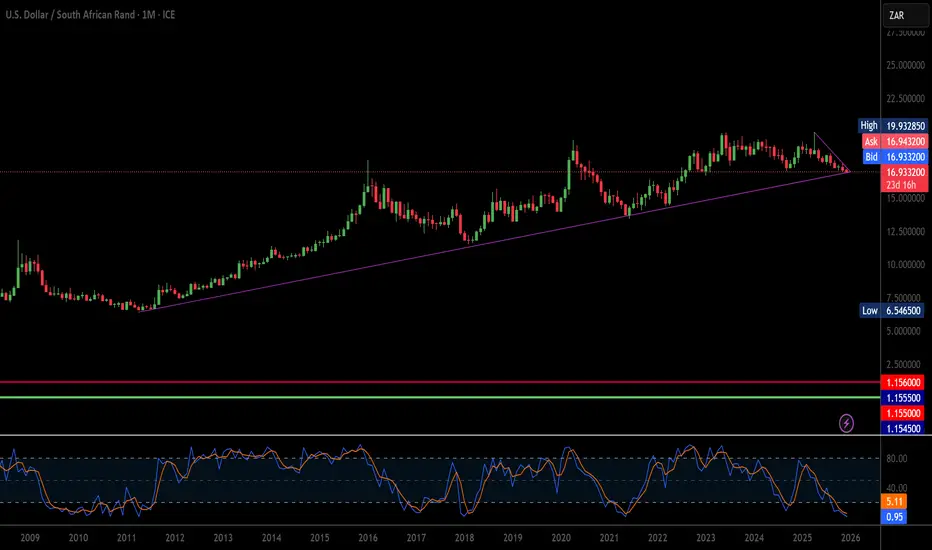
The US Dollar to South African Rand (USD/ZAR) exchange rate remains a critical barometer for emerging market sentiment, closing recently around 17.32. While UBS forecasts "limited upside" for the pair, implying Rand resilience, strategic analysis across multiple domains reveals a complex tug-of-war between fiscal consolidation and persistent structural headwinds.
Macroeconomics: The Fiscal Anchor
South Africa’s 2025 Medium Term Budget Policy Statement signaled a turning point in fiscal management. The National Treasury projected a consolidated budget deficit of 4.7% of GDP, a figure better contained than earlier fears suggested. This improved discipline, driven by solid revenue collection, supports the Rand by reducing sovereign risk premiums. Furthermore, the decision to lower the inflation target to 3% demonstrates the Reserve Bank’s assertive commitment to price stability, theoretically strengthening the currency's purchasing power parity over the long term.
Geopolitics and Geostrategy: The FATF Catalyst
A pivotal geostrategic victory was South Africa’s removal from the Financial Action Task Force (FATF) grey list in October 2025. This milestone reduces transaction costs for cross-border capital flows and reintegrates domestic financial institutions into the global high-trust network. Consequently, the risk premium embedded in the USD/ZAR exchange rate has diminished, limiting the Dollar’s upside potential. However, global trade fragmentation and protectionist policies in major trading partners (the US, China) remain latent geopolitical risks that could swiftly reverse these gains.
Industry Trends and Patent Analysis: Mining Innovation
The Rand’s performance is inextricably linked to the mining sector. Recent patent trends in Platinum Group Metals (PGM) extraction technologies indicate a shift toward more efficient, lower-energy recovery processes. As global demand for green hydrogen technologies—reliant on PGMs—accelerates, South African mines are positioning themselves to capitalize on this secular trend. UBS notes that the fiscal benefits of higher metal prices have yet to fully materialize, suggesting a delayed but potentially potent tailwind for the Rand heading into 2026.
Cyber Resilience and Financial Infrastructure
In the digital domain, the integrity of South Africa's financial infrastructure is paramount. The South African Reserve Bank’s cyber-resilience frameworks have fortified the banking sector against an escalating threat landscape, including ransomware and state-sponsored actors. This robust cyber-defense posture maintains foreign investor confidence in the JSE (Johannesburg Stock Exchange), preventing capital flight that would otherwise weaken the Rand.
Management and Leadership: Governance of National Unity
The formation of the Government of National Unity (GNU) has introduced a new dynamic in public sector leadership. The shift toward "coalition management" has enforced stricter checks and balances on public spending, mirroring corporate governance best practices. This cultural shift within government departments is reducing wasteful expenditure, directly supporting the Treasury’s deficit reduction goals, and stabilizing the currency.
Conclusion: Limited Upside for USD
UBS tactically favors selling USD/ZAR upside, viewing the pair as capped near current levels. The confluence of fiscal discipline, geostrategic reintegration (FATF), and resilient mining exports creates a formidable defense for the Rand. Unless global risk sentiment deteriorates sharply, the structural improvements in the South African economy suggest the path of least resistance for USD/ZAR is sideways to lower.

The5ers Funding Forex Traders & Growth Program. Get Funded with up to $2.56M
We Trade Forex - Come Join Us!
the5ers.com
We Trade Forex - Come Join Us!
the5ers.com
Disclaimer
The information and publications are not meant to be, and do not constitute, financial, investment, trading, or other types of advice or recommendations supplied or endorsed by TradingView. Read more in the Terms of Use.