
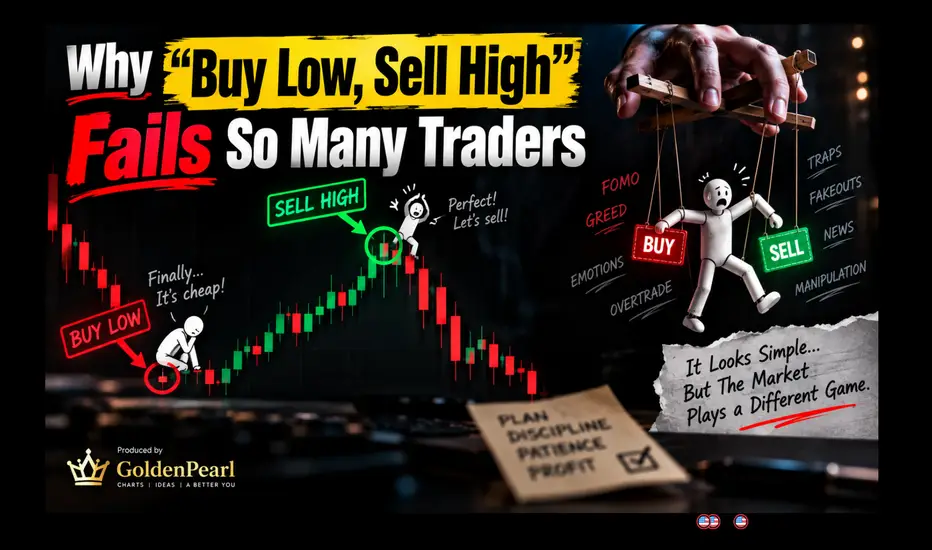
“Buy low, sell high” sounds like the simplest rule in trading.
Buy when the price is low. Sell when the price is high.
But in real markets, this idea often causes traders to buy too early in a downtrend and sell too early in an uptrend.
1. “Low” and “High” Are Always Relative
A price that looks very low today can still fall much further if the bearish structure remains intact.
On the other hand, a price that looks extremely high can continue rising if the trend remains strong.
A low price is not automatically a Buy opportunity. A high price is not automatically a Sell signal.
The more important question is:
Where is price within the current market structure?
2. Traders Often Buy When the Market Is at Its Weakest
After a sharp decline, price suddenly looks “cheap.”
This is when many traders start trying to catch the bottom simply because they think:
“It has already fallen too much.”
But if the market is still forming Lower Highs + Lower Lows, support keeps breaking, and selling pressure has not weakened, you are not necessarily “buying low.”
You may simply be buying into a downtrend that is not over yet.
3. “Sell High” Can Make You Exit Too Early
The opposite mistake happens when traders see price rally strongly and immediately want to sell because the market looks “too high.”
But in a healthy uptrend, Higher Highs and Higher Lows can continue for much longer than expected.
Don’t sell just because price looks high. Sell when the structure starts giving you a reason to exit.
4. Location Matters More Than the Absolute Price
Instead of asking:
“Is the price low enough yet?”
Ask:
Is price at support or in the middle of a range?
Is the broader trend bullish or bearish?
Has price action provided confirmation?
If I’m wrong, where is my invalidation?
A “cheap” price without structural support can always become cheaper.
5. A Better Approach Than Buy Low – Sell High
A more practical way to think about the market is:
Buy strength after weakness has failed.
Sell weakness after strength has failed.
In simple terms:
Don’t try to predict the bottom.
Don’t try to call the top.
Wait for the market to prove that control has shifted from one side to the other.

🚀 SMART CRYPTO TRADING STARTS HERE!
BTC • ETH • ALTCOINS
🎯 Daily Signals | Entry • TP • SL
⚡ Real-Time Alerts & Market Insights
💎 VIP Signals & Private Support
🔥 TRADE SMARTER. STAY AHEAD.
👇 JOIN OUR COMMUNITY
t.me/+22Cs-Z14bJg3NDJl
BTC • ETH • ALTCOINS
🎯 Daily Signals | Entry • TP • SL
⚡ Real-Time Alerts & Market Insights
💎 VIP Signals & Private Support
🔥 TRADE SMARTER. STAY AHEAD.
👇 JOIN OUR COMMUNITY
t.me/+22Cs-Z14bJg3NDJl
Related publications
Disclaimer
The information and publications are not meant to be, and do not constitute, financial, investment, trading, or other types of advice or recommendations supplied or endorsed by TradingView. Read more in the Terms of Use.