
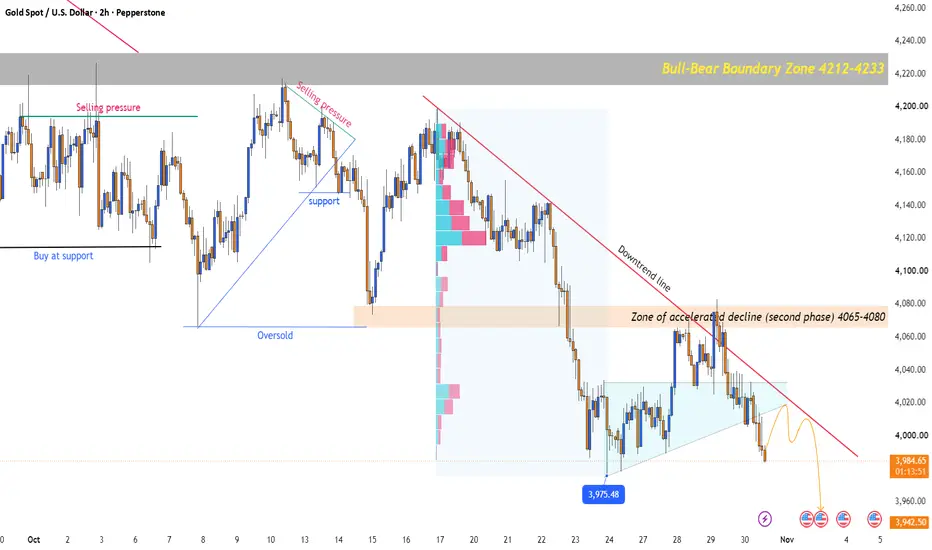
Macroeconomic Headwinds and Technical Breakdowns: Maintaining a Bearish Stance on Gold Below 4,000, Targeting 3,942
Core View: The psychological defense level of $4,000 is faltering. Both technical and fundamental factors align to support a "bearish trend-following" strategy. While a short-term oversold rebound is possible following the break below $4,000, the broader macroeconomic landscape—characterized by persistent inflation and lingering expectations of Federal Reserve rate hikes—remains unfavorable. Combined with heavy pressure from a descending trendline and a key supply zone, any rebound should be viewed as an opportunity to add to short positions rather than a signal of a trend reversal.
Fundamentals: Resurgent Inflation and High Holding Costs Weigh on Gold
The current market dynamic centers on the Federal Reserve’s interest rate trajectory. Although the Fed is widely expected to hold rates steady at its October meeting, the latest U.S. September PCE price index rose to 3.6% year-on-year, with core PCE reaching 3.1%. Coupled with a robust 3.4% GDP growth in the third quarter, these figures have effectively shattered any market hopes for a dovish policy shift. For a non-yielding asset like gold, the renewed probability of a December rate hike—which at one point climbed to 80%—means the opportunity cost of holding gold continues to rise; this serves as the most solid fundamental basis for the current decline. Furthermore, concerns over inflation fueled by high energy prices make it highly unlikely that the Fed will signal any monetary easing in the near term, creating an extremely hostile macroeconomic environment for gold.
Technical Analysis: A "Textbook" Bearish Structure
Descending Trendline Pressure: A red descending trendline, drawn from above the $4,200 level, acts as a definitive ceiling for any potential rallies. Each time the price touches or approaches this line, it faces renewed selling pressure, with successive highs continuing to trend lower.
Key Supply Zone (Zone of Accelerated Decline): The $4,065–$4,080 range, marked on the chart, represents a critical breakdown point from earlier price action. With the current price now trading well below this area, what was once "support" has effectively transformed into a "strong resistance" zone. The 4,000 Level as a Bull-Bear Watershed: As clearly shown on the chart, the price has breached the 4,000 round-number mark (currently trading near 3,987). This level serves not only as a psychological barrier but also as a critical "support-turned-resistance" zone. Should the price close firmly below 4,000, further downside potential will open up, targeting the 3,975 level—or even the 3,942–3,950 range—as marked on the chart.
Personal Strategy: Treat Any Rebound as an Opportunity to Short
My view is straightforward: do not be misled by a few small bullish candles in the short term; the current setup is a classic "continuation pattern" within a downtrend. Until a clear reversal signal—backed by high volume—emerges on the daily timeframe (such as a long lower shadow or a large bullish engulfing candle), going long is akin to "catching a falling knife."
Trading Approach:
Short-Entry Zone: Focus on the 4,000–4,005 range. If the price experiences a short-term rebound but fails to hold its ground upon reaching this zone, it presents an ideal entry point for a short position. For a more conservative approach, one could place a sell order near 4,020–4,030 (closer to the descending trendline).
Stop-Loss Placement: Place the stop-loss above the 4,065–4,080 supply zone to protect against potential "fake-outs" or stop-hunting.
Targets: The initial target is 3,975 (near the previous low); a break below this would point toward the 3,942–3,950 range. In the event of extreme hawkish signals from a macroeconomic perspective, the price could even test the 3,886 level—a support point previously noted by Standard Chartered.
Risk Warning: Be wary of sudden geopolitical developments (such as an escalation in the Middle East) that could trigger a short-term surge in safe-haven buying—the only variable likely to cause a sharp rebound from the current level. Consequently, prudent position sizing (keeping positions light) and strict adherence to stop-loss orders are essential prerequisites for executing this bearish strategy. 💡 If you found this analysis helpful, please show your support with a like! What’s your take on the current price of gold? Do you think it will continue to break lower, or is there strong support near the 4,000 level? Feel free to share your thoughts in the comments—let’s discuss! If you haven’t followed yet, be sure to hit the follow button; I’ll continue to provide real-time updates on Federal Reserve policy shifts and key price levels for gold.

💎 Free Trading Signals:
t.me/+wLfC3Bk_plZlMmEx
💎 Trend Analysis & Setup Planning
💎 Market Structure Shifts & Pattern Analysis
-------------------------
❤️ One-on-one guidance:
t.me/ElinaXau
t.me/+wLfC3Bk_plZlMmEx
💎 Trend Analysis & Setup Planning
💎 Market Structure Shifts & Pattern Analysis
-------------------------
❤️ One-on-one guidance:
t.me/ElinaXau
Disclaimer
The information and publications are not meant to be, and do not constitute, financial, investment, trading, or other types of advice or recommendations supplied or endorsed by TradingView. Read more in the Terms of Use.