
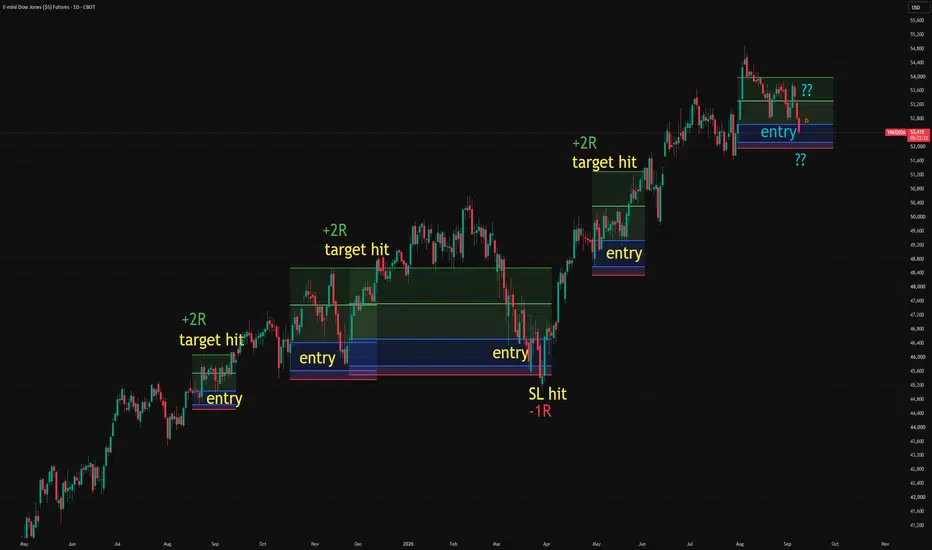
🔵 WHY BACKTEST AT ALL
A backtest is the cheapest way to discover that your edge does not exist. Better to find it in data than in your account. But a backtest is only as honest as its rules — and most backtests are dishonest in the same, quiet way.
🔵 THE EXACT-MECHANICS RULE
Before any test, write the trade in full mechanical detail: the exact entry condition, the exact stop, the exact target, the exact size. "Enter near support" is not testable — "buy on a daily close above X, stop below Y, first target Z" is. If two people reading your rules would trade differently, the rules are not rules yet.
🔵 THE SILENT LIES
Watch for the classics: curve-fitting (the rules were tuned on the same data they are tested on), ignoring costs (spread, commission, slippage — they eat small edges whole), cherry-picking the start date, and "after-the-fact" entry — entering at the exact low because the chart is already drawn. Every one of these inflates the result.
🔵 THE 80% RULE
A realistic backtest should survive a haircut: subtract costs, assume worse fills, test a different start date. If the edge disappears under the haircut, it was never an edge — it was precision disguised as insight.
Next lesson: the journal — the tool that turns your own trading into data.
Educational content only. Not investment advice.
A backtest is the cheapest way to discover that your edge does not exist. Better to find it in data than in your account. But a backtest is only as honest as its rules — and most backtests are dishonest in the same, quiet way.
🔵 THE EXACT-MECHANICS RULE
Before any test, write the trade in full mechanical detail: the exact entry condition, the exact stop, the exact target, the exact size. "Enter near support" is not testable — "buy on a daily close above X, stop below Y, first target Z" is. If two people reading your rules would trade differently, the rules are not rules yet.
🔵 THE SILENT LIES
Watch for the classics: curve-fitting (the rules were tuned on the same data they are tested on), ignoring costs (spread, commission, slippage — they eat small edges whole), cherry-picking the start date, and "after-the-fact" entry — entering at the exact low because the chart is already drawn. Every one of these inflates the result.
🔵 THE 80% RULE
A realistic backtest should survive a haircut: subtract costs, assume worse fills, test a different start date. If the edge disappears under the haircut, it was never an edge — it was precision disguised as insight.
Next lesson: the journal — the tool that turns your own trading into data.
Educational content only. Not investment advice.

Full multi-TF zones + COT + Macro Bias + Seasonality → confluenceedge.net
Disclaimer
The information and publications are not meant to be, and do not constitute, financial, investment, trading, or other types of advice or recommendations supplied or endorsed by TradingView. Read more in the Terms of Use.
Full multi-TF zones + COT + Macro Bias + Seasonality → confluenceedge.net
Disclaimer
The information and publications are not meant to be, and do not constitute, financial, investment, trading, or other types of advice or recommendations supplied or endorsed by TradingView. Read more in the Terms of Use.