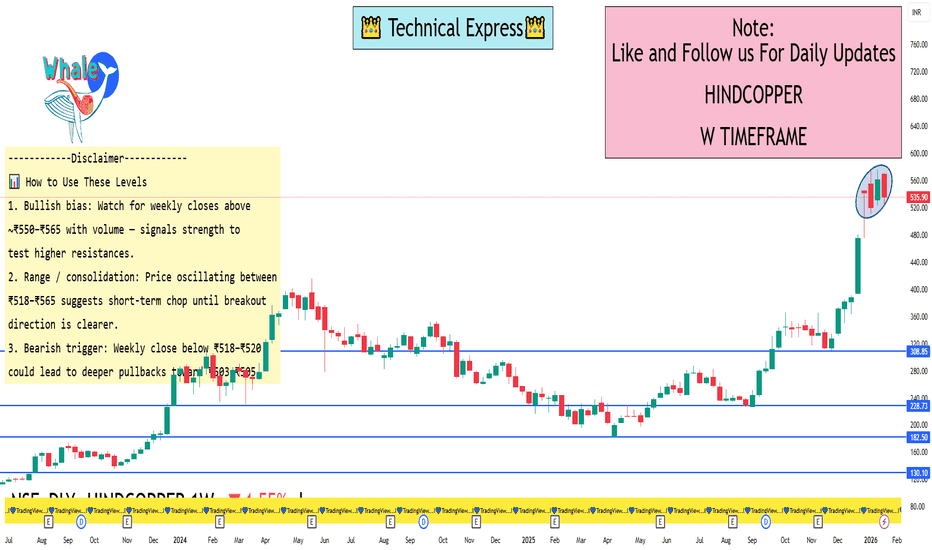
Trend Line Break
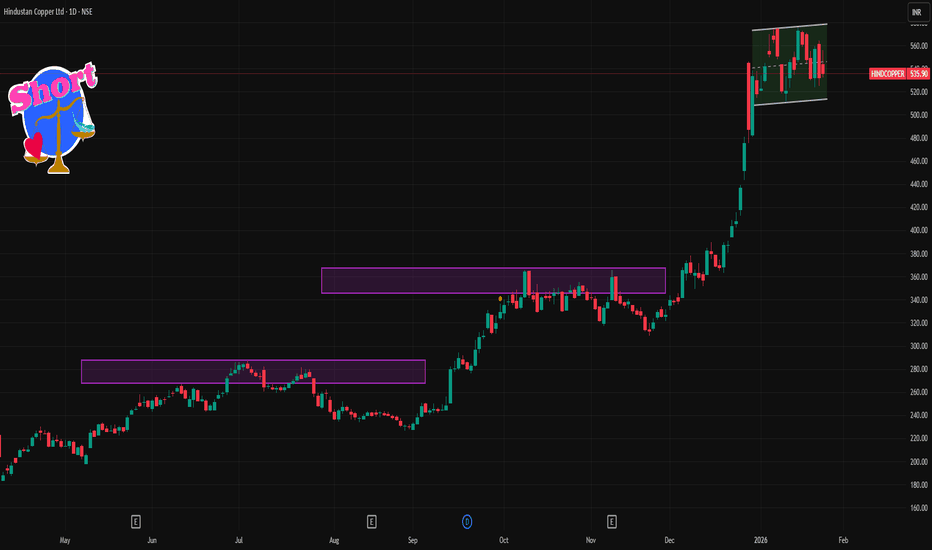
HINDCOPPER 1 Week VIew 📊 Current Price Snapshot
Live/Recent price: ~₹535–₹538 per share on NSE for this week.
52-week range: Low ~₹183.8 — High ~₹576.0; stock remains elevated near recent multi-week highs.
📈 Short-Term Resistance Levels (1-Week View)
These are the price zones where the stock may find selling pressure or pause its upside:
• Immediate Resistance: ~₹550–₹551 — first hurdle this week.
• Next Resistance: ~₹564–₹565 — pivot/resistance area seen on pivot calculations.
• Higher Resistance / Near-term Target:
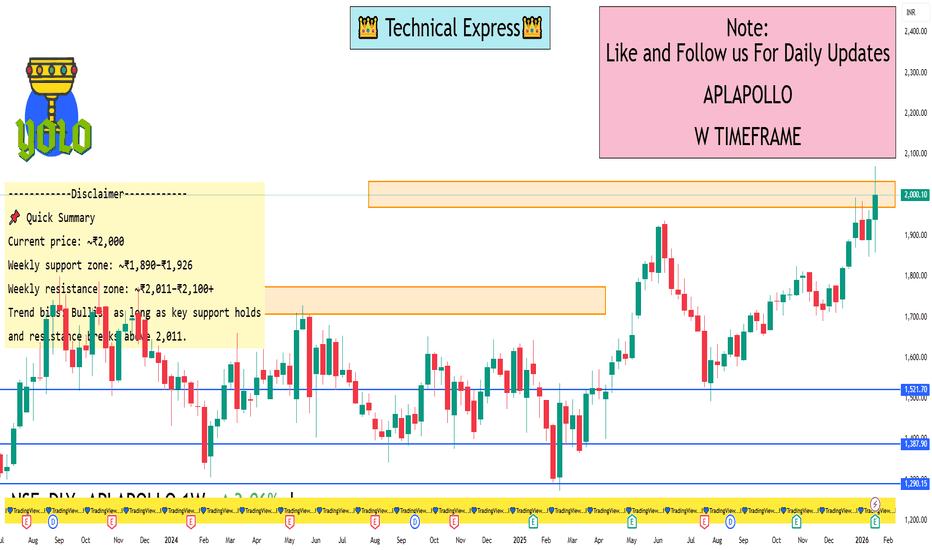
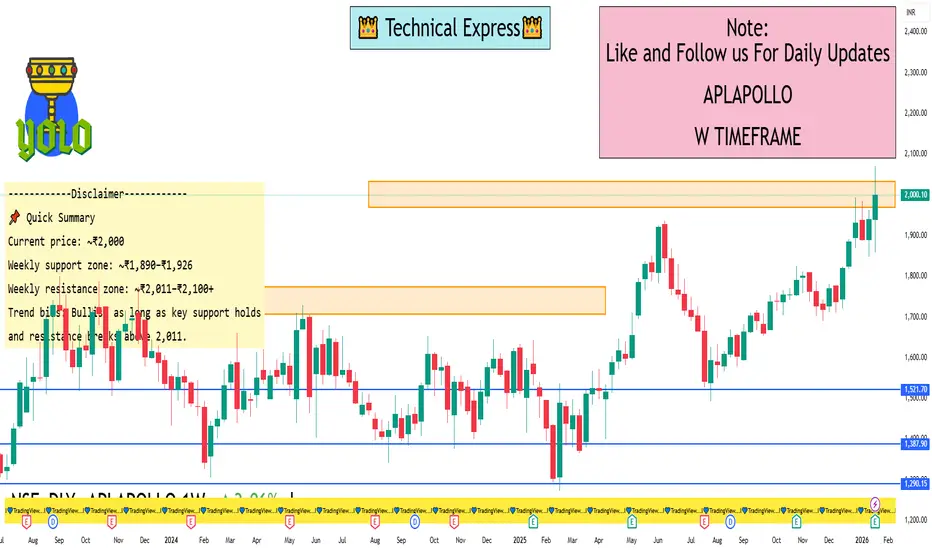
APLAPOLLO 1 Week View🔎 Current Price Snapshot
🟢 Last close: ₹2,000.10 (23 Jan 2026) — near a 52-week high zone.
📉 Weekly Technical Levels (1-Week Time Frame)
🧱 Support Levels (Key Floors)
These are levels where price is likely to find buying interest if the price pulls back:
S1: ~₹1,913 – ₹1,926 — first strong support band.
S2: ~₹1,890 – ₹1,911 — secondary support base from pivot structure.
S3: ~₹1,850+ — deeper support from broader weekly structure and previous pivot base.
Note: Above ~₹1,890 zone is a key def
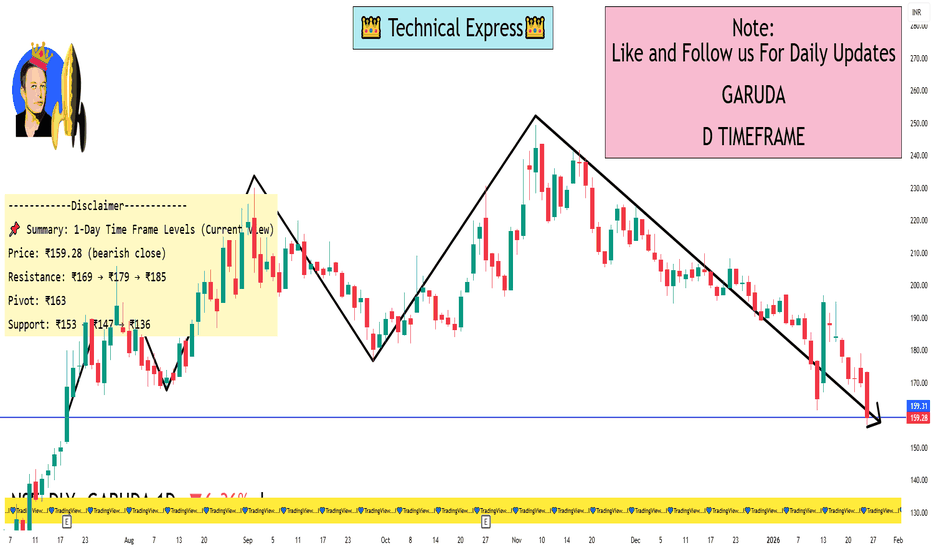
GARUDA 1 Day View📌 Current Daily Price Snapshot
Garuda Construction & Engineering Ltd. (GARUDA)
📅 Last Trading Session (23 Jan 2026)
• Last Close: ₹159.28 on NSE/BSE (down ~-6.37% on the day).
• Day’s Range: Approx ₹157.00 – ₹173.40.
• 52-Week Range: ₹87.50 – ₹249.30.
(This is the most recent full day’s market price data available.)
📊 Daily (1D) Support & Resistance Levels
These levels help track where price might react today or in upcoming sessions:
🔹 Pivot-based Levels (Approx. Current Daily)
• Resistance 3
Intraday Institutions Trading Option Pricing – How Premium Moves
Factors affecting premium
Underlying price movement.
Volatility levels (IV).
Time remaining for expiry.
Demand–supply and liquidity.
Strike price distance from spot.
How premium reacts
If underlying moves towards strike → premium increases.
If underlying moves away from strike → premium decreases.
Sharp move + low IV = huge premium expansion.
Sideways market = premium decay.
Before major events = IV rise → premium rise.
After events = IV crush → pre
Part 4 Techical Analysis Vs. Institutional Option TradingBuying Options – Explained in Points
Benefits of Buying Options
Limited risk, unlimited reward.
Small premium, large exposure.
Suitable for trending markets.
Ideal for news-driven moves (budget, RBI meetings, earnings, US data).
Great for breakout trading.
Risks of Buying Options
Time decay eats premium quickly.
Market can trap buyers in fake breakouts.
High volatility inflates premium (overpriced).
Reversal or sideways movement leads to loss.
When to Buy Options
Strong trend confirm
Part 1 Techical Analysis Vs. Institutional Option Trading Types of Options
A. Call Option (CE)
You buy CE when you expect price to go up.
You sell CE (write CE) when you expect price to stay below the strike or fall.
If market goes up strongly: CE buyers make big profits.
If market stays sideways: CE sellers profit due to premium decay.
B. Put Option (PE)
You buy PE when you expect price to go down.
You sell PE when you expect price to stay above the strike.
PE buyers profit from downside momentum.
PE sellers profit during sideways or uptrendi
Part 1 Support and Resistance Introduction to Option Trading
Option trading is a part of the derivatives market where traders buy and sell contracts whose value is derived from an underlying asset like Nifty, BankNifty, stocks, FINNIFTY, SENSEX, commodities, currency, etc.
Unlike equity trading, where you buy shares directly, in options you buy rights (not obligations) to buy or sell the underlying asset at a fixed price.
This fixed price is called the Strike Price.
The unique thing about option trading is that your risk
HINDCOPPER 1 Day Time Frame 📈 Current/Last Traded Price (Daily):
• ₹535.90 — Last traded price on the NSE, showing a positive move on the day.
• Change on day: approx +0.7% to +0.72% from previous close.
📊 Intraday Price Action:
• Open: ₹544.00
• Previous Close: ₹532.05
• High (today): ~₹555.95
• Low (today): ~₹532.50
• VWAP (average traded price): ~₹546.34
📉 1‑Day Movement Summary:
Today’s price action suggests a mild bullish bias, with price bouncing off the previous close and holding above ₹530 intraday, but also show
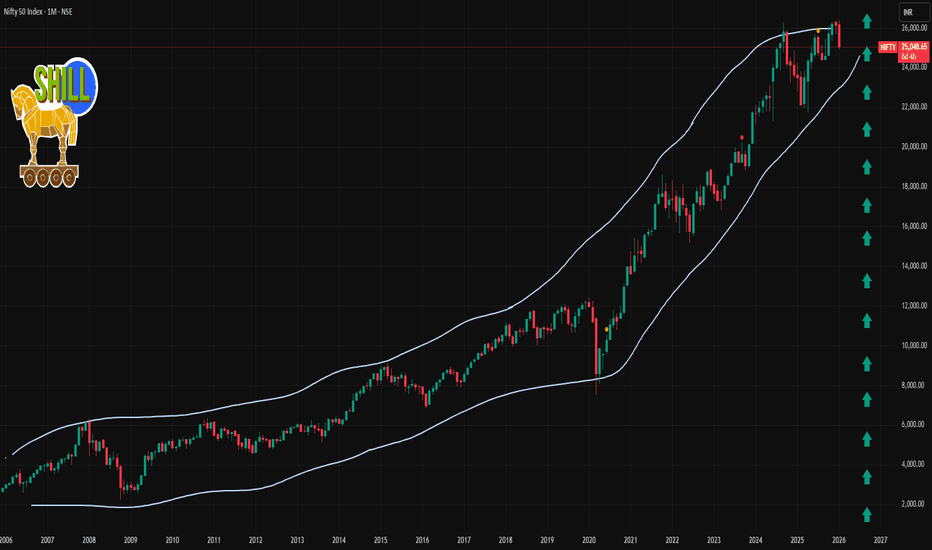
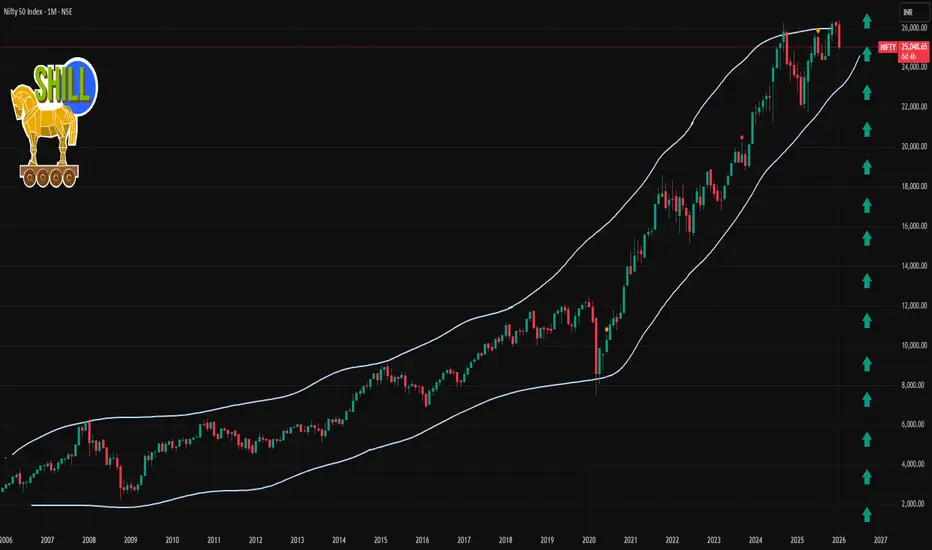
Nifty 50 1 Month Time Frame 📊 Live Price & Performance (1 Month)
Nifty 50 Index: 25,048.65 (close on 23 Jan 2026)
• Declined ~‑4.3% over the past month.
• 1‑month high ~26,373 / low ~24,919.
📈 Key 1‑Month Technical Levels
🎯 Resistance (Upside)
1. 26,000 – 26,100 — Immediate resistance zone where supply likely increases and prior range top is placed.
2. ~26,300 — 1‑month swing high / recent high area.
Breaking above 26,100–26,300 with momentum would signal a stronger upside breakout.
🛡️ Support (Downside)
1. 25,600 – 25,
Cross-Market ArbitrageConcept and Rationale
In an ideal and perfectly efficient market, the price of an identical asset should be the same everywhere once adjusted for factors such as transaction costs, taxes, and exchange rates. This principle is often referred to as the law of one price. However, in real-world markets, temporary deviations occur due to differences in liquidity, information flow, trading hours, capital controls, regulatory frameworks, and investor behavior. Cross-market arbitrage aims to capitalize
Exploring Financial Market Roles in Trading1. Investors
Investors are participants who allocate capital with the primary objective of long-term wealth creation. They include individuals, mutual funds, pension funds, insurance companies, and sovereign wealth funds. Investors typically focus on fundamentals such as earnings growth, economic trends, interest rates, and corporate governance. Their trades provide long-term stability to markets and form the backbone of capital formation. By investing in equities and debt instruments, they hel
Part 5 Advance Trading Strategies Option Trading in Different Market Conditions
A. Trending Market
Buyers get benefit
CE/PE give good returns
B. Sideways Market
Sellers benefit
Strangles, straddles perform well
C. High Volatility
Premium expands
Good for selling post-news
D. Low Volatility
Cheap premiums
Good for buying before breakout
PART 2 TECHNNICAL VS. INSTITUTIONALA. Strike Price
The strike price is the predetermined price at which the buyer can buy (CE) or sell (PE) the underlying.
Example:
Nifty Spot = 22,000
You buy Nifty 22,100 CE, meaning you can buy Nifty at 22,100.
B. Premium
Premium is the price you pay (buyer) or receive (seller) to enter the contract. Option prices change based on demand, volatility, time, and underlying movement.
C. Expiry
Options do not last forever. Every option expires:
Weekly (Most popular in Nifty/Bank Nifty)
Month
PART 1 TECHNNICAL VS. INSTITUTIONAL What Are Options?
Options are financial derivatives—meaning their value is derived from an underlying asset such as stock, index, commodity, etc. They are contracts between two parties: the option buyer and the option seller (writer).
There are two types of options:
Call Option (CE) – Right to buy the asset at a fixed price.
Put Option (PE) – Right to sell the asset at a fixed price.
The key point:
The buyer has a right but no obligation. The seller has an obligation but no rights.
Renewable Energy Certificates (RECs) and Carbon Credits1. Introduction: Why RECs and Carbon Credits Matter
As countries, corporations, and investors push toward net-zero emissions, two market-based instruments have become central to climate policy and sustainable finance: Renewable Energy Certificates (RECs) and Carbon Credits.
Both aim to reduce greenhouse gas (GHG) emissions, but they operate in different markets, address different problems, and serve different compliance and voluntary needs. Understanding their structure, pricing, and role is c
EURUSD – Breakout From Falling Resistance, Retest Holding WellEUR/USD was trading under a falling resistance trendline for a long time, with sellers consistently stepping in at higher levels. Recently, price managed to break above this trendline, which was the first sign that bearish pressure was easing.
After the breakout, price came back for a retest of the broken structure and previous resistance area. This retest is holding well so far, showing that buyers are defending the level and not allowing price to slip back below the structure.
What stands o
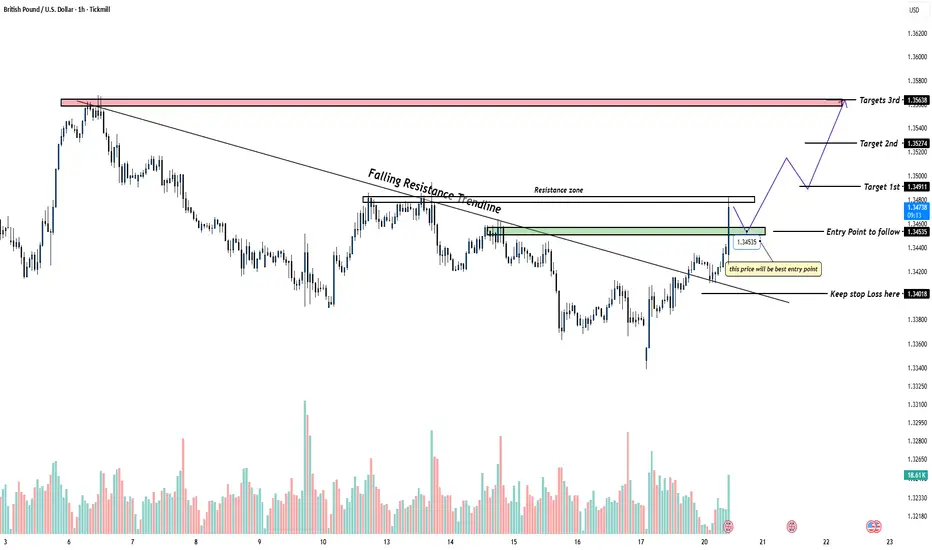
GBPUSD – Breakout Retest Looks Healthy, Bulls in ControlGBP/USD has been trading below a falling resistance trendline for quite some time. Recently, price managed to break above this trendline, which is the first sign that selling pressure is weakening.
After the breakout, price did not continue straight up. Instead, it came back for a retest, and that retest is holding well so far. This is usually a healthy sign, showing that buyers are willing to step in at higher levels instead of letting price fall back below structure.
What Price Is Telling Us
Part 11 Trading Master Class With Experts Time Decay (Theta)
Theta represents how much value option will lose per day even if price doesn’t move.
Sellers LOVE Theta
Buyers FEAR Theta
Near expiry:
A ₹200 premium may fall to ₹20 even with little change in spot.
This is how sellers make money consistently.
Part 5 Advance Trading Knowledge Introduction to Option Trading
Option trading is a sophisticated financial market activity that allows traders and investors to manage risk, speculate on price movements, and generate income using derivative instruments known as options. Unlike traditional equity trading—where an investor buys or sells shares outright—options derive their value from an underlying asset such as stocks, indices, commodities, currencies, or cryptocurrencies.
An option contract gives the buyer the right, but not t
Part 4 Institutional Option Trading Vs. Technical AnalysisBasic Terminology of Options
Underlying: Asset on which the option is based (Nifty, Bank Nifty, stocks).
Strike Price: The fixed price at which the holder can buy or sell.
Premium: The price paid to buy an option.
Expiry Date: Date on which the option becomes void.
Lot Size: Minimum quantity you must trade (e.g., Nifty lot = 50).
Intrinsic Value: Real value if the option is exercised now.
Time Value: Extra premium due to remaining time until expiry.
Option Buyer: Pays premium, has limite