Jurik Relative Strength Quality Index (RSX)
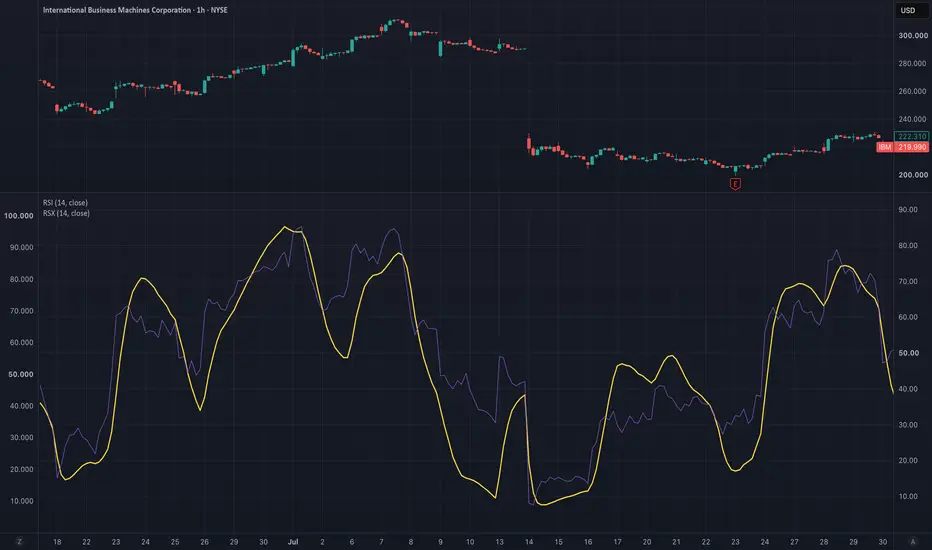
RSX is a bounded 0-100 momentum oscillator measuring the direction and quality of price movement. It keeps the RSI identity (net momentum over total momentum) but replaces Wilder's single-pole smoothing with three cascaded lag-compensated filter stages. The result is far smoother than RSI and turns about one bar behind it at equal length, instead of the several bars a comparably smoothed RSI would need.
HISTORICAL CONTEXT
Jurik Research sold RSX in the 1990s as an encrypted TradeStation add-in, marketed as a "noise-free" RSI. The algorithm was never published. The original user guide uses a default length of 8, typical range 5-30, and allows fractional lengths.
This script implements the community reconstruction that surfaced on MQL4 forums around 2005, later ported to ProRealCode, AmiBroker, and pandas-ta. No numeric parity data against Jurik's DLL exists. Indirect evidence: digitizing the RSX(10) vs RSI(10) chart in Jurik's user guide gives a 1.1-bar turn offset, 0.91 correlation, and 1.40 swing ratio; the reconstruction on random-walk data gives 0.96 bars, 0.91, and 1.36. Consistent, not proof.
HOW IT WORKS
Stage 1: Momentum
M[t] = 100 × (x[t] − x[t−1]), A[t] = |M[t]|
Stage 2: Generalized-DEMA stage
α = 3 / (N + 2), β = 1 − α
E1[t] = β × E1[t−1] + α × u[t]
E2[t] = α × E1[t] + β × E2[t−1]
GD[t] = 1.5 × E1[t] − 0.5 × E2[t]
This is Tillson's generalized DEMA with volume factor 0.5.
Stage 3: Cascade and ratio
H(u) = GD(GD(GD(u)))
RSX = clamp(50 × (1 + H(M) / H(A)), 0, 100), or 50 if H(A) ≤ 1e−10
Why it is still an RSI: Wilder's RSI equals 50 × (1 + RMA(M) / RMA(|M|)). RSX keeps the identity and swaps RMA for the cascade.
Why the clamp: the lag-compensated stages overshoot, so the ratio can briefly leave [−1, 1]. RSX may sit flat at 0 or 100 in strong one-way moves.
Lag profile (N = 14)
- Slow trends: ≈ 6.5 bars delay vs 13 for RSI.
- Fast swings: RSX trails RSI (12-bar cycle: 4.8 vs 2.2 bars; 20-bar: 6.5 vs 3.8). Crossover near a 45-bar cycle.
- Noise: ~21 dB more high-frequency attenuation than RSI(14).
INPUTS & PARAMETERS
- Source: Default close. hlc3 gives the least input lag. Any series works; RSX ignores scale.
- Period: Default 14 (Jurik's original default was 8).
Period selection
- 5-10: Responsive, short swings.
- 10-20: Balanced, daily bars.
- 20-40: Trend state only.
RSX length is not interchangeable with RSI length. To replace RSI(14), start near RSX(10).
HOW TO USE
- Centerline: above 50 = net upward momentum. Crossings whipsaw far less than RSI.
- Slope with zones: go long when RSX is rising above a lower zone, short when falling below an upper zone, hold while in an extreme zone (Jurik's demo system). Optimize zone levels; don't assume 70/30.
- Extremes: readings near 0 or 100 mean one-directional movement, a statement of trend quality, not automatically overbought or oversold.
- Divergences: cleaner than RSI because jitter is removed; still needs confirmation.
- Composition: RSX of pre-smoothed price pushes output toward a two-state trend switch.
REFERENCES
- Jurik Research. RSX User's Guide (TradeStation add-in), 2000.
- Tillson, T. (1998). "Smoothing Techniques for More Accurate Signals." TASC, January 1998.
- Wilder, J. W. (1978). New Concepts in Technical Trading Systems.

Rigorous technical indicators for Pine Script 6 with O(1) streaming, defensible math, and proper initialization. Fully documented, implemented in C#, transcribed to Pine Script, and wrapped for Python.
Disclaimer
The information and publications are not meant to be, and do not constitute, financial, investment, trading, or other types of advice or recommendations supplied or endorsed by TradingView. Read more in the Terms of Use.