OPEN-SOURCE SCRIPT
Updated IB First Hour
// © Joey Morgan
// NY Session Initial Balance (First Hour)
// Includes:
// - IB High / Low
// - 50% Midline
// - First hour shading
// - Break + reclaim labels
// - Session ends 3:00pm CT
// NY Session Initial Balance (First Hour)
// Includes:
// - IB High / Low
// - 50% Midline
// - First hour shading
// - Break + reclaim labels
// - Session ends 3:00pm CT
Release Notes
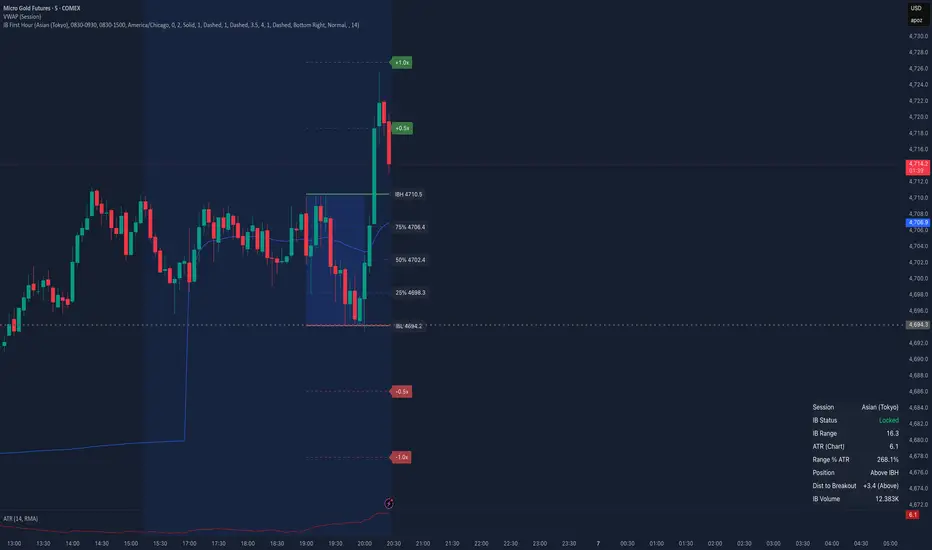
IB First Hour (NY Session) – With Quartiles & ExpansionsThis indicator automatically plots the Initial Balance (IB) of the New York session (8:30–9:30am CT) and extends those levels through the regular session (ending 3:00pm CT).
It is built for structured session-based traders who use the first hour to frame daily bias, targets, and expansion potential.
🔹 What It Plots
IB High
IB Low
50% Midline
Optional 25% and 75% quartile levels
Optional IB Expansion Levels
0.5x
1.0x
1.5x
2.0x
Custom multiplier
All levels:
Update in real time during the first hour
Extend through the session
Automatically clamp at 3:00pm CT
Remain visible on prior sessions when scrolling back
🔹 Why Use It
The Initial Balance is one of the most widely referenced session structures in futures trading.
This tool helps identify:
Range days vs expansion days
One-sided vs two-sided auctions
1x and 2x measured move targets
Balance vs imbalance behavior
Structured intraday bias
Instead of guessing targets, expansions are calculated directly from the first-hour range.
🔹 Designed For
Futures traders (NQ, ES, YM, RTY, etc.)
NY session intraday traders
Structured range/auction-based trading approaches
Traders who use measured move logic
🔹 Notes
Default timezone: America/Chicago (CT)
IB window: 8:30–9:30am CT
RTH session: 8:30am–3:00pm CT
Precision respects instrument tick size
Release Notes
📦 Initial Balance (IB) – First Hour NY Session (CT)With 25/50/75 Levels + Expansion Targets + Session Lock
This indicator maps the true Initial Balance (IB) from the first hour of the New York session (8:30–9:30am CT) and projects key levels traders use for structure, continuation, and expansion plays.
It automatically:
• Marks IB High & IB Low
• Draws 50% equilibrium
• Optional 25% & 75% internal structure levels
• Projects configurable expansion targets (0.5x, 1x, 1.5x, 2x, custom)
• Locks all levels at 3:00pm CT
• Preserves historical sessions for backtesting
Release Notes
📦 Initial Balance (IB) – First Hour NY Session (CT)With 25/50/75 Levels + Expansion Targets + Session Lock
This indicator maps the true Initial Balance (IB) from the first hour of the New York session (8:30–9:30am CT) and projects key levels traders use for structure, continuation, and expansion plays.
It automatically:
• Marks IB High & IB Low
• Draws 50% equilibrium
• Optional 25% & 75% internal structure levels
• Projects configurable expansion targets (0.5x, 1x, 1.5x, 2x, custom)
• Locks all levels at 3:00pm CT
• Preserves historical sessions for backtesting
Release Notes
📦 Initial Balance (IB) – First Hour NY Session (CT)With 25/50/75 Levels + Expansion Targets + Session Lock
This indicator maps the true Initial Balance (IB) from the first hour of the New York session (8:30–9:30am CT) and projects key levels traders use for structure, continuation, and expansion plays.
It automatically:
• Marks IB High & IB Low
• Draws 50% equilibrium
• Optional 25% & 75% internal structure levels
• Projects configurable expansion targets (0.5x, 1x, 1.5x, 2x, custom)
• Locks all levels at 3:00pm CT
• Preserves historical sessions for backtesting
Release Notes
With 25/50/75 Levels + Expansion Targets + Session LockThis indicator maps the true Initial Balance (IB) from the first hour of the New York session (8:30–9:30am CT) and projects key levels traders use for structure, continuation, and expansion plays.
It automatically:
• Marks IB High & IB Low
• Draws 50% equilibrium
• Optional 25% & 75% internal structure levels
• Projects configurable expansion targets (0.5x, 1x, 1.5x, 2x, custom)
• Locks all levels at 3:00pm CT
• Preserves historical sessions for backtesting
Release Notes
With 25/50/75 Levels + Expansion Targets + Session LockThis indicator maps the true Initial Balance (IB) from the first hour of the New York session (8:30–9:30am CT) and projects key levels traders use for structure, continuation, and expansion plays.
It automatically:
• Marks IB High & IB Low
• Draws 50% equilibrium
• Optional 25% & 75% internal structure levels
• Projects configurable expansion targets (0.5x, 1x, 1.5x, 2x, custom)
• Locks all levels at 3:00pm CT
• Preserves historical sessions for backtesting
Release Notes
B First Hour (NY Session) – With Quartiles & ExpansionsThis indicator automatically plots the Initial Balance (IB) of the New York session (8:30–9:30am CT) and extends those levels through the regular session (ending 3:00pm CT).
It is built for structured session-based traders who use the first hour to frame daily bias, targets, and expansion potential.
🔹 What It Plots
IB High
IB Low
50% Midline
Optional 25% and 75% quartile levels
Optional IB Expansion Levels
0.5x
1.0x
1.5x
2.0x
Custom multiplier
All levels:
Update in real time during the first hour
Extend through the session
Automatically clamp at 3:00pm CT
Remain visible on prior sessions when scrolling back
🔹 Why Use It
The Initial Balance is one of the most widely referenced session structures in futures trading.
This tool helps identify:
Range days vs expansion days
One-sided vs two-sided auctions
1x and 2x measured move targets
Balance vs imbalance behavior
Structured intraday bias
Instead of guessing targets, expansions are calculated directly from the first-hour range.
🔹 Designed For
Futures traders (NQ, ES, YM, RTY, etc.)
NY session intraday traders
Structured range/auction-based trading approaches
Traders who use measured move logic
🔹 Notes
Default timezone: America/Chicago (CT)
IB window: 8:30–9:30am CT
RTH session: 8:30am–3:00pm CT
Precision respects instrument tick size
Release Notes
/ © Joey Morgan// NY Session Initial Balance (First Hour)
// Includes:
// - IB High / Low
// - 50% Midline
// - First hour shading
// - Break + reclaim labels
// - Session ends 3:00pm CT
Feb 26
Release Notes
IB First Hour (NY Session) – With Quartiles & Expansions
This indicator automatically plots the Initial Balance (IB) of the New York session (8:30–9:30am CT) and extends those levels through the regular session (ending 3:00pm CT).
It is built for structured session-based traders who use the first hour to frame daily bias, targets, and expansion potential.
🔹 What It Plots
IB High
IB Low
50% Midline
Optional 25% and 75% quartile levels
Optional IB Expansion Levels
0.5x
1.0x
1.5x
2.0x
Custom multiplier
All levels:
Update in real time during the first hour
Extend through the session
Automatically clamp at 3:00pm CT
Remain visible on prior sessions when scrolling back
🔹 Why Use It
The Initial Balance is one of the most widely referenced session structures in futures trading.
This tool helps identify:
Range days vs expansion days
One-sided vs two-sided auctions
1x and 2x measured move targets
Balance vs imbalance behavior
Structured intraday bias
Instead of guessing targets, expansions are calculated directly from the first-hour range.
🔹 Designed For
Futures traders (NQ, ES, YM, RTY, etc.)
NY session intraday traders
Structured range/auction-based trading approaches
Traders who use measured move logic
🔹 Notes
Default timezone: America/Chicago (CT)
IB window: 8:30–9:30am CT
RTH session: 8:30am–3:00pm CT
Precision respects instrument tick size
Open-source script
In true TradingView spirit, the creator of this script has made it open-source, so that traders can review and verify its functionality. Kudos to the author! While you can use it for free, remember that republishing the code is subject to our House Rules.

Disclaimer
The information and publications are not meant to be, and do not constitute, financial, investment, trading, or other types of advice or recommendations supplied or endorsed by TradingView. Read more in the Terms of Use.
Open-source script
In true TradingView spirit, the creator of this script has made it open-source, so that traders can review and verify its functionality. Kudos to the author! While you can use it for free, remember that republishing the code is subject to our House Rules.
Disclaimer
The information and publications are not meant to be, and do not constitute, financial, investment, trading, or other types of advice or recommendations supplied or endorsed by TradingView. Read more in the Terms of Use.