OPEN-SOURCE SCRIPT
Time Acceptance Profile TPO Levels
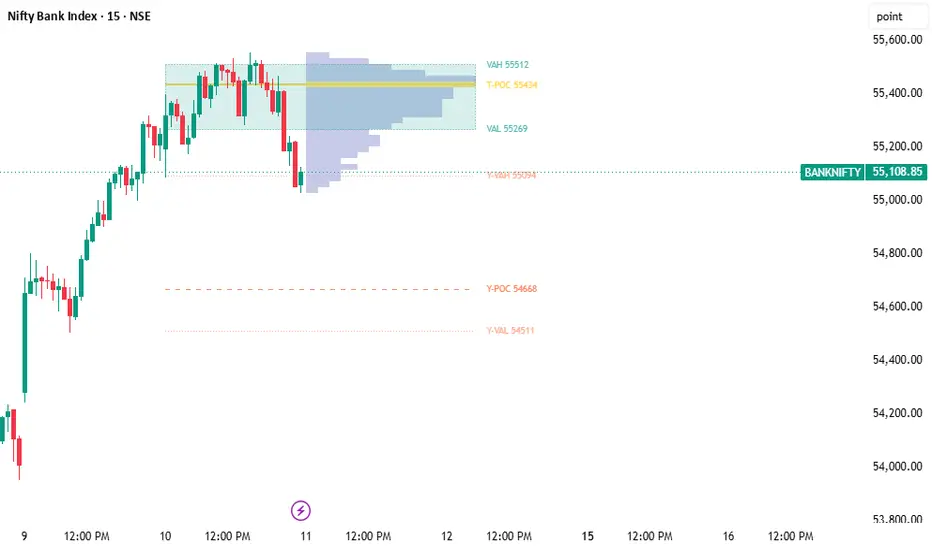
TIME ACCEPTANCE PROFILE — TPO-STYLE LEVELS THAT WORK WITHOUT VOLUME
Volume profile tools fail on index spot charts — NIFTY, BANKNIFTY and SENSEX spot have no volume data at all. This indicator solves that by profiling TIME instead of volume: it counts how many bars touched each price bin during the session. Where price spent the most time is where the market found acceptance — and those levels act as the day's strongest reference points.
WHAT IT PLOTS
- Time POC — the price row with the highest time count today (gold line)
- Value Area (VAH / VAL) — the price band containing ~70% of today's time, expanded outward from the POC (teal box)
- Time Histogram — the full time-at-price distribution drawn to the right of price, POC row highlighted
- Prior-Day POC / VAH / VAL — yesterday's completed levels, frozen at the day close and extended across today (dashed)
HOW IT WORKS
1. The day's range is divided into N price bins (default 24)
2. Every bar adds one time-unit to each bin its high-low range touched
3. The bin with the maximum count = Time POC
4. The Value Area expands outward from the POC, adding the larger neighbouring bin until 70% of total time is covered
5. At the session change, the completed profile is frozen into prior-day levels — these never repaint
HOW TRADERS USE IT
- Prior-day POC acts as a magnet/pivot — rejections and reclaims there are high-information events
- Open outside yesterday's Value Area = imbalance day; watch for continuation away from value or a rotation back to Y-POC
- Open inside the Value Area = balance day; VAH/VAL rotation setups become relevant
- Thin rows in the histogram (low time) mark prices the market rejected — price tends to move quickly through them
NOTES
- Designed for intraday timeframes; shows a warning otherwise
- Today's POC and Value Area update as the session develops (by design); prior-day levels are fixed and never repaint
- Alerts are available on prior-day POC / VAH / VAL crosses — static levels only, alert-safe
- Price labels round to integers by default (toggle off for low-priced symbols)
- No volume data is used anywhere — works identically on spot indices, futures, stocks and crypto
This is an original implementation in Pine Script v6. The time-binning, POC selection and value-area expansion logic are fully described above.
Educational tool for market context — not financial advice.
Volume profile tools fail on index spot charts — NIFTY, BANKNIFTY and SENSEX spot have no volume data at all. This indicator solves that by profiling TIME instead of volume: it counts how many bars touched each price bin during the session. Where price spent the most time is where the market found acceptance — and those levels act as the day's strongest reference points.
WHAT IT PLOTS
- Time POC — the price row with the highest time count today (gold line)
- Value Area (VAH / VAL) — the price band containing ~70% of today's time, expanded outward from the POC (teal box)
- Time Histogram — the full time-at-price distribution drawn to the right of price, POC row highlighted
- Prior-Day POC / VAH / VAL — yesterday's completed levels, frozen at the day close and extended across today (dashed)
HOW IT WORKS
1. The day's range is divided into N price bins (default 24)
2. Every bar adds one time-unit to each bin its high-low range touched
3. The bin with the maximum count = Time POC
4. The Value Area expands outward from the POC, adding the larger neighbouring bin until 70% of total time is covered
5. At the session change, the completed profile is frozen into prior-day levels — these never repaint
HOW TRADERS USE IT
- Prior-day POC acts as a magnet/pivot — rejections and reclaims there are high-information events
- Open outside yesterday's Value Area = imbalance day; watch for continuation away from value or a rotation back to Y-POC
- Open inside the Value Area = balance day; VAH/VAL rotation setups become relevant
- Thin rows in the histogram (low time) mark prices the market rejected — price tends to move quickly through them
NOTES
- Designed for intraday timeframes; shows a warning otherwise
- Today's POC and Value Area update as the session develops (by design); prior-day levels are fixed and never repaint
- Alerts are available on prior-day POC / VAH / VAL crosses — static levels only, alert-safe
- Price labels round to integers by default (toggle off for low-priced symbols)
- No volume data is used anywhere — works identically on spot indices, futures, stocks and crypto
This is an original implementation in Pine Script v6. The time-binning, POC selection and value-area expansion logic are fully described above.
Educational tool for market context — not financial advice.
Open-source script
In true TradingView spirit, the creator of this script has made it open-source, so that traders can review and verify its functionality. Kudos to the author! While you can use it for free, remember that republishing the code is subject to our House Rules.

Disclaimer
The information and publications are not meant to be, and do not constitute, financial, investment, trading, or other types of advice or recommendations supplied or endorsed by TradingView. Read more in the Terms of Use.
Open-source script
In true TradingView spirit, the creator of this script has made it open-source, so that traders can review and verify its functionality. Kudos to the author! While you can use it for free, remember that republishing the code is subject to our House Rules.
Disclaimer
The information and publications are not meant to be, and do not constitute, financial, investment, trading, or other types of advice or recommendations supplied or endorsed by TradingView. Read more in the Terms of Use.