OPEN-SOURCE SCRIPT
Updated UT Bot + STC Conjunction Strategy Tester v4.8
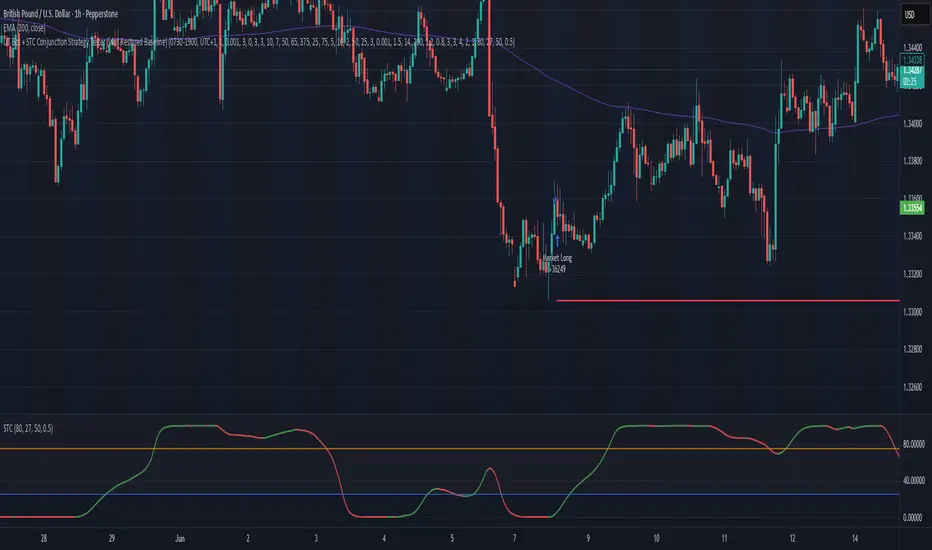
For GBPUSD 1H only
UT Bot + STC Conjunction Engine [v4.7 Baseline]
Overview
The UT Bot + STC Conjunction Engine is a high-precision, institutional-grade intraday trading framework designed specifically for major currency pairs (optimized for GBPUSD). By marrying fast-reacting momentum tracking with a multi-layered liquidity and volatility filtering stack, this strategy aims to capture highly explosive value turnarounds while aggressively minimizing flat-market drawdowns.Rather than chasing price or trading blind indicator crossovers, the system requires a perfect alignment of momentum, structural value zones, volume intensity, candle geometry, and trend velocity before deploying capital.
Key Features & Architectural Core
Dual-Indicator Conjunction Core: Combines a hyper-tuned UT Bot Alerts trailing-stop engine with the Schaff Trend Cycle (STC). The system isolates absolute cyclical extremes, restricting Long entries to oversold floors and Short entries to overbought ceilings.
Dynamic R:R & Parameter Regime Scaling: The script automatically analyzes historical volatility by calculating a ratio between a fast and a slow Baseline ATR. Based on whether the market is in a High Volatility Breakout, Normal, or Low Volatility Compression regime, the system dynamically scales its Risk-to-Reward targets and technical swing lookbacks.
Volatility-Scaled Entry Offsets: To combat execution friction and protect against chasing fakeouts, entries utilize a dynamic pipette offset that scales directly with real-time market volatility.
The Institutional Guard Stack:
Candle Range Filters: Blocks executions on anomalous candles—filtering out low-liquidity drift (too small) and news-driven exhaustion spikes (too large) relative to a 50-period ATR.
Volume Intensity Filter: Uses a fast/slow volume oscillator breakdown to ensure institutional volume is expanding in favor of the momentum trigger.
Rejection Wick Filter: Analyzes counter-wick percentages to mathematically block entries pushing directly into overhead structural resistance or underlying support.
Trend Velocity Blocker: Measures the instantaneous mathematical slope of a baseline EMA window, instantly freezing execution if the micro-trend is moving too aggressively against the signal.
Static Weekly Circuit Breaker: An built-in risk management safeguard that monitors peak weekly equity. If the account experiences a pre-set maximum weekly drawdown percentage, the system trips its circuit breaker, flattens all risk, and blocks new entries until the start of the next trading week.
How To Use & Optimization GuideSession Control: The default settings are optimized for an intraday window (07:30 - 19:00 UTC). This captures the peak liquidity segments of both the London Open and New York morning drives while stepping aside during low-volume roll-overs.Risk Specification: Input your exact preferred risk percentage per trade (e.g., $1.0\%$). The strategy automatically calculates your structural stop-loss position based on dynamic swing highs/lows and adjusts your exact contract/lot sizing to keep cash risk perfectly constant.Trade Management: The system features a built-in Breakeven Trigger. Once a position hits a profit milestone equivalent to twice your initial structural risk, the stop-loss automatically moves to your exact execution entry price to lock in a completely risk-free ride.
Disclaimer: Past performance does not guarantee future results. This script is intended strictly for educational and backtesting purposes. Always conduct comprehensive forward-testing on a demo environment before committing live capital to any quantitative strategy.
UT Bot + STC Conjunction Engine [v4.7 Baseline]
Overview
The UT Bot + STC Conjunction Engine is a high-precision, institutional-grade intraday trading framework designed specifically for major currency pairs (optimized for GBPUSD). By marrying fast-reacting momentum tracking with a multi-layered liquidity and volatility filtering stack, this strategy aims to capture highly explosive value turnarounds while aggressively minimizing flat-market drawdowns.Rather than chasing price or trading blind indicator crossovers, the system requires a perfect alignment of momentum, structural value zones, volume intensity, candle geometry, and trend velocity before deploying capital.
Key Features & Architectural Core
Dual-Indicator Conjunction Core: Combines a hyper-tuned UT Bot Alerts trailing-stop engine with the Schaff Trend Cycle (STC). The system isolates absolute cyclical extremes, restricting Long entries to oversold floors and Short entries to overbought ceilings.
Dynamic R:R & Parameter Regime Scaling: The script automatically analyzes historical volatility by calculating a ratio between a fast and a slow Baseline ATR. Based on whether the market is in a High Volatility Breakout, Normal, or Low Volatility Compression regime, the system dynamically scales its Risk-to-Reward targets and technical swing lookbacks.
Volatility-Scaled Entry Offsets: To combat execution friction and protect against chasing fakeouts, entries utilize a dynamic pipette offset that scales directly with real-time market volatility.
The Institutional Guard Stack:
Candle Range Filters: Blocks executions on anomalous candles—filtering out low-liquidity drift (too small) and news-driven exhaustion spikes (too large) relative to a 50-period ATR.
Volume Intensity Filter: Uses a fast/slow volume oscillator breakdown to ensure institutional volume is expanding in favor of the momentum trigger.
Rejection Wick Filter: Analyzes counter-wick percentages to mathematically block entries pushing directly into overhead structural resistance or underlying support.
Trend Velocity Blocker: Measures the instantaneous mathematical slope of a baseline EMA window, instantly freezing execution if the micro-trend is moving too aggressively against the signal.
Static Weekly Circuit Breaker: An built-in risk management safeguard that monitors peak weekly equity. If the account experiences a pre-set maximum weekly drawdown percentage, the system trips its circuit breaker, flattens all risk, and blocks new entries until the start of the next trading week.
How To Use & Optimization GuideSession Control: The default settings are optimized for an intraday window (07:30 - 19:00 UTC). This captures the peak liquidity segments of both the London Open and New York morning drives while stepping aside during low-volume roll-overs.Risk Specification: Input your exact preferred risk percentage per trade (e.g., $1.0\%$). The strategy automatically calculates your structural stop-loss position based on dynamic swing highs/lows and adjusts your exact contract/lot sizing to keep cash risk perfectly constant.Trade Management: The system features a built-in Breakeven Trigger. Once a position hits a profit milestone equivalent to twice your initial structural risk, the stop-loss automatically moves to your exact execution entry price to lock in a completely risk-free ride.
Disclaimer: Past performance does not guarantee future results. This script is intended strictly for educational and backtesting purposes. Always conduct comprehensive forward-testing on a demo environment before committing live capital to any quantitative strategy.
Release Notes
Further optimsations made to the settings. Open-source script
In true TradingView spirit, the creator of this script has made it open-source, so that traders can review and verify its functionality. Kudos to the author! While you can use it for free, remember that republishing the code is subject to our House Rules.

Disclaimer
The information and publications are not meant to be, and do not constitute, financial, investment, trading, or other types of advice or recommendations supplied or endorsed by TradingView. Read more in the Terms of Use.
Open-source script
In true TradingView spirit, the creator of this script has made it open-source, so that traders can review and verify its functionality. Kudos to the author! While you can use it for free, remember that republishing the code is subject to our House Rules.
Disclaimer
The information and publications are not meant to be, and do not constitute, financial, investment, trading, or other types of advice or recommendations supplied or endorsed by TradingView. Read more in the Terms of Use.