OPEN-SOURCE SCRIPT
GLI Fed Plumbing Regime (v1.0)
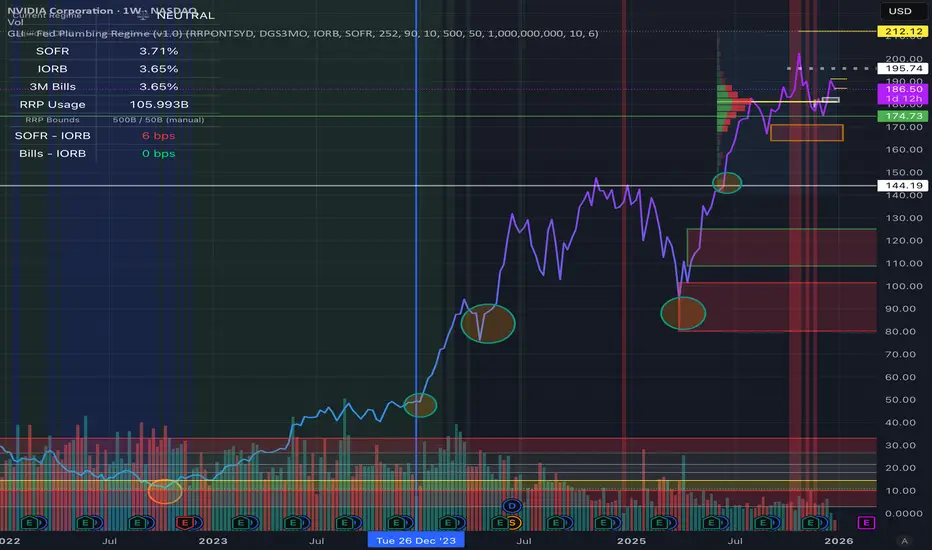
GLI Regime Index
Global Liquidity Intelligence for Risk Markets
The GLI Regime Index is a macro-liquidity regime engine that classifies the financial system based on where cash is actually flowing inside the Fed–Treasury plumbing.
Markets do not move on narratives.
They move on liquidity.
GLI measures that liquidity in real time by combining four institutional-grade signals:
• Fed Reverse Repo (RRP) – where excess cash is being parked
• 3-Month Treasury Bills – where short-term money prefers to earn yield
• IORB – the Federal Reserve’s policy floor
• SOFR – the true cost of funding in the system
By comparing these flows, GLI identifies which institution is currently in control of money:
Regime What It Means
FED DOMINANT Abundant reserves, liquidity flowing into risk assets
T-BILL DOMINANT Treasury absorbing liquidity, risk tightening
CASH GLUT Excess money trapped at the Fed (RRP high)
FUNDING STRESS Funding markets under pressure (SOFR > IORB)
NEUTRAL Transition state between regimes
Why this matters
Assets like NVDA, BTC, high-beta tech, and growth stocks don’t trade on earnings — they trade on marginal liquidity.
GLI tells you:
When rallies are supported by real money
When breakouts are likely to fail
When dips are being bought vs distributed
When risk is being quietly withdrawn
How to use it
Apply GLI to any chart.
When the background turns:
Green (Fed Dominant) → Risk assets are structurally supported
Orange (T-Bill Dominant) → Liquidity is draining from risk
Blue (Cash Glut) → Money is stuck at the Fed, rallies struggle
Red (Funding Stress) → Volatility and liquidation risk rise
The built-in Liquidity HUD shows:
RRP usage
Fed vs Treasury dominance
SOFR stress
Rate spreads in real time
No interpretation required.
What GLI is not
GLI is not a technical indicator.
It does not look at price, volume, or momentum.
It looks at the money behind the price.
That’s why it works.
Global Liquidity Intelligence for Risk Markets
The GLI Regime Index is a macro-liquidity regime engine that classifies the financial system based on where cash is actually flowing inside the Fed–Treasury plumbing.
Markets do not move on narratives.
They move on liquidity.
GLI measures that liquidity in real time by combining four institutional-grade signals:
• Fed Reverse Repo (RRP) – where excess cash is being parked
• 3-Month Treasury Bills – where short-term money prefers to earn yield
• IORB – the Federal Reserve’s policy floor
• SOFR – the true cost of funding in the system
By comparing these flows, GLI identifies which institution is currently in control of money:
Regime What It Means
FED DOMINANT Abundant reserves, liquidity flowing into risk assets
T-BILL DOMINANT Treasury absorbing liquidity, risk tightening
CASH GLUT Excess money trapped at the Fed (RRP high)
FUNDING STRESS Funding markets under pressure (SOFR > IORB)
NEUTRAL Transition state between regimes
Why this matters
Assets like NVDA, BTC, high-beta tech, and growth stocks don’t trade on earnings — they trade on marginal liquidity.
GLI tells you:
When rallies are supported by real money
When breakouts are likely to fail
When dips are being bought vs distributed
When risk is being quietly withdrawn
How to use it
Apply GLI to any chart.
When the background turns:
Green (Fed Dominant) → Risk assets are structurally supported
Orange (T-Bill Dominant) → Liquidity is draining from risk
Blue (Cash Glut) → Money is stuck at the Fed, rallies struggle
Red (Funding Stress) → Volatility and liquidation risk rise
The built-in Liquidity HUD shows:
RRP usage
Fed vs Treasury dominance
SOFR stress
Rate spreads in real time
No interpretation required.
What GLI is not
GLI is not a technical indicator.
It does not look at price, volume, or momentum.
It looks at the money behind the price.
That’s why it works.
Open-source script
In true TradingView spirit, the creator of this script has made it open-source, so that traders can review and verify its functionality. Kudos to the author! While you can use it for free, remember that republishing the code is subject to our House Rules.

Disclaimer
The information and publications are not meant to be, and do not constitute, financial, investment, trading, or other types of advice or recommendations supplied or endorsed by TradingView. Read more in the Terms of Use.
Open-source script
In true TradingView spirit, the creator of this script has made it open-source, so that traders can review and verify its functionality. Kudos to the author! While you can use it for free, remember that republishing the code is subject to our House Rules.
Disclaimer
The information and publications are not meant to be, and do not constitute, financial, investment, trading, or other types of advice or recommendations supplied or endorsed by TradingView. Read more in the Terms of Use.