Pattern Radar
═════════════════════════════════════════════════════════════
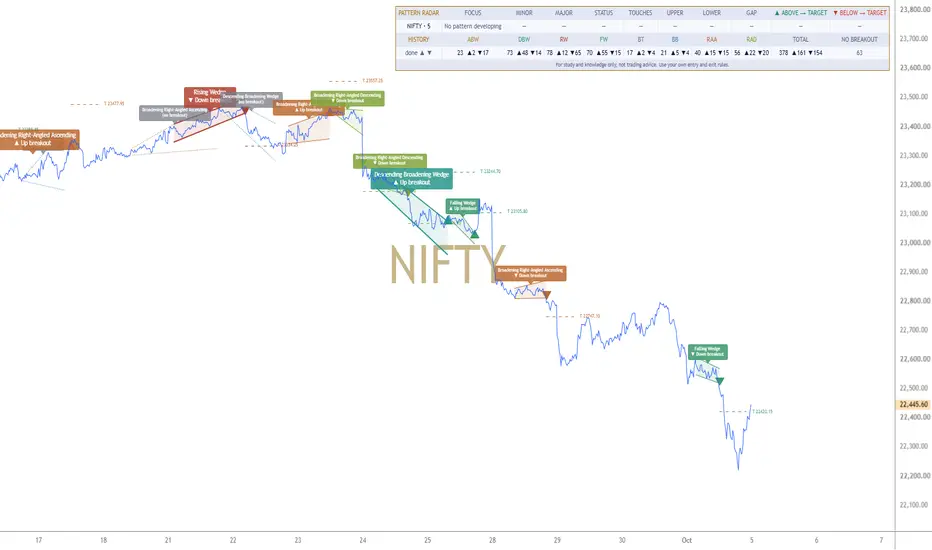
PATTERN RADAR — Broadening & Wedge family (8 patterns)
═════════════════════════════════════════════════════════════
DISCLAIMER
This indicator is for study and knowledge purposes only. It is not trading
or investment advice. Always apply your own entry, exit and risk rules.
WHAT IT DOES
------------
Scans the chart for the eight megaphone / wedge formations described in
Thomas Bulkowski's pattern research, paints EVERY occurrence in the loaded
history, and names the pattern price is building RIGHT NOW on whatever
timeframe the chart is set to (the engine runs on chart bars, 1m … Monthly).
THE EIGHT PATTERNS (one geometry engine + one classifier)
---------------------------------------------------------------------------
# Pattern Upper line Lower line Gap
1 Ascending Broadening Wedge up up (shallow) widening needs 3 peaks + 3 valleys
2 Descending Broadening Wedge down(shal.) down widening needs 5 touches (3+2)
3 Rising Wedge up up (steeper) narrowing needs 5 touches (3+2)
4 Falling Wedge down down(steeper) narrowing needs 5 touches (3+2)
5 Broadening Top up down widening after an up-move
6 Broadening Bottom up down widening after a down-move
7 Broadening Right-Angled Ascending up flat widening
8 Broadening Right-Angled Descending flat down widening
HOW A PATTERN IS FOUND (confirmed pivots + bar close → no repainting)
---------------------------------------------------------------------------
1. Swing pivots are collected at two scales: MINOR (small) and MAJOR (large).
2. On every new pivot, the last 3 highs + last 3 lows (or 3+2 / 2+3) are
fitted with least-squares trendlines.
3. Validation: each pivot must sit within tolerance of its line, closes must
stay inside the lines (max N exceptions), minimum length and height (ATR).
4. Classification uses only the slope of the upper line, the slope of the
lower line, and whether the gap between them widens or narrows.
5. Resolution: first close beyond a trendline = breakout (▲/▼). If the lines
cross or the pattern outlives its allowed time, it closes as "no breakout".
6. Targets:
• Ascending Broadening Wedge — published measure rule: down = lowest
valley; up = breakout + 61% × (highest peak − lowest valley).
• Descending Broadening Wedge — published measure rule: up = highest
peak; down = lowest valley − 32% × (highest peak − lowest valley).
• Other patterns — generic height projection from the
breakout close (multiplier is an input).

Disclaimer
The information and publications are not meant to be, and do not constitute, financial, investment, trading, or other types of advice or recommendations supplied or endorsed by TradingView. Read more in the Terms of Use.
Disclaimer
The information and publications are not meant to be, and do not constitute, financial, investment, trading, or other types of advice or recommendations supplied or endorsed by TradingView. Read more in the Terms of Use.