Market Sessions - Auto DST
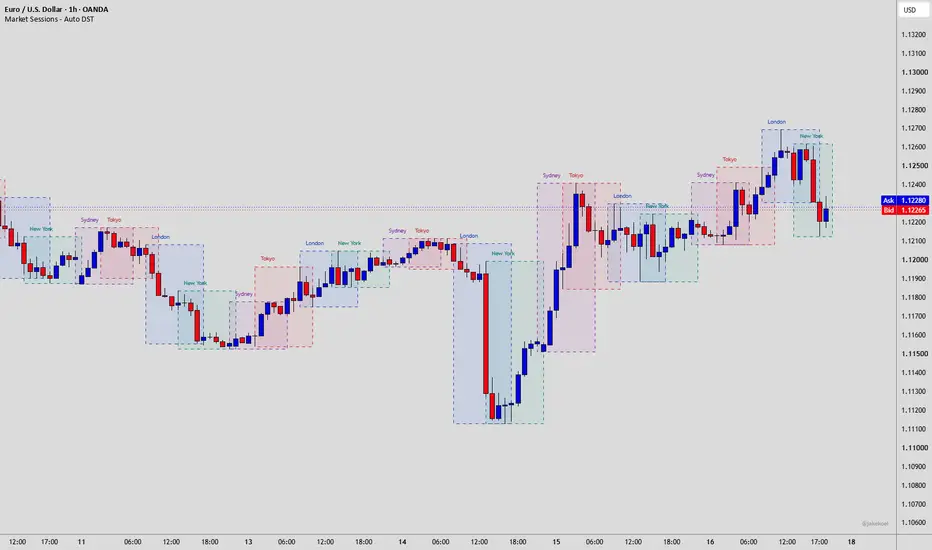
Market Sessions - Auto DST highlights the four main forex sessions on your chart: Sydney, Tokyo, London and New York. Each session is drawn from its open to its close, so you can see at a glance when each market was active and what price did during it.
It's a clean, informational tool: it marks the sessions and nothing else. No signals.
WHAT IT SHOWS
Two display styles:
- Box (default): each session is a box from its open to its close, and from its low to its high. The box grows live while the session is running.
- Full height: each session is a coloured band from the top to the bottom of the chart.
Sessions often overlap (for example London and New York in the afternoon). The boxes overlap too, and in Full height style the colours blend, so the overlap stands out on its own.
AUTO DST: ALWAYS IN SYNC WITH THE REAL MARKET OPEN
Each session is set in its own city's local time:
- Sydney: 07:00–16:00 Sydney time
- Tokyo: 09:00–18:00 Tokyo time
- London: 08:00–17:00 London time
- New York: 08:00–17:00 New York time
This matters because countries change their clocks on different dates. The UK, the US and Australia all switch between summer and winter time on different weekends (Australia in the opposite season), and Japan doesn't change its clocks at all. A session indicator set in one fixed time zone is therefore an hour off for several weeks every year. For example, in the weeks when the US has changed its clocks but the UK hasn't, New York opens at 12:00 London time instead of 13:00.
This indicator handles every clock change automatically, so each box always lines up with when that market actually opens, whatever time zone your chart is set to.
WHY TRADING SESSIONS MATTER
Forex trades 24 hours a day, but trading follows business hours around the world, so activity and volatility change a lot during the day. According to the Bank for International Settlements' 2025 survey, around 38% of all forex trading takes place in the United Kingdom and around 19% in the United States, with Singapore, Hong Kong and Japan the largest Asian centres. Studies of interbank trading data show activity peaks when each major market opens and during the London and New York overlap, and is lowest around lunch hours and in the late New York evening.
THE CHARACTER OF EACH SESSION
- Sydney: the quietest session. It opens around the daily rollover (5pm New York time), the least liquid part of the day, when spreads are usually at their widest.
- Tokyo: the main Asian session and the most active time for JPY, AUD and NZD pairs. The Tokyo fix at 9:55 Tokyo time is the busiest moment of the day for dollar/yen.
- London: the largest forex centre in the world. Trading activity jumps at the London open, and most European data is released during this session.
- New York: the session of US economic data. Releases such as GDP and non-farm payrolls (usually 8:30 New York time, 13:30 London time) and US Federal Reserve decisions cause sharp jumps in trading volume and volatility.
THE LONDON AND NEW YORK OVERLAP
When London and New York are both open (roughly 13:00 to 17:00 London time), the two largest forex centres trade at the same time. Federal Reserve research on interbank trading found volume is highest in the New York morning, which falls inside this overlap. It also includes the London 4pm fix (WM/Reuters), a benchmark rate around which research has found unusually high volatility and frequent short-term reversals. For most major pairs, this overlap is the busiest and usually the most volatile part of the trading day.
SESSION HIGHS AND LOWS
A session's high and low are among the most visible price levels on the chart, and many traders use them as reference levels for the rest of the day. Research on currency order flow by the Federal Reserve Bank of New York found that stop-loss orders tend to cluster just beyond obvious price levels, and that once they are triggered, moves tend to speed up. When a new session trades through the previous session's high or low, two outcomes are common: a sweep (price takes the orders and quickly reverses back into the range) or a breakout (the triggered orders add fuel and the move continues). Many traders watch how price closes after the level is taken to judge which one is unfolding.
HOW TRADERS COMMONLY USE SESSIONS
- Timing: trading when their pair is most active, such as EUR and GBP pairs during London and the overlap, or JPY, AUD and NZD pairs during Tokyo.
- Avoiding thin hours: staying careful around the late New York and early Sydney hours, when liquidity is low and spreads are wider.
- Reading the day: seeing how each session treats the previous session's range, for example whether London breaks the Asian range or New York continues or reverses the London move.
- Planning around news: knowing which session major data releases and benchmark fixes fall into.
SETTINGS
Sessions (one row per session)
- Tick box: show or hide the session.
- Hours: in that city's local time. Clock changes are handled automatically.
- First colour: the fill colour.
- Second colour: the border colour.
Display
- Display style: Box or Full height.
- Days to show: how many past trading days of sessions stay on the chart (up to 60).
- Fill transparency: how see-through the session colour is.
Borders
- Show borders: on or off.
- Border style: solid, dashed (default) or dotted.
Session names
- Show session names: on or off.
- Position: Above the session (default), Inside top or Inside bottom.
NOTES
- Works on 1-hour charts and lower, where the session times line up with the candles.
- There is no single official definition of forex session hours, and brokers and websites use slightly different times. The defaults follow the most common convention, and you can change any session's hours in the settings.
- This is an analysis tool, not a buy or sell signal. Use it alongside your own analysis and risk management.

Disclaimer
The information and publications are not meant to be, and do not constitute, financial, investment, trading, or other types of advice or recommendations supplied or endorsed by TradingView. Read more in the Terms of Use.
Disclaimer
The information and publications are not meant to be, and do not constitute, financial, investment, trading, or other types of advice or recommendations supplied or endorsed by TradingView. Read more in the Terms of Use.