OPEN-SOURCE SCRIPT
Bucket 3 Momentum
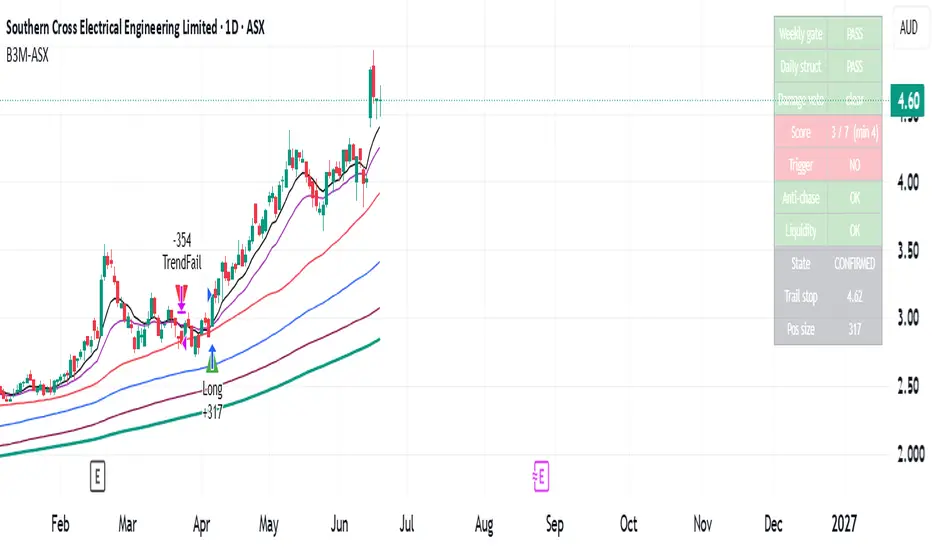
Bucket 3 Momentum
A backtestable daily-chart momentum strategy for ASX equities, built on a four-layer confirmation model: a trade fires only when the weekly trend grants permission, daily structure is intact, a price trigger confirms demand, and risk/extension checks pass.
The weekly layer is the gatekeeper — price above a rising 30-week SMA with healthy weekly RSI — so it won't buy dips in stocks that have quietly left a Stage-2 uptrend. The daily layer confirms the structure (price above the 50/150 DMAs, 50DMA flat-to-rising) with a damage veto for collapsing RSI, fresh 20-day lows, or bearish DMI. Entry triggers on a 5-day breakout with a strong close, but only once a tunable setup score is met (RSI curl + signal cross, fast-MACD turn, DMI recovery, improving RS vs XJO). An anti-chase filter blocks entries stretched too far above the 20EMA.
Positions are sized by defined risk (default 1.5% per trade), with the initial stop below the pullback swing low, floored at 1 ATR. Three exits execute: initial hard stop, a 1.5×ATR trailing stop that ratchets up only, and a structural trend-failure exit.
Built to be backtest-honest — weekly data uses the completed-bar pattern to avoid repaint/lookahead bias, structural decisions act on bar close, protective stops fill intrabar. An on-chart table shows each layer's status, live score, and current state. Tunable throughout; benchmarked against the XJO, so other universes need the benchmark and liquidity floor adjusted.
For education only — not financial advice. Past backtested performance does not guarantee future results.
A backtestable daily-chart momentum strategy for ASX equities, built on a four-layer confirmation model: a trade fires only when the weekly trend grants permission, daily structure is intact, a price trigger confirms demand, and risk/extension checks pass.
The weekly layer is the gatekeeper — price above a rising 30-week SMA with healthy weekly RSI — so it won't buy dips in stocks that have quietly left a Stage-2 uptrend. The daily layer confirms the structure (price above the 50/150 DMAs, 50DMA flat-to-rising) with a damage veto for collapsing RSI, fresh 20-day lows, or bearish DMI. Entry triggers on a 5-day breakout with a strong close, but only once a tunable setup score is met (RSI curl + signal cross, fast-MACD turn, DMI recovery, improving RS vs XJO). An anti-chase filter blocks entries stretched too far above the 20EMA.
Positions are sized by defined risk (default 1.5% per trade), with the initial stop below the pullback swing low, floored at 1 ATR. Three exits execute: initial hard stop, a 1.5×ATR trailing stop that ratchets up only, and a structural trend-failure exit.
Built to be backtest-honest — weekly data uses the completed-bar pattern to avoid repaint/lookahead bias, structural decisions act on bar close, protective stops fill intrabar. An on-chart table shows each layer's status, live score, and current state. Tunable throughout; benchmarked against the XJO, so other universes need the benchmark and liquidity floor adjusted.
For education only — not financial advice. Past backtested performance does not guarantee future results.
Open-source script
In true TradingView spirit, the creator of this script has made it open-source, so that traders can review and verify its functionality. Kudos to the author! While you can use it for free, remember that republishing the code is subject to our House Rules.

Disclaimer
The information and publications are not meant to be, and do not constitute, financial, investment, trading, or other types of advice or recommendations supplied or endorsed by TradingView. Read more in the Terms of Use.
Open-source script
In true TradingView spirit, the creator of this script has made it open-source, so that traders can review and verify its functionality. Kudos to the author! While you can use it for free, remember that republishing the code is subject to our House Rules.
Disclaimer
The information and publications are not meant to be, and do not constitute, financial, investment, trading, or other types of advice or recommendations supplied or endorsed by TradingView. Read more in the Terms of Use.