
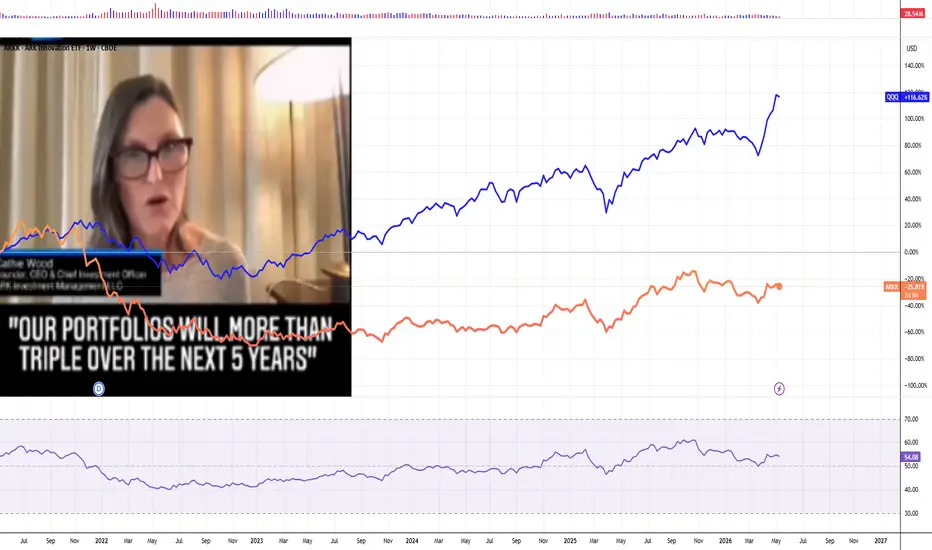
In the modern financial arena, the loudest conviction often commands the most attention, yet the market remains stubbornly indifferent to how well a story is told. Cathie Wood, the face of innovation-led investing, famously declared that her portfolios would more than triple over a five-year horizon. However, as of May 2026, the divergence between that bold prophecy and the cold reality of the charts is impossible to ignore.
The visual contrast is staggering. As shown in the attached chart, the blue line representing the QQQ — a benchmark for Nasdaq-100 innovation—has consistently outpaced the orange line of the ARKK ETF. While QQQ has delivered robust compounding, ARKK has struggled through a cycle of volatility and significant underperformance, leaving retail investors to wonder where the promised alpha went.
The disparity is compounded by the structural reality of the fees. Investors in QQQ benefit from a lean expense ratio of approximately 0.20%, allowing more of their capital to work within the market. In contrast, those tethered to ARKK have paid a premium 0.75% expense ratio for returns that have failed to justify the cost.
This situation illustrates a classic 21st-century trap: the conflation of vision with performance. In the age of social media, an articulate pitch can generate billions in inflows, but those inflows do not equate to asset appreciation. When the "Fire Wood" settles, we are left with the basic arithmetic of investing: hype is a fleeting commodity, but management fees are permanent.
For the trader or long-term investor, the lesson is clear: verify the narrative against the net-of-fee performance. While Wood continues to forecast a "Goldilocks" boom, the performance gap between her funds and standard index trackers suggests that being a visionary is secondary to being a prudent allocator.

The visual contrast is staggering. As shown in the attached chart, the blue line representing the
QQQ — a benchmark for Nasdaq-100 innovation—has consistently outpaced the orange line of the ARKK ETF. While QQQ has delivered robust compounding, ARKK has struggled through a cycle of volatility and significant underperformance, leaving retail investors to wonder where the promised alpha went.The disparity is compounded by the structural reality of the fees. Investors in QQQ benefit from a lean expense ratio of approximately 0.20%, allowing more of their capital to work within the market. In contrast, those tethered to ARKK have paid a premium 0.75% expense ratio for returns that have failed to justify the cost.
This situation illustrates a classic 21st-century trap: the conflation of vision with performance. In the age of social media, an articulate pitch can generate billions in inflows, but those inflows do not equate to asset appreciation. When the "Fire Wood" settles, we are left with the basic arithmetic of investing: hype is a fleeting commodity, but management fees are permanent.
For the trader or long-term investor, the lesson is clear: verify the narrative against the net-of-fee performance. While Wood continues to forecast a "Goldilocks" boom, the performance gap between her funds and standard index trackers suggests that being a visionary is secondary to being a prudent allocator.

Declinazione di responsabilità
Le informazioni e le pubblicazioni non sono intese come, e non costituiscono, consulenza o raccomandazioni finanziarie, di investimento, di trading o di altro tipo fornite o approvate da TradingView. Per ulteriori informazioni, consultare i Termini di utilizzo.
Declinazione di responsabilità
Le informazioni e le pubblicazioni non sono intese come, e non costituiscono, consulenza o raccomandazioni finanziarie, di investimento, di trading o di altro tipo fornite o approvate da TradingView. Per ulteriori informazioni, consultare i Termini di utilizzo.