
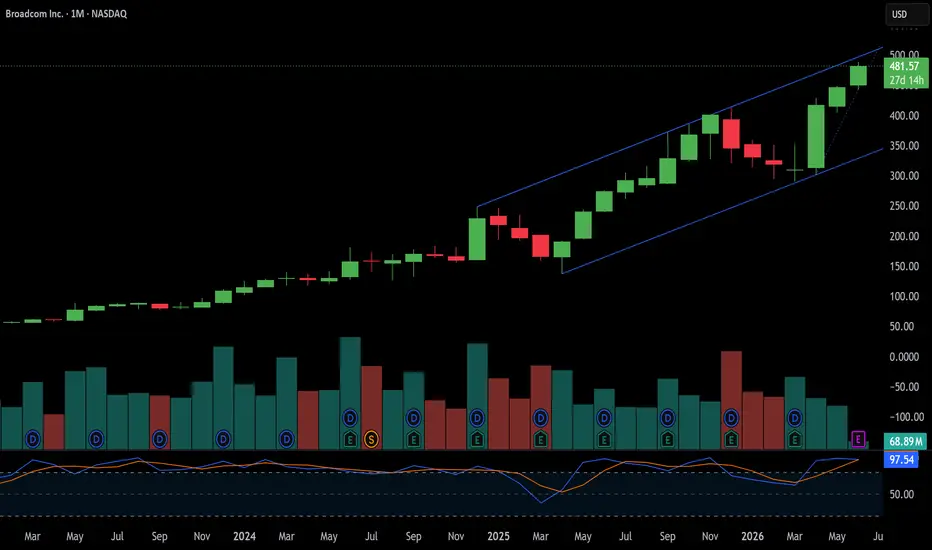
Fiscal Q2 Earnings Preview
Broadcom (NASDAQ: AVGO) reports fiscal Q2 2026 earnings on June 3, 2026 after market close. Management guided Q2 revenue to $22 billion, representing 47% year-over-year growth. The Zacks Consensus Estimate sits at $22.04 billion, suggesting 46.9% growth from the year-ago quarter.
Consensus EPS sits at $2.40 per share, indicating 52% year-over-year growth. Adjusted EBITDA margin is guided at approximately 68% of revenue.
The $73 billion AI order book provides extraordinary multi-quarter visibility. Q1 FY2026 actual revenue hit a record $19.3 billion (+29% YoY) with AI revenue of $8.4 billion (+106% YoY). AI revenue is expected to accelerate to $10.7 billion (+140% YoY) in Q2.
Technology, Science, and High-Tech
Broadcom drives the high-tech frontier with its new BCM68850 Wi-Fi 8 system-on-chip (SoC) ecosystem. The architecture embeds neural processing units (NPUs) directly into wireless routing silicon. The integration brings localized AI processing to edge networks and residential broadband.
Furthermore, custom ASIC programs accelerate data transmission for Google's TPU and Meta's MTIA hardware. Broadcom bridges the gap between massive data centers and consumer devices.
The BCM68850 extends Broadcom's AI infrastructure strategy from hyperscale data centers to the broadband edge. The chip creates a new semiconductor growth vector alongside the booming XPU business.
Moreover, Broadcom's 102-terabit per second Tomahawk 6 switch captures aggressive hyperscaler demand. The 200G SerDes technology positions Broadcom at the center of next-generation AI fabrics. AI switch backlog alone exceeds $10 billion as of late Q1 FY2026. Management projects AI chip revenues could exceed $100 billion in 2027.
Patent Analysis and Cybersecurity
Proprietary silicon designs form an impenetrable technological moat for the company. Patent analysis reveals massive, compounding intellectual property holdings in optical interconnects and Ethernet routing.
The patents effectively block competitors from replicating Broadcom's highly efficient architectures. Marvell remains the primary alternative provider but operates at materially smaller scale.
Additionally, Broadcom integrates hardware-based security directly into modern silicon. The embedded cybersecurity safeguards sensitive AI models against remote infrastructure attacks.
Furthermore, the patent portfolio extends across custom XPU architectures, advanced packaging, and inference-optimized silicon. The company aggressively protects its valuable intellectual assets globally through ongoing enforcement.
Industry Trends and Business Models
The global enterprise landscape demands efficient, scalable AI networking hardware. Broadcom exploits this trend via a highly profitable, sticky business model. Long-term supplier agreements with hyperscalers guarantee recurring multi-billion-dollar revenue streams.
CEO Hock Tan disclosed six major XPU customers on the Q1 FY2026 earnings call. The customer roster includes Google (TPU through 2031), Meta (MTIA through 2029), Anthropic (3.5 GW from 2027), and OpenAI (1+ GW first-gen 2027) plus two unnamed hyperscalers.
The Anthropic engagement covers 3.5 gigawatts of TPU-based compute capacity starting 2027. The OpenAI deployment exceeds 1 gigawatt of first-generation custom XPU in 2027.
Moreover, semiconductor revenues are expected to grow 76% year-over-year to $14.8 billion in Q2. AI networking is expected to account for 40% of total AI revenues. Infrastructure software revenues should reach $7.2 billion (+9% YoY) driven by sustained VMware demand. The ecosystem approach locks clients into Broadcom's proprietary technology environment.
Geopolitics and Geostrategy
Geopolitical tensions heavily influence the global semiconductor supply chain. Broadcom executes an aggressive geostrategy to diversify its manufacturing footprint. The company strategically mitigates geographic risks by utilizing varied global chip foundries.
On May 21, 2026, Broadcom joined Meta, Applied Materials, GlobalFoundries, and Synopsys to launch a $125 million Semiconductor Hub at UCLA. The five-year initiative anchors at UCLA's Samueli School of Engineering.
The hub addresses the critical workforce shortage facing the US chip industry. UCLA's Jason Cong noted approximately 2 million software developers exist in the US versus fewer than 100,000 hardware designers.
Furthermore, the geostrategy aligns perfectly with Western data sovereignty mandates. Sovereign entities require secure, domestic AI infrastructure to ensure national safety. Broadcom addresses these high-stakes geopolitical demands through localized partnerships and diversified foundry relationships.
Macroeconomics and Economics
Persistent inflation and high interest rates pressure standard corporate earnings. However, Broadcom thrives due to stellar economic fundamentals. The company guided Q2 adjusted EBITDA margin at approximately 68% of revenue.
Q1 FY2026 adjusted EBITDA reached $13.1 billion (68% of revenue). The exceptional profitability fuels a fresh $10 billion share repurchase program announced in March 2026.
Broadcom repurchased $7.8 billion of common stock in Q1 FY2026 alone. The company returned $10.9 billion to shareholders through dividends and buybacks during the same quarter.
Furthermore, trailing free cash flow sits near $28.9 billion. The PEG ratio of approximately 0.26 looks attractive relative to growth and broader AI semiconductor peers. Strong free cash flows insulate Broadcom against broader macroeconomic downturns. Investors heavily favor the disciplined financial performance.
Management, Leadership, and Culture
Visionary management relentlessly prioritizes high-margin innovation over low-yield commoditized products. CEO Hock Tan executed the VMware acquisition (~$69 billion, completed November 2023) with surgical efficiency. CFO Kirsten Spears guided Q2 FY2026 numbers with conviction on the Q1 earnings call.
The Symantec divestiture (post-VMware) and the broader portfolio rationalization demonstrate disciplined capital allocation. A corporate culture of absolute accountability drives continuous engineering breakthroughs.
Furthermore, the aggressive leadership style guarantees market dominance across networking and custom silicon. Broadcom sets the gold standard for operational execution in the technology sector.
Note: The article references Juniper acquisition incorrectly. HPE acquired Juniper Networks in 2025, not Broadcom. Broadcom focuses its M&A on VMware (software) and continues organic growth in semiconductors.
Catalysts and Risks Heading Into June 3
Investors should monitor closely:
* Q2 actual revenue versus $22B guide (47% YoY growth target)
* AI semiconductor revenue versus $10.7B Q2 target
* Custom XPU customer momentum (Google, Meta, Anthropic, OpenAI)
* AI switch backlog growth beyond $10B
* FY27 commentary on $100B+ AI chip revenue trajectory
* Gross margin guidance updates
* Capital return commentary on the $10B buyback
Risks to monitor include:
* Stock up ~28% YTD, lagging PHLX Semiconductor +74%
* Stretched valuation versus broader semiconductor peers
* Gross margin under pressure from product mix shifts
* Customer concentration in top hyperscalers
* AI capex bubble concerns from Burry and Goldman Sachs
* Geopolitical TSMC supply chain exposure
Broadcom (NASDAQ: AVGO) reports fiscal Q2 2026 earnings on June 3, 2026 after market close. Management guided Q2 revenue to $22 billion, representing 47% year-over-year growth. The Zacks Consensus Estimate sits at $22.04 billion, suggesting 46.9% growth from the year-ago quarter.
Consensus EPS sits at $2.40 per share, indicating 52% year-over-year growth. Adjusted EBITDA margin is guided at approximately 68% of revenue.
The $73 billion AI order book provides extraordinary multi-quarter visibility. Q1 FY2026 actual revenue hit a record $19.3 billion (+29% YoY) with AI revenue of $8.4 billion (+106% YoY). AI revenue is expected to accelerate to $10.7 billion (+140% YoY) in Q2.
Technology, Science, and High-Tech
Broadcom drives the high-tech frontier with its new BCM68850 Wi-Fi 8 system-on-chip (SoC) ecosystem. The architecture embeds neural processing units (NPUs) directly into wireless routing silicon. The integration brings localized AI processing to edge networks and residential broadband.
Furthermore, custom ASIC programs accelerate data transmission for Google's TPU and Meta's MTIA hardware. Broadcom bridges the gap between massive data centers and consumer devices.
The BCM68850 extends Broadcom's AI infrastructure strategy from hyperscale data centers to the broadband edge. The chip creates a new semiconductor growth vector alongside the booming XPU business.
Moreover, Broadcom's 102-terabit per second Tomahawk 6 switch captures aggressive hyperscaler demand. The 200G SerDes technology positions Broadcom at the center of next-generation AI fabrics. AI switch backlog alone exceeds $10 billion as of late Q1 FY2026. Management projects AI chip revenues could exceed $100 billion in 2027.
Patent Analysis and Cybersecurity
Proprietary silicon designs form an impenetrable technological moat for the company. Patent analysis reveals massive, compounding intellectual property holdings in optical interconnects and Ethernet routing.
The patents effectively block competitors from replicating Broadcom's highly efficient architectures. Marvell remains the primary alternative provider but operates at materially smaller scale.
Additionally, Broadcom integrates hardware-based security directly into modern silicon. The embedded cybersecurity safeguards sensitive AI models against remote infrastructure attacks.
Furthermore, the patent portfolio extends across custom XPU architectures, advanced packaging, and inference-optimized silicon. The company aggressively protects its valuable intellectual assets globally through ongoing enforcement.
Industry Trends and Business Models
The global enterprise landscape demands efficient, scalable AI networking hardware. Broadcom exploits this trend via a highly profitable, sticky business model. Long-term supplier agreements with hyperscalers guarantee recurring multi-billion-dollar revenue streams.
CEO Hock Tan disclosed six major XPU customers on the Q1 FY2026 earnings call. The customer roster includes Google (TPU through 2031), Meta (MTIA through 2029), Anthropic (3.5 GW from 2027), and OpenAI (1+ GW first-gen 2027) plus two unnamed hyperscalers.
The Anthropic engagement covers 3.5 gigawatts of TPU-based compute capacity starting 2027. The OpenAI deployment exceeds 1 gigawatt of first-generation custom XPU in 2027.
Moreover, semiconductor revenues are expected to grow 76% year-over-year to $14.8 billion in Q2. AI networking is expected to account for 40% of total AI revenues. Infrastructure software revenues should reach $7.2 billion (+9% YoY) driven by sustained VMware demand. The ecosystem approach locks clients into Broadcom's proprietary technology environment.
Geopolitics and Geostrategy
Geopolitical tensions heavily influence the global semiconductor supply chain. Broadcom executes an aggressive geostrategy to diversify its manufacturing footprint. The company strategically mitigates geographic risks by utilizing varied global chip foundries.
On May 21, 2026, Broadcom joined Meta, Applied Materials, GlobalFoundries, and Synopsys to launch a $125 million Semiconductor Hub at UCLA. The five-year initiative anchors at UCLA's Samueli School of Engineering.
The hub addresses the critical workforce shortage facing the US chip industry. UCLA's Jason Cong noted approximately 2 million software developers exist in the US versus fewer than 100,000 hardware designers.
Furthermore, the geostrategy aligns perfectly with Western data sovereignty mandates. Sovereign entities require secure, domestic AI infrastructure to ensure national safety. Broadcom addresses these high-stakes geopolitical demands through localized partnerships and diversified foundry relationships.
Macroeconomics and Economics
Persistent inflation and high interest rates pressure standard corporate earnings. However, Broadcom thrives due to stellar economic fundamentals. The company guided Q2 adjusted EBITDA margin at approximately 68% of revenue.
Q1 FY2026 adjusted EBITDA reached $13.1 billion (68% of revenue). The exceptional profitability fuels a fresh $10 billion share repurchase program announced in March 2026.
Broadcom repurchased $7.8 billion of common stock in Q1 FY2026 alone. The company returned $10.9 billion to shareholders through dividends and buybacks during the same quarter.
Furthermore, trailing free cash flow sits near $28.9 billion. The PEG ratio of approximately 0.26 looks attractive relative to growth and broader AI semiconductor peers. Strong free cash flows insulate Broadcom against broader macroeconomic downturns. Investors heavily favor the disciplined financial performance.
Management, Leadership, and Culture
Visionary management relentlessly prioritizes high-margin innovation over low-yield commoditized products. CEO Hock Tan executed the VMware acquisition (~$69 billion, completed November 2023) with surgical efficiency. CFO Kirsten Spears guided Q2 FY2026 numbers with conviction on the Q1 earnings call.
The Symantec divestiture (post-VMware) and the broader portfolio rationalization demonstrate disciplined capital allocation. A corporate culture of absolute accountability drives continuous engineering breakthroughs.
Furthermore, the aggressive leadership style guarantees market dominance across networking and custom silicon. Broadcom sets the gold standard for operational execution in the technology sector.
Note: The article references Juniper acquisition incorrectly. HPE acquired Juniper Networks in 2025, not Broadcom. Broadcom focuses its M&A on VMware (software) and continues organic growth in semiconductors.
Catalysts and Risks Heading Into June 3
Investors should monitor closely:
* Q2 actual revenue versus $22B guide (47% YoY growth target)
* AI semiconductor revenue versus $10.7B Q2 target
* Custom XPU customer momentum (Google, Meta, Anthropic, OpenAI)
* AI switch backlog growth beyond $10B
* FY27 commentary on $100B+ AI chip revenue trajectory
* Gross margin guidance updates
* Capital return commentary on the $10B buyback
Risks to monitor include:
* Stock up ~28% YTD, lagging PHLX Semiconductor +74%
* Stretched valuation versus broader semiconductor peers
* Gross margin under pressure from product mix shifts
* Customer concentration in top hyperscalers
* AI capex bubble concerns from Burry and Goldman Sachs
* Geopolitical TSMC supply chain exposure

Stock N Roll!
Declinazione di responsabilità
Le informazioni e le pubblicazioni non sono intese come, e non costituiscono, consulenza o raccomandazioni finanziarie, di investimento, di trading o di altro tipo fornite o approvate da TradingView. Per ulteriori informazioni, consultare i Termini di utilizzo.
Stock N Roll!
Declinazione di responsabilità
Le informazioni e le pubblicazioni non sono intese come, e non costituiscono, consulenza o raccomandazioni finanziarie, di investimento, di trading o di altro tipo fornite o approvate da TradingView. Per ulteriori informazioni, consultare i Termini di utilizzo.