
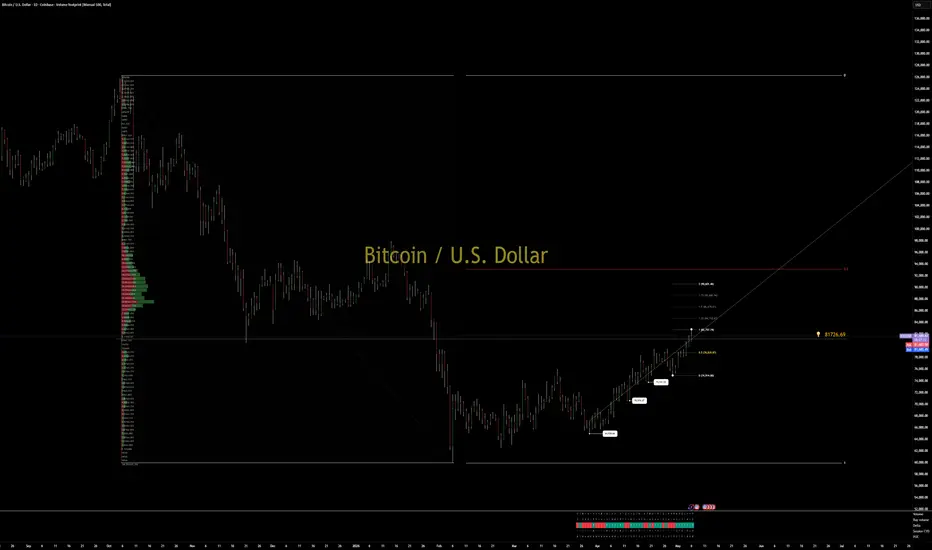
BTCUSD has produced a sustained seven-day advance into the 81,726.69 resistance node. Volume has been substantial across sessions, delta has carried price from the early hours, and the Asian, European, and London windows have each contributed clean directional movement. The main question today is no longer whether the advance has been strong, but whether order-flow pressure is still being accepted at this level or whether exposure should be reduced.
The move has had real participation behind it. This was not a passive drift. It was a strong advance with order flow underneath it.
That fact does not retire the risk. It reframes the question.
The question is no longer whether the move has been strong. The question is whether the next increment of the move still warrants fresh exposure.
Price has now reached 81,726.69, a resistance node that sits near the monthly range low established after the prior imbalance. This location is structurally different from where the advance began. Early in the move, continuation had open space above it. Here, continuation must press into overhead supply.
That asymmetry is the reason I will not compound exposure at this level. Adding into a stretched location after the principal target has already printed introduces risk for which no commensurate edge remains. Should price retrace into a selling node and meet a response from sellers, I would prefer not to carry unnecessary size into that move.
This is not a bearish forecast.
It is capital control.
A stretched price condition is a warning, not an authorization. Extension describes the present condition. It does not predict the next interval. Markets can remain extended longer than the technical reading suggests is reasonable, and extension alone is therefore not sufficient grounds to trade against the prevailing direction.
Used correctly, the reading governs sizing and timing.
It tells us to stop pressing into resistance after strong delta and high volume have already done their work. It tells us to reduce exposure, tighten risk, and wait for evidence of weakness before treating retracement as tradable.
The order-flow principle underneath this is simple.
Imbalance is pressure. Acceptance is different.
A market can show one-sided pressure without producing durable acceptance away from prior balance. Pressure that is reabsorbed leaves no clean structural footprint. An imbalance zone is therefore a data point, not permission.
Should that imbalance zone fail and price be rejected from it, the market is communicating that prior pressure is no longer being accepted. In that case, the retracement argument becomes stronger.
Until that rejection occurs, there is no basis to force the idea.
BTCUSD may continue higher from here. Technical levels do not resolve favorably one hundred percent of the time. Strong markets can advance well past the point at which they appear extended.
The plan therefore cannot be built on directional opinion.
It must be built on exposure allowance.
The correct procedure is to step back across timeframes and impose clarity. We observe whether daily lows hold higher, break lower, or fail after the imbalance zones are tested. We determine whether price accepts above the resistance area or begins to register weakness beneath it.
If weakness develops, the short-term reference becomes the daily midrange discount zone near 78,835.
That is not a target to chase. It is the next logical area to evaluate, and only after the market grants permission.
Should price lose the imbalance zone and bearish order flow enter, higher-frequency trades inside the retracement become cleaner. If the imbalance zone holds, no rotation should be invented.
No weakness, no short.
No acceptance failure, no fresh bearish authorization.
This week also carries dollar-related news risk. BTCUSD is not perfectly correlated with the dollar complex, but scheduled high-impact data releases can still affect liquidity, spreads, and short-timeframe execution. Small-timeframe entries into news prints are not worth forcing.
The principle is the same one that governs the broader posture here.
We are not obligated to participate in every candle. We are obligated to manage the account to a standard.
After a sustained advance, after high-volume sessions, after early-session delta has carried price into a primary resistance node, stepping aside is not timidity. It is process.
Often, the correct trade is no trade.
The market may continue without us, and that is an acceptable outcome. The rule is not to capture every continuation. The rule is to protect capital when price is extended, the principal target has been reached, and fresh exposure no longer has clean permission.
The plan for today is narrow.
Reduce exposure.
Stop compounding.
Tighten risk.
Track the imbalance zones.
Withhold bearish authorization until order flow confirms it.
Respect the resistance node at 81,726.69.
Treat the discount zone near 78,835 as a reference only if weakness confirms.
Decline small-timeframe trades into scheduled news.
Treat extension as a warning rather than a reason. Let it raise the bar for the next decision instead of supplying one.
The market has already paid us for this sequence. There is no requirement to push after the account has been given the good part of the move.
The move has had real participation behind it. This was not a passive drift. It was a strong advance with order flow underneath it.
That fact does not retire the risk. It reframes the question.
The question is no longer whether the move has been strong. The question is whether the next increment of the move still warrants fresh exposure.
Price has now reached 81,726.69, a resistance node that sits near the monthly range low established after the prior imbalance. This location is structurally different from where the advance began. Early in the move, continuation had open space above it. Here, continuation must press into overhead supply.
That asymmetry is the reason I will not compound exposure at this level. Adding into a stretched location after the principal target has already printed introduces risk for which no commensurate edge remains. Should price retrace into a selling node and meet a response from sellers, I would prefer not to carry unnecessary size into that move.
This is not a bearish forecast.
It is capital control.
A stretched price condition is a warning, not an authorization. Extension describes the present condition. It does not predict the next interval. Markets can remain extended longer than the technical reading suggests is reasonable, and extension alone is therefore not sufficient grounds to trade against the prevailing direction.
Used correctly, the reading governs sizing and timing.
It tells us to stop pressing into resistance after strong delta and high volume have already done their work. It tells us to reduce exposure, tighten risk, and wait for evidence of weakness before treating retracement as tradable.
The order-flow principle underneath this is simple.
Imbalance is pressure. Acceptance is different.
A market can show one-sided pressure without producing durable acceptance away from prior balance. Pressure that is reabsorbed leaves no clean structural footprint. An imbalance zone is therefore a data point, not permission.
Should that imbalance zone fail and price be rejected from it, the market is communicating that prior pressure is no longer being accepted. In that case, the retracement argument becomes stronger.
Until that rejection occurs, there is no basis to force the idea.
BTCUSD may continue higher from here. Technical levels do not resolve favorably one hundred percent of the time. Strong markets can advance well past the point at which they appear extended.
The plan therefore cannot be built on directional opinion.
It must be built on exposure allowance.
The correct procedure is to step back across timeframes and impose clarity. We observe whether daily lows hold higher, break lower, or fail after the imbalance zones are tested. We determine whether price accepts above the resistance area or begins to register weakness beneath it.
If weakness develops, the short-term reference becomes the daily midrange discount zone near 78,835.
That is not a target to chase. It is the next logical area to evaluate, and only after the market grants permission.
Should price lose the imbalance zone and bearish order flow enter, higher-frequency trades inside the retracement become cleaner. If the imbalance zone holds, no rotation should be invented.
No weakness, no short.
No acceptance failure, no fresh bearish authorization.
This week also carries dollar-related news risk. BTCUSD is not perfectly correlated with the dollar complex, but scheduled high-impact data releases can still affect liquidity, spreads, and short-timeframe execution. Small-timeframe entries into news prints are not worth forcing.
The principle is the same one that governs the broader posture here.
We are not obligated to participate in every candle. We are obligated to manage the account to a standard.
After a sustained advance, after high-volume sessions, after early-session delta has carried price into a primary resistance node, stepping aside is not timidity. It is process.
Often, the correct trade is no trade.
The market may continue without us, and that is an acceptable outcome. The rule is not to capture every continuation. The rule is to protect capital when price is extended, the principal target has been reached, and fresh exposure no longer has clean permission.
The plan for today is narrow.
Reduce exposure.
Stop compounding.
Tighten risk.
Track the imbalance zones.
Withhold bearish authorization until order flow confirms it.
Respect the resistance node at 81,726.69.
Treat the discount zone near 78,835 as a reference only if weakness confirms.
Decline small-timeframe trades into scheduled news.
Treat extension as a warning rather than a reason. Let it raise the bar for the next decision instead of supplying one.
The market has already paid us for this sequence. There is no requirement to push after the account has been given the good part of the move.

Danel Fadejev
Founder, CORE 5 Tradecraft
Measure. Define. Qualify. Authorize. Execute. Protect. Record. Audit. Scale. Repeat.
— CORE5DAN
Institutional Logic. Modern Technology. Real Freedom.
Founder, CORE 5 Tradecraft
Measure. Define. Qualify. Authorize. Execute. Protect. Record. Audit. Scale. Repeat.
— CORE5DAN
Institutional Logic. Modern Technology. Real Freedom.
Pubblicazioni correlate
Declinazione di responsabilità
Le informazioni e le pubblicazioni non sono intese come, e non costituiscono, consulenza o raccomandazioni finanziarie, di investimento, di trading o di altro tipo fornite o approvate da TradingView. Per ulteriori informazioni, consultare i Termini di utilizzo.
Danel Fadejev
Founder, CORE 5 Tradecraft
Measure. Define. Qualify. Authorize. Execute. Protect. Record. Audit. Scale. Repeat.
— CORE5DAN
Institutional Logic. Modern Technology. Real Freedom.
Founder, CORE 5 Tradecraft
Measure. Define. Qualify. Authorize. Execute. Protect. Record. Audit. Scale. Repeat.
— CORE5DAN
Institutional Logic. Modern Technology. Real Freedom.
Pubblicazioni correlate
Declinazione di responsabilità
Le informazioni e le pubblicazioni non sono intese come, e non costituiscono, consulenza o raccomandazioni finanziarie, di investimento, di trading o di altro tipo fornite o approvate da TradingView. Per ulteriori informazioni, consultare i Termini di utilizzo.