
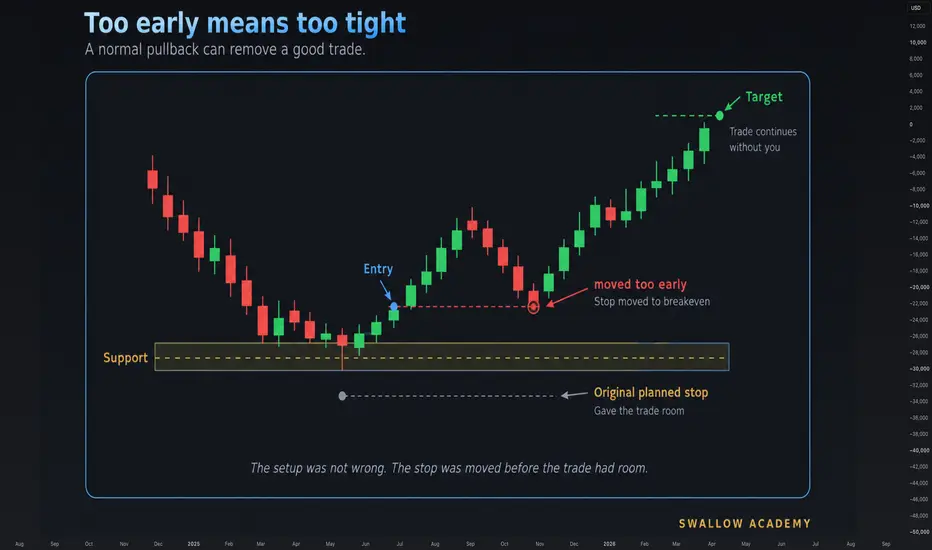
Breakeven feels safe. Moving it too early can still ruin a good trade.
🔵 Breakeven Feels Safer Than It Is
Moving a stop loss to breakeven feels smart because the trade can no longer lose on paper. Price moves a little in profit, the trader moves the stop to entry, and the mind relaxes.

The problem is that the market does not care that the trader wants comfort. A breakeven stop can be useful, but moving it too early can turn a good trade into a scratch before the setup has enough time to work. That is why breakeven should not be automatic. If the only reason for moving the stop is “I do not want this green trade to turn red,” the decision is emotional, not technical.
🔵 Too Early Means Too Tight
The most common mistake is moving to breakeven the moment price is slightly in profit. At that point, the trade may still be inside normal movement. Price can pull back to the entry, tap the stop, and then continue toward the original target without you.

This is not protection. It is often fear with a cleaner name. The trader wants the emotional relief of “I cannot lose now,” but the price may still need space to build the move. A stop should not move just because the trade is green. It should move because the trade has changed enough to justify a new risk point.
🔵 Move It When There Is A Reason
A better rule is to move the stop only after the market gives a real reason. That can be after price breaks and holds a key level, after a clean retest, after a new structure forms, or after partial profit has already been taken.
This is the difference between planned management and emotional management. Planned management says, “If price reaches this area and confirms, I can reduce risk.” Emotional management says, “I am slightly in profit and I want to feel safe.” At Swallow, moving the stop is not the problem. We also move stops when the trade gives the right reason. The mistake is moving it only for psychological safety while ignoring the structure of the trade.
🔵 Partials Make It Cleaner
Taking partial profit can make breakeven cleaner because some money is already secured. The rest of the position can then be managed with less pressure. But even then, the stop move should be part of the plan before entry, not a panic decision after seeing a small green number. For example, a trader may take partial profit at a planned area, then move the stop on the remaining position once price has reached a proper level. That is very different from moving to breakeven after a tiny push just to avoid feeling a loss.
Breakeven is useful when it supports the trade plan. It becomes harmful when it cuts the trade before the real target had a chance.
🔵 Ask Before You Move It
Before moving your stop, ask one simple question: am I moving it because the market gave me a reason, or because I want emotional comfort?

That question removes a lot of bad adjustments. It also keeps the trader honest. If the trade has not cleared a key level, has not formed new structure, and has not reached a planned partial area, there may be no reason to rush the stop. Sometimes the best move is leaving the stop where the original plan placed it.
🔵 Final Take
Moving your stop loss to breakeven can help, but only when it is part of the trade plan. Moving it too early does not make the setup better. It only makes the trader feel safer for a moment. Move the stop after proof, structure, or planned partials. Do not move it just because green feels better than risk.
Swallow Academy
🔵 Breakeven Feels Safer Than It Is
Moving a stop loss to breakeven feels smart because the trade can no longer lose on paper. Price moves a little in profit, the trader moves the stop to entry, and the mind relaxes.
The problem is that the market does not care that the trader wants comfort. A breakeven stop can be useful, but moving it too early can turn a good trade into a scratch before the setup has enough time to work. That is why breakeven should not be automatic. If the only reason for moving the stop is “I do not want this green trade to turn red,” the decision is emotional, not technical.
🔵 Too Early Means Too Tight
The most common mistake is moving to breakeven the moment price is slightly in profit. At that point, the trade may still be inside normal movement. Price can pull back to the entry, tap the stop, and then continue toward the original target without you.
This is not protection. It is often fear with a cleaner name. The trader wants the emotional relief of “I cannot lose now,” but the price may still need space to build the move. A stop should not move just because the trade is green. It should move because the trade has changed enough to justify a new risk point.
🔵 Move It When There Is A Reason
A better rule is to move the stop only after the market gives a real reason. That can be after price breaks and holds a key level, after a clean retest, after a new structure forms, or after partial profit has already been taken.
This is the difference between planned management and emotional management. Planned management says, “If price reaches this area and confirms, I can reduce risk.” Emotional management says, “I am slightly in profit and I want to feel safe.” At Swallow, moving the stop is not the problem. We also move stops when the trade gives the right reason. The mistake is moving it only for psychological safety while ignoring the structure of the trade.
🔵 Partials Make It Cleaner
Taking partial profit can make breakeven cleaner because some money is already secured. The rest of the position can then be managed with less pressure. But even then, the stop move should be part of the plan before entry, not a panic decision after seeing a small green number. For example, a trader may take partial profit at a planned area, then move the stop on the remaining position once price has reached a proper level. That is very different from moving to breakeven after a tiny push just to avoid feeling a loss.
Breakeven is useful when it supports the trade plan. It becomes harmful when it cuts the trade before the real target had a chance.
🔵 Ask Before You Move It
Before moving your stop, ask one simple question: am I moving it because the market gave me a reason, or because I want emotional comfort?
That question removes a lot of bad adjustments. It also keeps the trader honest. If the trade has not cleared a key level, has not formed new structure, and has not reached a planned partial area, there may be no reason to rush the stop. Sometimes the best move is leaving the stop where the original plan placed it.
🔵 Final Take
Moving your stop loss to breakeven can help, but only when it is part of the trade plan. Moving it too early does not make the setup better. It only makes the trader feel safer for a moment. Move the stop after proof, structure, or planned partials. Do not move it just because green feels better than risk.
Swallow Academy

🚨Years on charts build the habit of sensing psychological market direction. So far working :)
Telegram: t.me/+fiEDSn7M9pJkODA0
Telegram: t.me/+fiEDSn7M9pJkODA0
Declinazione di responsabilità
Le informazioni e le pubblicazioni non sono intese come, e non costituiscono, consulenza o raccomandazioni finanziarie, di investimento, di trading o di altro tipo fornite o approvate da TradingView. Per ulteriori informazioni, consultare i Termini di utilizzo.
🚨Years on charts build the habit of sensing psychological market direction. So far working :)
Telegram: t.me/+fiEDSn7M9pJkODA0
Telegram: t.me/+fiEDSn7M9pJkODA0
Declinazione di responsabilità
Le informazioni e le pubblicazioni non sono intese come, e non costituiscono, consulenza o raccomandazioni finanziarie, di investimento, di trading o di altro tipo fornite o approvate da TradingView. Per ulteriori informazioni, consultare i Termini di utilizzo.