
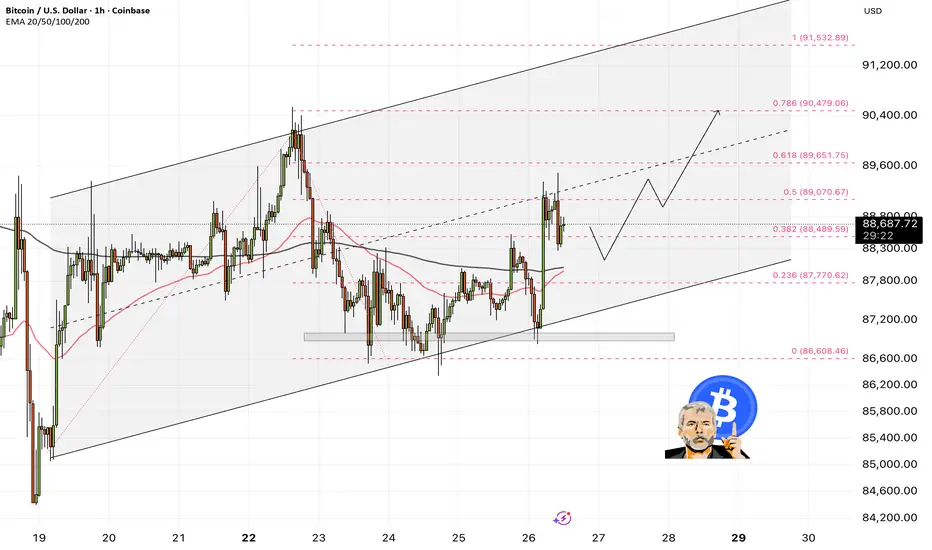
Bitcoin is above the EMA50 and EMA200 on the one-hour timeframe and is in its ascending channel. As long as Bitcoin is in this channel and above the support area, we can expect it to continue to rise and reach $91,000.
It should be noted that there is a possibility of heavy fluctuations and shadows due to the movement of whales in the market and compliance with capital management in the cryptocurrency market will be more important. If the downward trend continues, we can buy within the demand area.
It has now been **around eight months** since what became known as “Liberation Day”—the moment when the United States introduced a new wave of **trade tariffs on imports**, triggering widespread expectations of an immediate and sharp surge in inflation. Contrary to those fears, however, the inflation picture in the months that followed turned out to be far less alarming. Prices did rise, but **not to an extent that fundamentally altered the market’s dominant inflation narrative**.
As markets now look ahead to **2026**, the central question becomes: **how will the inflation story evolve from here?** Are we genuinely entering a new phase of sustained disinflation, or are we instead facing a **statistical mirage**—one that shows lower headline inflation rates without a meaningful reduction in the actual cost of living?
The key point is this: **tariffs do not have an immediate impact**. Higher import costs take months to move through supply chains, reach producers, pass on to retailers, and ultimately appear in consumer prices. For that reason, it is entirely possible that **even now, the full inflationary effects of tariffs have yet to be fully captured in official data**.
At present, the only area clearly showing signs of this pressure is **core goods inflation**, where prices of certain physical goods have been rising gradually. Even so, **overall inflation has remained much calmer than many observers feared at the beginning of the year**.
That said, this sense of calm may be misleading. What is likely to emerge next year may have less to do with **genuine disinflation** and more to do with **base effects in annual calculations**. Put simply, when prices jump once and then stabilize at a higher level, year-over-year inflation mechanically declines in the following year—even if prices themselves remain elevated and living costs do not actually fall.
Alongside these macroeconomic developments, multiple reports emerged over the past day from **Trust Wallet users**, indicating that balances in certain wallets were **drained without any apparent suspicious activity**. While the root cause has not yet been definitively identified, the timing—coinciding with the release of a **new Chrome extension update for Trust Wallet**—has drawn significant attention.
It has been confirmed that approximately **$7 million** was affected, and authorities have stated that **all impacted users will be reimbursed**. For users running **version 2.6.8 of the browser extension**, the following steps should be taken immediately:
**Step 1:** Do not open the Trust Wallet browser extension version 2.6.8 under any circumstances.
**Step 2:** Go to your browser’s extension settings and switch the extension from “on” to “off” if it is still enabled.
**Step 3:** Enable “Developer Mode” in the upper-right corner, then click “Update” in the upper-left corner.
**Step 4:** Verify the version number—**version 2.6.9** is the latest and most secure release.
It should be noted that there is a possibility of heavy fluctuations and shadows due to the movement of whales in the market and compliance with capital management in the cryptocurrency market will be more important. If the downward trend continues, we can buy within the demand area.
It has now been **around eight months** since what became known as “Liberation Day”—the moment when the United States introduced a new wave of **trade tariffs on imports**, triggering widespread expectations of an immediate and sharp surge in inflation. Contrary to those fears, however, the inflation picture in the months that followed turned out to be far less alarming. Prices did rise, but **not to an extent that fundamentally altered the market’s dominant inflation narrative**.
As markets now look ahead to **2026**, the central question becomes: **how will the inflation story evolve from here?** Are we genuinely entering a new phase of sustained disinflation, or are we instead facing a **statistical mirage**—one that shows lower headline inflation rates without a meaningful reduction in the actual cost of living?
The key point is this: **tariffs do not have an immediate impact**. Higher import costs take months to move through supply chains, reach producers, pass on to retailers, and ultimately appear in consumer prices. For that reason, it is entirely possible that **even now, the full inflationary effects of tariffs have yet to be fully captured in official data**.
At present, the only area clearly showing signs of this pressure is **core goods inflation**, where prices of certain physical goods have been rising gradually. Even so, **overall inflation has remained much calmer than many observers feared at the beginning of the year**.
That said, this sense of calm may be misleading. What is likely to emerge next year may have less to do with **genuine disinflation** and more to do with **base effects in annual calculations**. Put simply, when prices jump once and then stabilize at a higher level, year-over-year inflation mechanically declines in the following year—even if prices themselves remain elevated and living costs do not actually fall.
Alongside these macroeconomic developments, multiple reports emerged over the past day from **Trust Wallet users**, indicating that balances in certain wallets were **drained without any apparent suspicious activity**. While the root cause has not yet been definitively identified, the timing—coinciding with the release of a **new Chrome extension update for Trust Wallet**—has drawn significant attention.
It has been confirmed that approximately **$7 million** was affected, and authorities have stated that **all impacted users will be reimbursed**. For users running **version 2.6.8 of the browser extension**, the following steps should be taken immediately:
**Step 1:** Do not open the Trust Wallet browser extension version 2.6.8 under any circumstances.
**Step 2:** Go to your browser’s extension settings and switch the extension from “on” to “off” if it is still enabled.
**Step 3:** Enable “Developer Mode” in the upper-right corner, then click “Update” in the upper-left corner.
**Step 4:** Verify the version number—**version 2.6.9** is the latest and most secure release.

Declinazione di responsabilità
Le informazioni e le pubblicazioni non sono intese come, e non costituiscono, consulenza o raccomandazioni finanziarie, di investimento, di trading o di altro tipo fornite o approvate da TradingView. Per ulteriori informazioni, consultare i Termini di utilizzo.
Declinazione di responsabilità
Le informazioni e le pubblicazioni non sono intese come, e non costituiscono, consulenza o raccomandazioni finanziarie, di investimento, di trading o di altro tipo fornite o approvate da TradingView. Per ulteriori informazioni, consultare i Termini di utilizzo.