
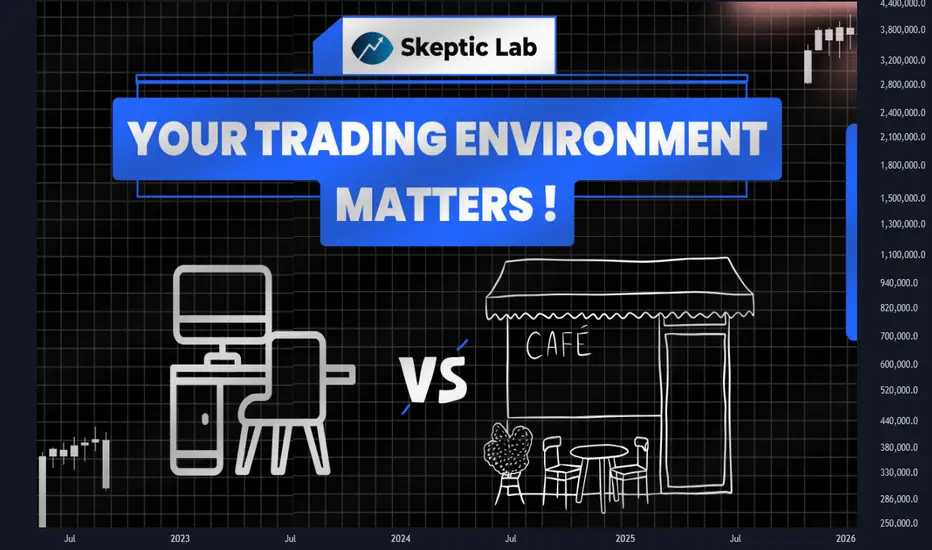
Where do you trade?
At a café?
At university?
Between tasks at work?
Or inside your own office?
Today I want to talk about something many traders underestimate — and end up hurting themselves, others, and their accounts because of it.
Let’s assume you trade in a café. 🍵
High or inappropriate background noise reduces focus, increases stress, and disrupts financial decision-making — especially in tasks that require precision, such as chart analysis or risk management.
Research shows that background noise negatively affects cognitive performance and alters risk perception (Payzan-LeNestour & Doran, 2021, Scientific Reports).
Now add a stop loss to that situation — which is completely normal.
You get frustrated.
Your mood shifts.
And that emotional state often spills over to the people around you.
Eventually, this can even lead to isolation — because most people around you don’t understand what a stop loss, drawdown, or trading emotion actually means.
Now imagine the opposite.
You trade in a space you fully control — your own office. 💻
No noise.
No distractions.
No emotional spillover to others.
Whether you hit a stop loss or a target, the emotional load stays contained.
Your awareness increases.
Your confidence improves.
And the overall quality of your trades goes up.
What do I do?
I only allow myself to trade at my personal workstation, inside my office, following my trading plan.
If I’m outside — at a café, a gathering, anywhere — and an alert goes off, I simply ignore it.
I don’t open trades.
There are rare exceptions, like managing a partial take profit at a predefined level — but nothing beyond that.
Believe it or not, this simple rule — controlling your trading environment — can improve both your win rate and trade quality.
That’s it.
By the way — I’m Skeptic, founder of Skeptic Lab.
I focus on long-term performance through psychology, data-driven thinking, and tested processes.
If this was useful, feel free to support it 🩵
At a café?
At university?
Between tasks at work?
Or inside your own office?
Today I want to talk about something many traders underestimate — and end up hurting themselves, others, and their accounts because of it.
Let’s assume you trade in a café. 🍵
High or inappropriate background noise reduces focus, increases stress, and disrupts financial decision-making — especially in tasks that require precision, such as chart analysis or risk management.
Research shows that background noise negatively affects cognitive performance and alters risk perception (Payzan-LeNestour & Doran, 2021, Scientific Reports).
Now add a stop loss to that situation — which is completely normal.
You get frustrated.
Your mood shifts.
And that emotional state often spills over to the people around you.
Eventually, this can even lead to isolation — because most people around you don’t understand what a stop loss, drawdown, or trading emotion actually means.
Now imagine the opposite.
You trade in a space you fully control — your own office. 💻
No noise.
No distractions.
No emotional spillover to others.
Whether you hit a stop loss or a target, the emotional load stays contained.
Your awareness increases.
Your confidence improves.
And the overall quality of your trades goes up.
What do I do?
I only allow myself to trade at my personal workstation, inside my office, following my trading plan.
If I’m outside — at a café, a gathering, anywhere — and an alert goes off, I simply ignore it.
I don’t open trades.
There are rare exceptions, like managing a partial take profit at a predefined level — but nothing beyond that.
Believe it or not, this simple rule — controlling your trading environment — can improve both your win rate and trade quality.
That’s it.
By the way — I’m Skeptic, founder of Skeptic Lab.
I focus on long-term performance through psychology, data-driven thinking, and tested processes.
If this was useful, feel free to support it 🩵

Pubblicazioni correlate
Declinazione di responsabilità
Le informazioni e le pubblicazioni non sono intese come, e non costituiscono, consulenza o raccomandazioni finanziarie, di investimento, di trading o di altro tipo fornite o approvate da TradingView. Per ulteriori informazioni, consultare i Termini di utilizzo.
Pubblicazioni correlate
Declinazione di responsabilità
Le informazioni e le pubblicazioni non sono intese come, e non costituiscono, consulenza o raccomandazioni finanziarie, di investimento, di trading o di altro tipo fornite o approvate da TradingView. Per ulteriori informazioni, consultare i Termini di utilizzo.