
What Are Order Blocks and Why They Matter — Complete SMC Guide
Most BTC traders have heard the term "Order Block." Few actually understand what it is, how it forms, and why price reacts at those zones. This guide exists to change that.
What is an Order Block?
An Order Block is the last candle (or group of candles) of consolidation before an impulsive move that generates a Break of Structure. It is not just any box drawn on the chart. It is a specific zone where institutional activity left a structural footprint — unfilled orders, pending liquidity, an imbalance that the market needs to revisit.
At the fund where I worked on the algorithmic execution side, we did not use the term "Order Block." We called it an order accumulation zone or pending liquidity cluster. But the concept is identical: identify where large participants left open positions that the market will eventually need to fill.
How does a valid Order Block form?
Not all Order Blocks deserve your attention. A valid OB requires three things:
1) Displacement: After the consolidation, there must be an impulsive move — large-bodied candles with little to no wick. That indicates institutional urgency, not retail noise.
2) Break of Structure (BOS): That impulsive move must break a prior swing high or swing low. Without a BOS, there is no confirmation of structural change. And without structural change, your "Order Block" is just a box on the chart.
3) Imbalance / Fair Value Gap: The move out of the OB frequently leaves an FVG — a three-candle gap where price moved so fast that there were no transactions in both directions. That gap acts as a magnet: price tends to return to fill it.
Why does it work?
The market is an auction mechanism. Its job is to facilitate transactions at the most efficient price. When an impulsive move leaves unfilled orders (the OB) and a liquidity void (the FVG), the market has a structural reason to return. It is not magic. It is not conspiracy. It is market mechanics.
Mark Douglas wrote that an edge is nothing more than an indication of a higher probability that one thing will happen over another. That is exactly what a valid Order Block offers: not a certainty, but an elevated probability based on structure, not opinion.
Example on BTC 4H:
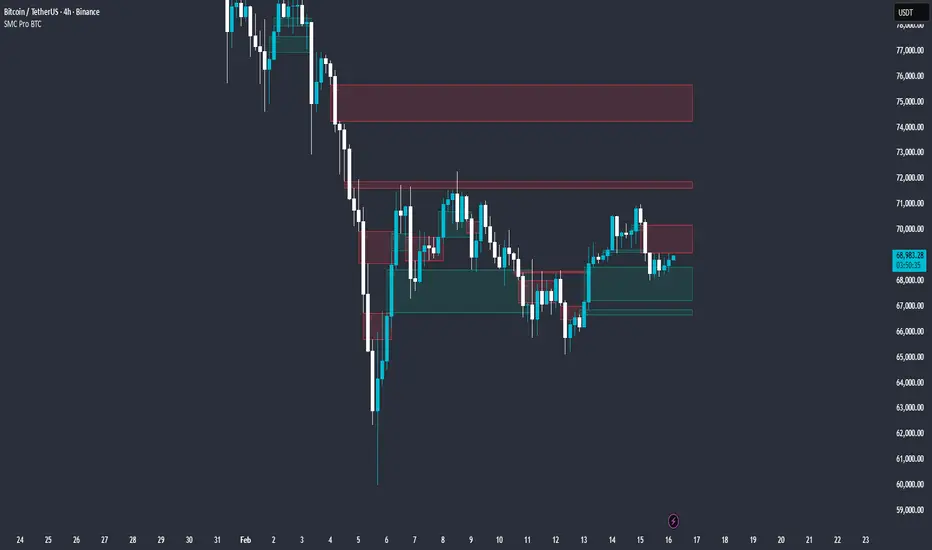
Look at the chart. On February 8, BTC rallied to $72,271 — the local swing high after bouncing from the $60,000 zone. There was consolidation between $70,000 and $72,271 on February 8-9. That last consolidation before the impulsive move down is the supply-side Order Block.
The displacement followed immediately: from February 9 through February 12, price dropped over $7,000 in large-bodied bearish candles with minimal wicks. The move broke below the prior swing low, confirming a bearish BOS. Along the way, it left multiple Fair Value Gaps — three-candle imbalances where price moved too fast for bidirectional exchange.
The swing low was printed on February 12 at $65,118. Price has since recovered to $68,636 — still below the equilibrium at $68,695. If price continues higher and enters that supply OB zone near $70,000-$72,271, watch for a reaction. Not a certainty — a probability. The structure is either respected or it is not. That is the discipline this approach requires.
How I use this in my trading:
The SMC Pro DOE indicator detects these setups automatically. It scans OB formation, validates the BOS, maps FVGs, and marks confluence on the chart without subjective interpretation. It has two modes:
1) Aggressive Mode: Enters when price reaches a valid OB. More trades, 49% win rate, but with favorable risk-reward that generates +49% net P&L in backtesting (with commissions).
2) Selective Mode: Requires OB + FVG + additional confirmation. Fewer trades, 62% win rate, profit factor of 2.35.
Both modes are backtested on BTC 4H from January 2023 through February 2026. With 0.075% commission per trade. No repainting. The numbers are on the script page.
Conclusion:
Order Blocks are not magic lines. They are high-probability zones based on market structure. Learning to identify them correctly — with displacement, BOS, and FVG confluence — is what separates structural analysis from subjective chart art.
If you want to see how the indicator identifies these setups in real time, it is available for free on my profile.
Disclaimer: This is not financial advice. Past performance does not guarantee future results. Always trade with proper risk management.
Tags: orderblocks, smartmoney, SMC, education, tutorial, BTC, Bitcoin, FVG, liquidity, priceaction, ICT, marketstructure, institutionaltrading, BOS, trendanalysis
Most BTC traders have heard the term "Order Block." Few actually understand what it is, how it forms, and why price reacts at those zones. This guide exists to change that.
What is an Order Block?
An Order Block is the last candle (or group of candles) of consolidation before an impulsive move that generates a Break of Structure. It is not just any box drawn on the chart. It is a specific zone where institutional activity left a structural footprint — unfilled orders, pending liquidity, an imbalance that the market needs to revisit.
At the fund where I worked on the algorithmic execution side, we did not use the term "Order Block." We called it an order accumulation zone or pending liquidity cluster. But the concept is identical: identify where large participants left open positions that the market will eventually need to fill.
How does a valid Order Block form?
Not all Order Blocks deserve your attention. A valid OB requires three things:
1) Displacement: After the consolidation, there must be an impulsive move — large-bodied candles with little to no wick. That indicates institutional urgency, not retail noise.
2) Break of Structure (BOS): That impulsive move must break a prior swing high or swing low. Without a BOS, there is no confirmation of structural change. And without structural change, your "Order Block" is just a box on the chart.
3) Imbalance / Fair Value Gap: The move out of the OB frequently leaves an FVG — a three-candle gap where price moved so fast that there were no transactions in both directions. That gap acts as a magnet: price tends to return to fill it.
Why does it work?
The market is an auction mechanism. Its job is to facilitate transactions at the most efficient price. When an impulsive move leaves unfilled orders (the OB) and a liquidity void (the FVG), the market has a structural reason to return. It is not magic. It is not conspiracy. It is market mechanics.
Mark Douglas wrote that an edge is nothing more than an indication of a higher probability that one thing will happen over another. That is exactly what a valid Order Block offers: not a certainty, but an elevated probability based on structure, not opinion.
Example on BTC 4H:
Look at the chart. On February 8, BTC rallied to $72,271 — the local swing high after bouncing from the $60,000 zone. There was consolidation between $70,000 and $72,271 on February 8-9. That last consolidation before the impulsive move down is the supply-side Order Block.
The displacement followed immediately: from February 9 through February 12, price dropped over $7,000 in large-bodied bearish candles with minimal wicks. The move broke below the prior swing low, confirming a bearish BOS. Along the way, it left multiple Fair Value Gaps — three-candle imbalances where price moved too fast for bidirectional exchange.
The swing low was printed on February 12 at $65,118. Price has since recovered to $68,636 — still below the equilibrium at $68,695. If price continues higher and enters that supply OB zone near $70,000-$72,271, watch for a reaction. Not a certainty — a probability. The structure is either respected or it is not. That is the discipline this approach requires.
How I use this in my trading:
The SMC Pro DOE indicator detects these setups automatically. It scans OB formation, validates the BOS, maps FVGs, and marks confluence on the chart without subjective interpretation. It has two modes:
1) Aggressive Mode: Enters when price reaches a valid OB. More trades, 49% win rate, but with favorable risk-reward that generates +49% net P&L in backtesting (with commissions).
2) Selective Mode: Requires OB + FVG + additional confirmation. Fewer trades, 62% win rate, profit factor of 2.35.
Both modes are backtested on BTC 4H from January 2023 through February 2026. With 0.075% commission per trade. No repainting. The numbers are on the script page.
Conclusion:
Order Blocks are not magic lines. They are high-probability zones based on market structure. Learning to identify them correctly — with displacement, BOS, and FVG confluence — is what separates structural analysis from subjective chart art.
If you want to see how the indicator identifies these setups in real time, it is available for free on my profile.
Disclaimer: This is not financial advice. Past performance does not guarantee future results. Always trade with proper risk management.
Tags: orderblocks, smartmoney, SMC, education, tutorial, BTC, Bitcoin, FVG, liquidity, priceaction, ICT, marketstructure, institutionaltrading, BOS, trendanalysis

Declinazione di responsabilità
Le informazioni e le pubblicazioni non sono intese come, e non costituiscono, consulenza o raccomandazioni finanziarie, di investimento, di trading o di altro tipo fornite o approvate da TradingView. Per ulteriori informazioni, consultare i Termini di utilizzo.
Declinazione di responsabilità
Le informazioni e le pubblicazioni non sono intese come, e non costituiscono, consulenza o raccomandazioni finanziarie, di investimento, di trading o di altro tipo fornite o approvate da TradingView. Per ulteriori informazioni, consultare i Termini di utilizzo.