
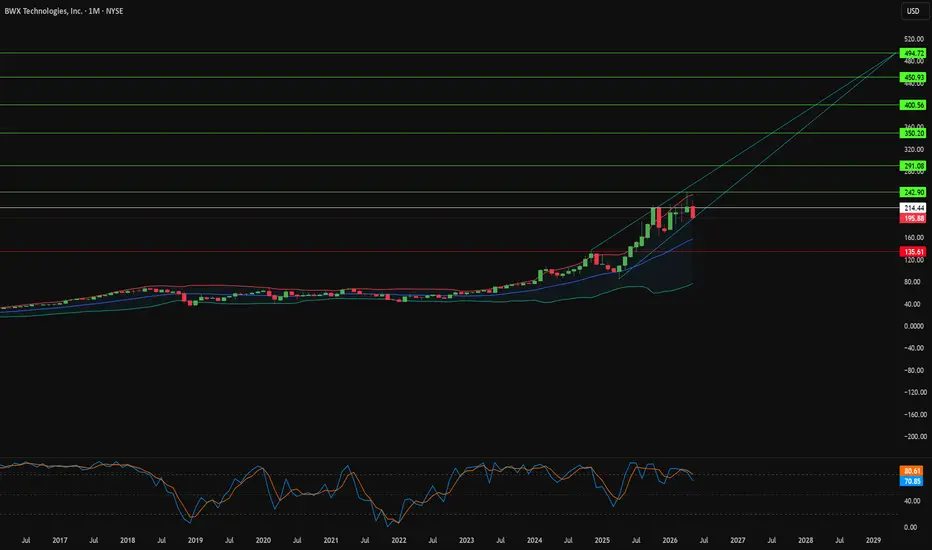
BWX Technologies (NYSE: BWXT) opened 2026 with momentum that few defense-and-nuclear suppliers can match. First-quarter consolidated revenue climbed 26% year-over-year to $860.2 million, GAAP net income rose 21% to $91.2 million, and adjusted EBITDA reached $148 million, all underpinned by a commanding order backlog of $8.65 billion. Management responded by lifting full-year guidance to above $3.75 billion in revenue, $650–665 million in adjusted EBITDA, and $315–330 million in free cash flow. The catch lies in the price: shares trade at a 52.1x P/E versus an industry average of 40.2x, with some analysts pegging the stock 57.2% above fair value and flagging a steep 157.6% debt-to-equity ratio. The premium leaves essentially no cushion if execution slips.
The backlog rests on geopolitics. Indo-Pacific competition is fueling a defense-spending supercycle, and as the sole-source manufacturer of naval reactors for the U.S. Navy, BWXT sits at the center of it, supplying propulsion systems for Virginia-class and Columbia-class submarines. In May 2026, the company captured over $1.4 billion in naval awards, including a $1.285 billion base contract for fiscal 2026 material procurement (the first of five annual awards through 2030) and a $165 million carrier-component contract. The AUKUS pact extends this demand internationally, with Australia recently authorizing a $218 million payment for UK-sourced long-lead reactor items, reinforcing the broader Western defense supply chain.
Beyond the seas, BWXT is reaching into space and next-generation energy. It partners with Lockheed Martin on the $499 million DRACO nuclear-thermal rocket targeting a 2027 launch and far shorter transits to Mars and supports the AFRL JETSON program, where reactor-driven Stirling engines could deliver four times the power of conventional solar arrays. On the commercial side, the company is helping rebuild a domestic HALEU supply chain (currently dominated by Russia and China) through an NNSA downblending contract, while advancing TRISO-fueled microreactors such as the 75 MWt BANR. A deep patent portfolio in additive manufacturing of nuclear fuel and fail-safe reactivity control further cements its technological moat, though tightening CMMC 2.0 cybersecurity mandates and False Claims Act exposure add compliance pressure.
Tying the threads together, BWXT's roughly $200 million acquisition of Precision Components Group, adding 500,000 square feet of capacity and 400+ skilled workers, aims to relieve manufacturing bottlenecks and scale commercial operations toward SMRs and fuel expansion. The strategic picture is compelling: a near-monopoly franchise riding defense, space, and clean-energy tailwinds. Yet the investment case hinges on a single tension: whether massive backlogs and successful PCG integration can grow into a valuation that already assumes near-flawless delivery, against the drag of heavy leverage. The answer to "what powers the risk" is the very thing that powers the upside.
The backlog rests on geopolitics. Indo-Pacific competition is fueling a defense-spending supercycle, and as the sole-source manufacturer of naval reactors for the U.S. Navy, BWXT sits at the center of it, supplying propulsion systems for Virginia-class and Columbia-class submarines. In May 2026, the company captured over $1.4 billion in naval awards, including a $1.285 billion base contract for fiscal 2026 material procurement (the first of five annual awards through 2030) and a $165 million carrier-component contract. The AUKUS pact extends this demand internationally, with Australia recently authorizing a $218 million payment for UK-sourced long-lead reactor items, reinforcing the broader Western defense supply chain.
Beyond the seas, BWXT is reaching into space and next-generation energy. It partners with Lockheed Martin on the $499 million DRACO nuclear-thermal rocket targeting a 2027 launch and far shorter transits to Mars and supports the AFRL JETSON program, where reactor-driven Stirling engines could deliver four times the power of conventional solar arrays. On the commercial side, the company is helping rebuild a domestic HALEU supply chain (currently dominated by Russia and China) through an NNSA downblending contract, while advancing TRISO-fueled microreactors such as the 75 MWt BANR. A deep patent portfolio in additive manufacturing of nuclear fuel and fail-safe reactivity control further cements its technological moat, though tightening CMMC 2.0 cybersecurity mandates and False Claims Act exposure add compliance pressure.
Tying the threads together, BWXT's roughly $200 million acquisition of Precision Components Group, adding 500,000 square feet of capacity and 400+ skilled workers, aims to relieve manufacturing bottlenecks and scale commercial operations toward SMRs and fuel expansion. The strategic picture is compelling: a near-monopoly franchise riding defense, space, and clean-energy tailwinds. Yet the investment case hinges on a single tension: whether massive backlogs and successful PCG integration can grow into a valuation that already assumes near-flawless delivery, against the drag of heavy leverage. The answer to "what powers the risk" is the very thing that powers the upside.

Connecting the dots to Decode the Invisible. This post is a summary. To understand the rigged game, you need the evidence. Access the Full Analysis + Raw Sources (Lab Reports, Patents, Academic Research & Cyber Intel). See the reality here ➜ udisview.com
Declinazione di responsabilità
Le informazioni e le pubblicazioni non sono intese come, e non costituiscono, consulenza o raccomandazioni finanziarie, di investimento, di trading o di altro tipo fornite o approvate da TradingView. Per ulteriori informazioni, consultare i Termini di utilizzo.
Connecting the dots to Decode the Invisible. This post is a summary. To understand the rigged game, you need the evidence. Access the Full Analysis + Raw Sources (Lab Reports, Patents, Academic Research & Cyber Intel). See the reality here ➜ udisview.com
Declinazione di responsabilità
Le informazioni e le pubblicazioni non sono intese come, e non costituiscono, consulenza o raccomandazioni finanziarie, di investimento, di trading o di altro tipo fornite o approvate da TradingView. Per ulteriori informazioni, consultare i Termini di utilizzo.