
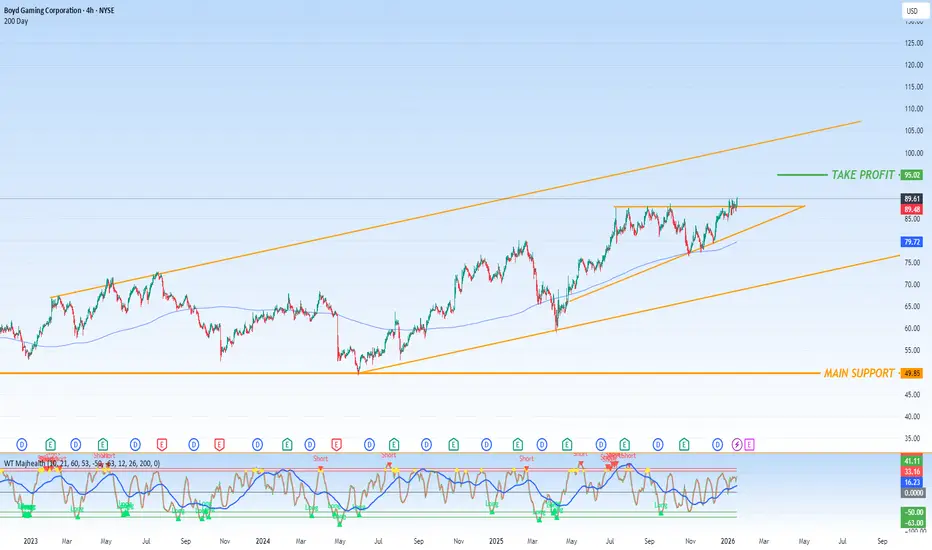
While the broader equity market has demonstrated robust performance over the recent half-year period, not all constituent stocks are poised to sustain this momentum or deliver attractive future returns. Boyd Gaming Corporation (BYD), despite moving in concert with the prevailing market trend, presents a case for potential underperformance relative to both the index and higher-quality alternatives within the consumer discretionary sector. A closer examination of its fundamental financial health reveals several concerning trends that undermine confidence in its long-term investment appeal.
1. Lackluster Long-Term Revenue Trajectory
A company's sustained ability to grow its top line is a primary indicator of its competitive positioning, market relevance, and operational execution. While Boyd Gaming has achieved revenue growth over a multi-year horizon, the quality and pace of this expansion are questionable. Over the past five years, the company has grown sales at an annualized rate of 11.4%. Although this figure appears reasonable in isolation, it falls short when contextualized within the dynamic consumer discretionary sector. This sector benefits from powerful secular tailwinds, including evolving consumer spending habits and experiential demand, against which Boyd's growth appears merely adequate rather than exceptional. This suggests the company may be capturing general market expansion rather than demonstrably gaining share or out-executing its peers—a critical distinction for a long-term quality investment.
2. Constrained Financial Flexibility Due to Mediocre Cash Generation
True financial strength and shareholder return potential are best measured by free cash flow (FCF). This metric, representing the cash a company generates after accounting for all operational costs and necessary capital expenditures, is notoriously difficult to manipulate and is essential for funding dividends, share buybacks, debt reduction, and reinvestment. Boyd Gaming's performance on this front has been persistently weak. Its average free cash flow margin over the last two years stands at a modest 11.9%. For a business in the consumer discretionary space—where stronger operators often convert a much higher percentage of revenue into cash—this level is subpar. A lousy cash conversion profile directly limits management's strategic optionality, constraining its ability to reward shareholders meaningfully or invest aggressively in future growth initiatives without resorting to additional leverage or equity dilution.
3. Deteriorating Capital Efficiency Signals Few Profitable Growth Avenues
Perhaps the most telling metric of a company's strategic health is its Return on Invested Capital (ROIC). ROIC measures how effectively a company generates profits from the capital it has deployed (both equity and debt). While a high absolute ROIC is desirable, the trend in ROIC is often what truly moves stock prices, as it indicates whether new investments are creating or destroying value. For Boyd Gaming, the trend is unfavorable. The company has experienced a decline in its ROIC over recent years. When this declining trend is coupled with an already lackluster level of returns, it paints a concerning picture: the business appears to be facing diminishing marginal returns on its investments. This implies that its most profitable growth opportunities may be largely exhausted, and new capital expenditures or acquisitions are failing to generate value at historical rates, threatening future earnings quality.
Final Assessment: Fair Valuation Does Not Offset Fundamental Weaknesses
Synthesizing these factors, Boyd Gaming fails to meet the criteria for a high-quality business with a durable competitive advantage. Its growth is underwhelming within its sector, its cash generation is weak, and its capital efficiency is deteriorating. While the stock currently trades at a seemingly reasonable valuation of approximately 11.7x forward earnings (or $87.72 per share), a "fair" price for a company with challenged fundamentals does not equate to an attractive investment opportunity. The risk/reward profile appears skewed; the limited upside potential, given the growth and profitability constraints, does not adequately compensate for the downside risk should these negative trends persist or the macroeconomic environment for discretionary spending soften.
Technical Context for Traders
For market participants monitoring price action, the technical landscape provides defined levels. The stock identifies a major support zone at the $50.00 level, which would represent a significant retracement and a critical test of long-term buyer conviction. On the upside, a take-profit target is situated near $95.00, which would require a meaningful breakout from the current trading range and a reversal of the bearish fundamental narrative.
In conclusion, while Boyd Gaming has ridden the market's wave higher, its underlying fundamentals suggest it is not built to sustainably outperform. Investors may find superior risk-adjusted returns by seeking opportunities in companies within the same sector that demonstrate stronger revenue growth, robust free cash flow generation, and an expanding—or at least stable—return on invested capital.
1. Lackluster Long-Term Revenue Trajectory
A company's sustained ability to grow its top line is a primary indicator of its competitive positioning, market relevance, and operational execution. While Boyd Gaming has achieved revenue growth over a multi-year horizon, the quality and pace of this expansion are questionable. Over the past five years, the company has grown sales at an annualized rate of 11.4%. Although this figure appears reasonable in isolation, it falls short when contextualized within the dynamic consumer discretionary sector. This sector benefits from powerful secular tailwinds, including evolving consumer spending habits and experiential demand, against which Boyd's growth appears merely adequate rather than exceptional. This suggests the company may be capturing general market expansion rather than demonstrably gaining share or out-executing its peers—a critical distinction for a long-term quality investment.
2. Constrained Financial Flexibility Due to Mediocre Cash Generation
True financial strength and shareholder return potential are best measured by free cash flow (FCF). This metric, representing the cash a company generates after accounting for all operational costs and necessary capital expenditures, is notoriously difficult to manipulate and is essential for funding dividends, share buybacks, debt reduction, and reinvestment. Boyd Gaming's performance on this front has been persistently weak. Its average free cash flow margin over the last two years stands at a modest 11.9%. For a business in the consumer discretionary space—where stronger operators often convert a much higher percentage of revenue into cash—this level is subpar. A lousy cash conversion profile directly limits management's strategic optionality, constraining its ability to reward shareholders meaningfully or invest aggressively in future growth initiatives without resorting to additional leverage or equity dilution.
3. Deteriorating Capital Efficiency Signals Few Profitable Growth Avenues
Perhaps the most telling metric of a company's strategic health is its Return on Invested Capital (ROIC). ROIC measures how effectively a company generates profits from the capital it has deployed (both equity and debt). While a high absolute ROIC is desirable, the trend in ROIC is often what truly moves stock prices, as it indicates whether new investments are creating or destroying value. For Boyd Gaming, the trend is unfavorable. The company has experienced a decline in its ROIC over recent years. When this declining trend is coupled with an already lackluster level of returns, it paints a concerning picture: the business appears to be facing diminishing marginal returns on its investments. This implies that its most profitable growth opportunities may be largely exhausted, and new capital expenditures or acquisitions are failing to generate value at historical rates, threatening future earnings quality.
Final Assessment: Fair Valuation Does Not Offset Fundamental Weaknesses
Synthesizing these factors, Boyd Gaming fails to meet the criteria for a high-quality business with a durable competitive advantage. Its growth is underwhelming within its sector, its cash generation is weak, and its capital efficiency is deteriorating. While the stock currently trades at a seemingly reasonable valuation of approximately 11.7x forward earnings (or $87.72 per share), a "fair" price for a company with challenged fundamentals does not equate to an attractive investment opportunity. The risk/reward profile appears skewed; the limited upside potential, given the growth and profitability constraints, does not adequately compensate for the downside risk should these negative trends persist or the macroeconomic environment for discretionary spending soften.
Technical Context for Traders
For market participants monitoring price action, the technical landscape provides defined levels. The stock identifies a major support zone at the $50.00 level, which would represent a significant retracement and a critical test of long-term buyer conviction. On the upside, a take-profit target is situated near $95.00, which would require a meaningful breakout from the current trading range and a reversal of the bearish fundamental narrative.
In conclusion, while Boyd Gaming has ridden the market's wave higher, its underlying fundamentals suggest it is not built to sustainably outperform. Investors may find superior risk-adjusted returns by seeking opportunities in companies within the same sector that demonstrate stronger revenue growth, robust free cash flow generation, and an expanding—or at least stable—return on invested capital.

Declinazione di responsabilità
Le informazioni e le pubblicazioni non sono intese come, e non costituiscono, consulenza o raccomandazioni finanziarie, di investimento, di trading o di altro tipo fornite o approvate da TradingView. Per ulteriori informazioni, consultare i Termini di utilizzo.
Declinazione di responsabilità
Le informazioni e le pubblicazioni non sono intese come, e non costituiscono, consulenza o raccomandazioni finanziarie, di investimento, di trading o di altro tipo fornite o approvate da TradingView. Per ulteriori informazioni, consultare i Termini di utilizzo.