
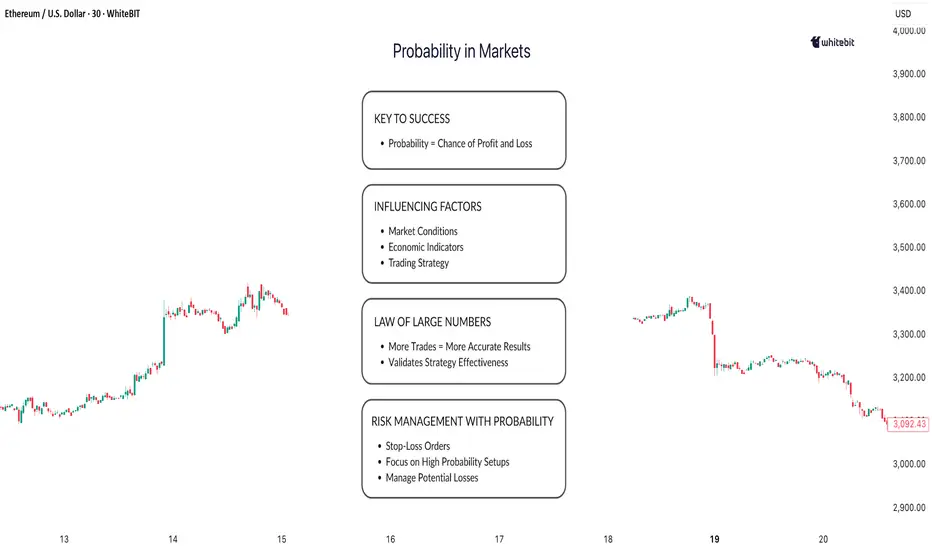
Wassup traders! 🔥
Ever thought trading was all about making the right calls? Well, let us hit you with a truth bomb — it's not about getting it right every time. It's about managing your edge and playing the odds. Trading is a probability game, and if you're not thinking in terms of probabilities, you're doing it wrong.
⚡Embracing Market Uncertainty
Let’s face it: the market is unpredictable. No matter how much you analyze, you can't fully predict what's coming next. Market uncertainty is real, and that’s exactly what makes trading interesting — and risky. The market isn't going to follow any pre-set rules, and that’s why we call it non-deterministic. It’s random, and if you're not comfortable with that, you're in the wrong game.
🕵️♂️ Understanding the Odds: Randomness in Trading
Simple truth — randomness in trading means you can’t guarantee a win. The good part? You don’t have to. What matters is that you’re stacking the odds in your favor. Probabilistic systems are just a way to describe how markets behave — uncertain, variable, and spread across different outcomes.
📊 Expected Value: A Useful Way to Frame Outcomes
Expected value describes the average result across a series of outcomes rather than the result of a single trade. It’s a statistical concept used to explain how gains and losses distribute over time, not a promise of performance or a guarantee of success. The idea isn’t about constant wins, but about how outcomes balance out across many observations. A helpful analogy is probability theory itself: even when a higher-probability outcome exists, individual results can still vary, and short-term deviations are part of the process.
🪤 Risk and Uncertainty: They’re Always There
In trading, there’s no such thing as no risk. Risk and uncertainty are just part of the game. But that doesn’t mean you can’t take control. The trick is to manage your statistical edge. By analyzing past patterns, using data, and looking at the bigger picture, you can make trades that improve your chances of success. It’s all about getting smarter with your decisions, even when the market feels like chaos.
🧠 Making Smart Decisions Under Uncertainty
The real skill in trading? Decision-making under uncertainty. You can't get rid of the uncertainty — that’s a given. But you can make better choices by using the odds to your advantage. The key is to not freak out over a loss or get too confident after a win. It's about understanding that every trade is a part of a bigger, ongoing strategy.
🧭 Final Thought
So, next time you’re ready to make a trade, remember: it’s not about being right every time. It’s about making your own decisions based on probability in markets and understanding that each trade is part of the bigger picture. Nothing here is a recommendation, signal, or financial advice — you’re on your own with every click you make. The more you manage your edge and stay disciplined with the numbers, the less power uncertainty has over your decisions. Markets thrive on ambiguity, and that’s exactly what creates hesitation. That’s why DYOR isn’t optional — it’s survival. Stay sharp, stay skeptical, and stay safe in this ocean of probabilities.
This material is for informational purposes only and does not constitute trading or investment advice.
Ever thought trading was all about making the right calls? Well, let us hit you with a truth bomb — it's not about getting it right every time. It's about managing your edge and playing the odds. Trading is a probability game, and if you're not thinking in terms of probabilities, you're doing it wrong.
⚡Embracing Market Uncertainty
Let’s face it: the market is unpredictable. No matter how much you analyze, you can't fully predict what's coming next. Market uncertainty is real, and that’s exactly what makes trading interesting — and risky. The market isn't going to follow any pre-set rules, and that’s why we call it non-deterministic. It’s random, and if you're not comfortable with that, you're in the wrong game.
🕵️♂️ Understanding the Odds: Randomness in Trading
Simple truth — randomness in trading means you can’t guarantee a win. The good part? You don’t have to. What matters is that you’re stacking the odds in your favor. Probabilistic systems are just a way to describe how markets behave — uncertain, variable, and spread across different outcomes.
📊 Expected Value: A Useful Way to Frame Outcomes
Expected value describes the average result across a series of outcomes rather than the result of a single trade. It’s a statistical concept used to explain how gains and losses distribute over time, not a promise of performance or a guarantee of success. The idea isn’t about constant wins, but about how outcomes balance out across many observations. A helpful analogy is probability theory itself: even when a higher-probability outcome exists, individual results can still vary, and short-term deviations are part of the process.
🪤 Risk and Uncertainty: They’re Always There
In trading, there’s no such thing as no risk. Risk and uncertainty are just part of the game. But that doesn’t mean you can’t take control. The trick is to manage your statistical edge. By analyzing past patterns, using data, and looking at the bigger picture, you can make trades that improve your chances of success. It’s all about getting smarter with your decisions, even when the market feels like chaos.
🧠 Making Smart Decisions Under Uncertainty
The real skill in trading? Decision-making under uncertainty. You can't get rid of the uncertainty — that’s a given. But you can make better choices by using the odds to your advantage. The key is to not freak out over a loss or get too confident after a win. It's about understanding that every trade is a part of a bigger, ongoing strategy.
🧭 Final Thought
So, next time you’re ready to make a trade, remember: it’s not about being right every time. It’s about making your own decisions based on probability in markets and understanding that each trade is part of the bigger picture. Nothing here is a recommendation, signal, or financial advice — you’re on your own with every click you make. The more you manage your edge and stay disciplined with the numbers, the less power uncertainty has over your decisions. Markets thrive on ambiguity, and that’s exactly what creates hesitation. That’s why DYOR isn’t optional — it’s survival. Stay sharp, stay skeptical, and stay safe in this ocean of probabilities.
This material is for informational purposes only and does not constitute trading or investment advice.

Rate us & share your experience.
Thanks for being part of our community 🚀
👉 Leave your review here: tradingview.com/broker/WhiteBIT/reviews/
Thanks for being part of our community 🚀
👉 Leave your review here: tradingview.com/broker/WhiteBIT/reviews/
Declinazione di responsabilità
Le informazioni e le pubblicazioni non sono intese come, e non costituiscono, consulenza o raccomandazioni finanziarie, di investimento, di trading o di altro tipo fornite o approvate da TradingView. Per ulteriori informazioni, consultare i Termini di utilizzo.
Rate us & share your experience.
Thanks for being part of our community 🚀
👉 Leave your review here: tradingview.com/broker/WhiteBIT/reviews/
Thanks for being part of our community 🚀
👉 Leave your review here: tradingview.com/broker/WhiteBIT/reviews/
Declinazione di responsabilità
Le informazioni e le pubblicazioni non sono intese come, e non costituiscono, consulenza o raccomandazioni finanziarie, di investimento, di trading o di altro tipo fornite o approvate da TradingView. Per ulteriori informazioni, consultare i Termini di utilizzo.