
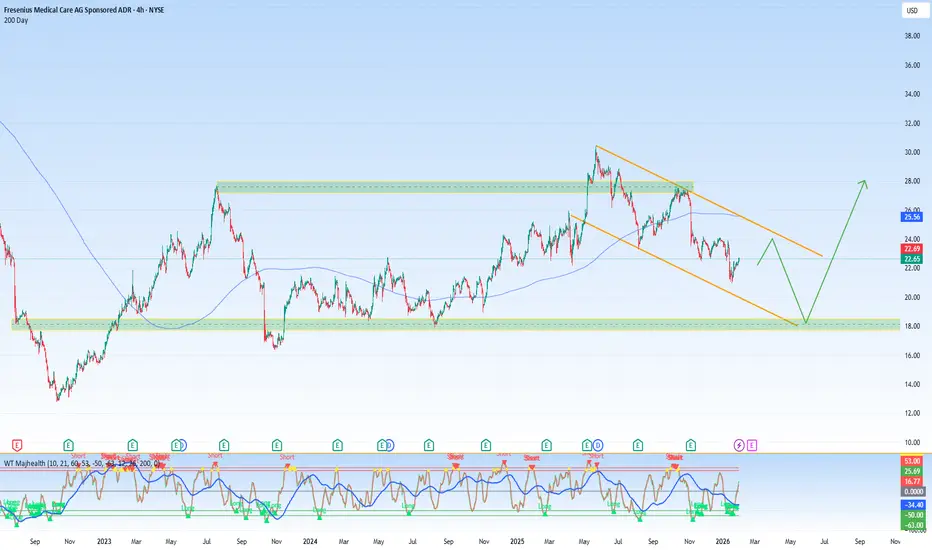
Synthesized Investment Thesis for Fresenius Medical Care (FMS): A High-Conviction Value Play with Executed Turnover
Fresenius Medical Care (FMS) presents a compelling case as a deep-value, contrarian investment for the long-term investor. The thesis hinges on its irreplaceable market position in a non-discretionary healthcare sector, a clear and financially quantified multi-year transformation plan, and a valuation that appears to price in perpetual distress. However, this opportunity is not without substantial risk, requiring investors to have a strong stomach for volatility and a firm belief in management's execution capabilities.
Part 1: The Foundation of Value – A Defensive Business at a Discounted Price
Non-Discretionary Demand & Global Scale: As the world's leading integrated dialysis provider, FMS operates in a sector underpinned by chronic, life-sustaining care. With over 308,000 patients across 3,624 clinics globally, the company benefits from recurring, predictable revenue streams that are largely insulated from economic cycles. This provides a defensive bedrock often sought during market uncertainty, as evidenced by its +13.3% YTD performance against steep market declines.
Exceptionally Attractive Valuation Metrics: The primary driver of the value thesis is FMS's valuation, which trades at a forward P/E of ~9x. This is a significant discount to both the broader market and many healthcare peers, suggesting the market is pricing in continued stagnation or decline. Coupled with a Zacks Value Style Score of 'A', this creates a classic "Graham-and-Dodd" value screen scenario where the price appears disconnected from the intrinsic value of the underlying cash-generative assets.
Part 2: The Growth & Transformation Catalysts – More Than Just a Static Asset
Beyond a cheap stock, FMS is actively engineering a corporate turnaround and pursuing strategic growth.
The FME25 Transformation Program: A Path to Profitability: This is the centerpiece of management's strategy. The program aims to deliver €1.05 billion in annualized savings by the end of 2027, with €180 million targeted for 2025 alone. The Q2 2025 update (€58 million in new savings) demonstrates the plan is on track. Successful execution is critical to offsetting inflationary costs and improving margins, directly impacting the bottom line.
Strategic Portfolio Reshaping: Management is proactively optimizing its business mix:
Divestitures: Exiting low-margin, non-core, or "less profitable acute care contracts" (Legacy Portfolio Optimization). This hurts short-term revenue but is designed to improve long-term profitability and capital efficiency.
Acquisitions & Partnerships: Strategic moves like the merger of Fresenius Health Partners with InterWell Health and Cricket Health (creating a value-based care giant managing $11B in medical costs) and expansion in markets like India and Japan are aimed at capturing higher-growth segments in home dialysis and integrated care.
Earnings Momentum & Analyst Sentiment: The upward revision in earnings estimates (Consensus up $0.06 to $2.26 for FY25) and a history of beating estimates (average surprise of +7.6% over four quarters) indicate that operational improvements may be starting to outpace challenges. A Zacks Rank #2 (Buy) reflects this positive earnings revision trend.
Part 3: The Substantial Headwinds – Why the Stock is Cheap
The discounted valuation exists for concrete reasons, which constitute the primary investment risks:
Persistent Cost Inflation: The company faces a "perfect storm" of labor and supply chain inflation, with a combined impact of €250-350 million. While labor markets may be stabilizing, these are structural cost increases that the FME25 program must fully offset to show net profit growth.
Volume & Revenue Headwinds: The deliberate portfolio optimization leads to treatment volume declines (e.g., -0.2% Same Market Treatment Growth in 2024). Investors must discern between bad volume (losing profitable patients) and good volume (shedding unprofitable contracts). The market often punishes top-line shrinkage initially, testing investor patience.
Operational Complexity & Execution Risk: Integrating large partnerships (the InterWell Health merger) and delivering hundreds of millions in cost savings across a global organization is a highly complex endeavor. Any stumble in execution could derail the profitability timeline and shatter market confidence.
Integrated Final Judgment & Strategic Recommendation
Fresenius Medical Care is a "show-me" deep value story with a defined catalyst path. It is not a low-risk, stable dividend stock, but rather a corporate turnaround bet on a essential-service provider.
The Bull Case (Why it's a Top Value Pick):
You are buying a global market leader in a defensive industry at a fire-sale valuation (P/E ~9x).
Management has a clear, quantified plan (FME25) to restore profitability, with early signs of success.
Strategic moves position the company for the future of value-based and home-based care.
Positive earnings estimate revisions suggest the turnaround is gaining recognition.
The Investor Profile Required:
Long-Term Horizon: The FME25 program runs through 2027. Full benefits will take time.
High Risk Tolerance: The stock will be volatile, reacting to quarterly cost/volume metrics.
Contrarian Mindset: Willing to buy when headlines are dominated by cost pressures and divestitures.
Verdict:
For the value-oriented investor who believes in management's execution and can look through 12-24 months of noisy financials, FMS represents a high-potential, asymmetric opportunity. The €1.05 billion savings target by 2027 provides a tangible benchmark for success. The current price offers a significant margin of safety if the transformation is even moderately successful. However, it should be sized appropriately within a portfolio as a high-conviction, higher-risk value holding, not a core stable position.
In summary, FMS is a compelling long-term value stock precisely because its deep valuation discounts severe challenges that management is actively—and measurably—working to solve. The investment is a vote of confidence in the FME25 program's execution.
Fresenius Medical Care (FMS) presents a compelling case as a deep-value, contrarian investment for the long-term investor. The thesis hinges on its irreplaceable market position in a non-discretionary healthcare sector, a clear and financially quantified multi-year transformation plan, and a valuation that appears to price in perpetual distress. However, this opportunity is not without substantial risk, requiring investors to have a strong stomach for volatility and a firm belief in management's execution capabilities.
Part 1: The Foundation of Value – A Defensive Business at a Discounted Price
Non-Discretionary Demand & Global Scale: As the world's leading integrated dialysis provider, FMS operates in a sector underpinned by chronic, life-sustaining care. With over 308,000 patients across 3,624 clinics globally, the company benefits from recurring, predictable revenue streams that are largely insulated from economic cycles. This provides a defensive bedrock often sought during market uncertainty, as evidenced by its +13.3% YTD performance against steep market declines.
Exceptionally Attractive Valuation Metrics: The primary driver of the value thesis is FMS's valuation, which trades at a forward P/E of ~9x. This is a significant discount to both the broader market and many healthcare peers, suggesting the market is pricing in continued stagnation or decline. Coupled with a Zacks Value Style Score of 'A', this creates a classic "Graham-and-Dodd" value screen scenario where the price appears disconnected from the intrinsic value of the underlying cash-generative assets.
Part 2: The Growth & Transformation Catalysts – More Than Just a Static Asset
Beyond a cheap stock, FMS is actively engineering a corporate turnaround and pursuing strategic growth.
The FME25 Transformation Program: A Path to Profitability: This is the centerpiece of management's strategy. The program aims to deliver €1.05 billion in annualized savings by the end of 2027, with €180 million targeted for 2025 alone. The Q2 2025 update (€58 million in new savings) demonstrates the plan is on track. Successful execution is critical to offsetting inflationary costs and improving margins, directly impacting the bottom line.
Strategic Portfolio Reshaping: Management is proactively optimizing its business mix:
Divestitures: Exiting low-margin, non-core, or "less profitable acute care contracts" (Legacy Portfolio Optimization). This hurts short-term revenue but is designed to improve long-term profitability and capital efficiency.
Acquisitions & Partnerships: Strategic moves like the merger of Fresenius Health Partners with InterWell Health and Cricket Health (creating a value-based care giant managing $11B in medical costs) and expansion in markets like India and Japan are aimed at capturing higher-growth segments in home dialysis and integrated care.
Earnings Momentum & Analyst Sentiment: The upward revision in earnings estimates (Consensus up $0.06 to $2.26 for FY25) and a history of beating estimates (average surprise of +7.6% over four quarters) indicate that operational improvements may be starting to outpace challenges. A Zacks Rank #2 (Buy) reflects this positive earnings revision trend.
Part 3: The Substantial Headwinds – Why the Stock is Cheap
The discounted valuation exists for concrete reasons, which constitute the primary investment risks:
Persistent Cost Inflation: The company faces a "perfect storm" of labor and supply chain inflation, with a combined impact of €250-350 million. While labor markets may be stabilizing, these are structural cost increases that the FME25 program must fully offset to show net profit growth.
Volume & Revenue Headwinds: The deliberate portfolio optimization leads to treatment volume declines (e.g., -0.2% Same Market Treatment Growth in 2024). Investors must discern between bad volume (losing profitable patients) and good volume (shedding unprofitable contracts). The market often punishes top-line shrinkage initially, testing investor patience.
Operational Complexity & Execution Risk: Integrating large partnerships (the InterWell Health merger) and delivering hundreds of millions in cost savings across a global organization is a highly complex endeavor. Any stumble in execution could derail the profitability timeline and shatter market confidence.
Integrated Final Judgment & Strategic Recommendation
Fresenius Medical Care is a "show-me" deep value story with a defined catalyst path. It is not a low-risk, stable dividend stock, but rather a corporate turnaround bet on a essential-service provider.
The Bull Case (Why it's a Top Value Pick):
You are buying a global market leader in a defensive industry at a fire-sale valuation (P/E ~9x).
Management has a clear, quantified plan (FME25) to restore profitability, with early signs of success.
Strategic moves position the company for the future of value-based and home-based care.
Positive earnings estimate revisions suggest the turnaround is gaining recognition.
The Investor Profile Required:
Long-Term Horizon: The FME25 program runs through 2027. Full benefits will take time.
High Risk Tolerance: The stock will be volatile, reacting to quarterly cost/volume metrics.
Contrarian Mindset: Willing to buy when headlines are dominated by cost pressures and divestitures.
Verdict:
For the value-oriented investor who believes in management's execution and can look through 12-24 months of noisy financials, FMS represents a high-potential, asymmetric opportunity. The €1.05 billion savings target by 2027 provides a tangible benchmark for success. The current price offers a significant margin of safety if the transformation is even moderately successful. However, it should be sized appropriately within a portfolio as a high-conviction, higher-risk value holding, not a core stable position.
In summary, FMS is a compelling long-term value stock precisely because its deep valuation discounts severe challenges that management is actively—and measurably—working to solve. The investment is a vote of confidence in the FME25 program's execution.

Declinazione di responsabilità
Le informazioni e le pubblicazioni non sono intese come, e non costituiscono, consulenza o raccomandazioni finanziarie, di investimento, di trading o di altro tipo fornite o approvate da TradingView. Per ulteriori informazioni, consultare i Termini di utilizzo.
Declinazione di responsabilità
Le informazioni e le pubblicazioni non sono intese come, e non costituiscono, consulenza o raccomandazioni finanziarie, di investimento, di trading o di altro tipo fornite o approvate da TradingView. Per ulteriori informazioni, consultare i Termini di utilizzo.