
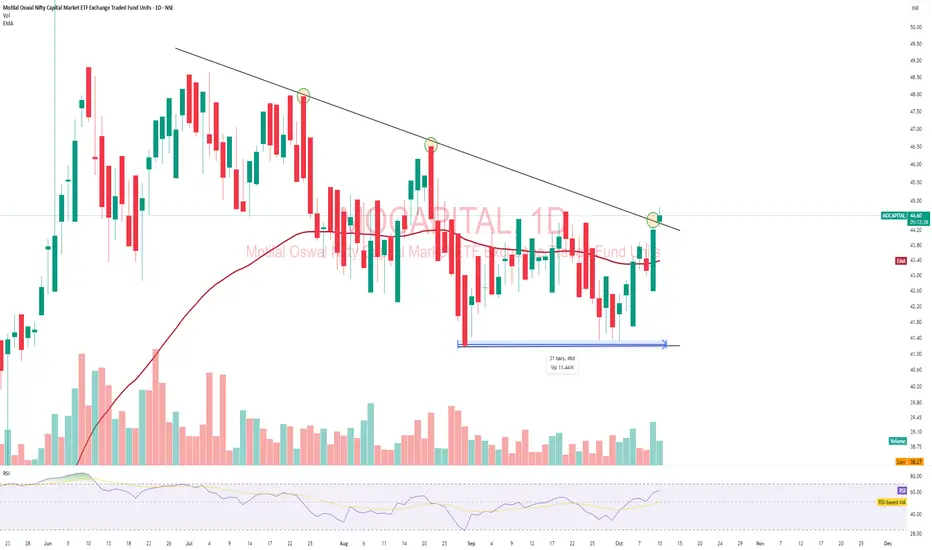
MOCAPITAL: Short Breakout after 46 day's consolidations.
Looks good for 46, 48, 50 in few months.
Why MOCAPITAL is pocket portfolio ETF's ?
Motilal Oswal Nifty Capital Market ETF (MO Capital Market ETF), which tracks India’s listed capital markets ecosystem (broking, AMCs, exchanges, depositories, wealth managers)
Why it matters
1. Direct, pure-play exposure to India’s capital markets cycle: rising demat accounts, SIP flows, retail participation, and market depth can translate into operating leverage for constituents.
2. Complements core index funds by adding a structural-financials tilt beyond banks/insurers, capturing brokerage, AMC, exchange and market-infrastructure economics.
3.Transparent, rules-based exposure with the convenience and cost-efficiency of an ETF; no active stock-picking required.
What it tracks
1. Replicates the Nifty Capital Market Index, a sectoral index within financial services focused on market infrastructure and intermediaries.
2. Includes brokers, exchanges, AMCs, depositories, and diversified capital market platforms; free-float market-cap weighted with periodic rebalancing.
Holdings snapshot (typical constituents)
1. Exchanges and infra: NSE’s listed peer (BSE), CDSL
2. Brokers/wealth: Angel One, IIFL Finance/IIFL Securities, 360 One, Anand Rathi Wealth, Motilal Oswal Financial Services
3. AMCs: HDFC AMC, Nippon Life India AMC, UTI AMC, ABSL AMC
Pros:
1. Plays financialization trend: higher equity ownership, SIP penetration, and market volumes can drive revenue growth and margin expansion.
2. Capital-light, high operating leverage businesses can scale profit pools faster than GDP in bull markets.
3. Sector ETF avoids single-stock risk while maintaining targeted exposure.
Risks:
1. Pro-cyclical: earnings are sensitive to market turnover, valuations, and risk appetite; drawdowns can be sharp in bear phases.
2. Regulatory risk: fee caps, disclosure rules, margin norms, or product restrictions can impact profitability across brokers/AMCs.
3. Concentration: sector-specific and often top-heavy; expect higher volatility versus diversified indices.
Portfolio fit (simple use)
1. Satellite allocation of 5–10% around a diversified core (Nifty 50/Next 50 or flexi-cap index).
2. Maintain a minimum 3–5 year horizon; avoid short-term timing around policy or budget events.
3. Monitor three things: AUM/liquidity, tracking difference, and expense ratio; use limit orders for better execution.
Current perspective
1. Structural tailwinds: steady SIP inflows, growing demat base, deepening derivatives and passive products, and rising household equity allocation.
2. Cyclical watchpoints: market volumes, broking yields, AMC flows/market share, and valuation multiples that can compress in risk-off phases.
3. Expect leadership to rotate within the basket—exchanges/depositories tend to be steadier; brokers/AMCs more cyclical with higher beta.
Bottom line
The Motilal Oswal Nifty Capital Market ETF is a focused way to ride India’s financialization and equity-market depth, best used as a modest, long-horizon satellite alongside broad market holdings.
Looks good for 46, 48, 50 in few months.
Why MOCAPITAL is pocket portfolio ETF's ?
Motilal Oswal Nifty Capital Market ETF (MO Capital Market ETF), which tracks India’s listed capital markets ecosystem (broking, AMCs, exchanges, depositories, wealth managers)
Why it matters
1. Direct, pure-play exposure to India’s capital markets cycle: rising demat accounts, SIP flows, retail participation, and market depth can translate into operating leverage for constituents.
2. Complements core index funds by adding a structural-financials tilt beyond banks/insurers, capturing brokerage, AMC, exchange and market-infrastructure economics.
3.Transparent, rules-based exposure with the convenience and cost-efficiency of an ETF; no active stock-picking required.
What it tracks
1. Replicates the Nifty Capital Market Index, a sectoral index within financial services focused on market infrastructure and intermediaries.
2. Includes brokers, exchanges, AMCs, depositories, and diversified capital market platforms; free-float market-cap weighted with periodic rebalancing.
Holdings snapshot (typical constituents)
1. Exchanges and infra: NSE’s listed peer (BSE), CDSL
2. Brokers/wealth: Angel One, IIFL Finance/IIFL Securities, 360 One, Anand Rathi Wealth, Motilal Oswal Financial Services
3. AMCs: HDFC AMC, Nippon Life India AMC, UTI AMC, ABSL AMC
Pros:
1. Plays financialization trend: higher equity ownership, SIP penetration, and market volumes can drive revenue growth and margin expansion.
2. Capital-light, high operating leverage businesses can scale profit pools faster than GDP in bull markets.
3. Sector ETF avoids single-stock risk while maintaining targeted exposure.
Risks:
1. Pro-cyclical: earnings are sensitive to market turnover, valuations, and risk appetite; drawdowns can be sharp in bear phases.
2. Regulatory risk: fee caps, disclosure rules, margin norms, or product restrictions can impact profitability across brokers/AMCs.
3. Concentration: sector-specific and often top-heavy; expect higher volatility versus diversified indices.
Portfolio fit (simple use)
1. Satellite allocation of 5–10% around a diversified core (Nifty 50/Next 50 or flexi-cap index).
2. Maintain a minimum 3–5 year horizon; avoid short-term timing around policy or budget events.
3. Monitor three things: AUM/liquidity, tracking difference, and expense ratio; use limit orders for better execution.
Current perspective
1. Structural tailwinds: steady SIP inflows, growing demat base, deepening derivatives and passive products, and rising household equity allocation.
2. Cyclical watchpoints: market volumes, broking yields, AMC flows/market share, and valuation multiples that can compress in risk-off phases.
3. Expect leadership to rotate within the basket—exchanges/depositories tend to be steadier; brokers/AMCs more cyclical with higher beta.
Bottom line
The Motilal Oswal Nifty Capital Market ETF is a focused way to ride India’s financialization and equity-market depth, best used as a modest, long-horizon satellite alongside broad market holdings.
Trade chiuso: obiettivo raggiunto
Full target achieved of Rs. 48, upgrading for RS. 50 within few weeks!
Declinazione di responsabilità
Le informazioni e le pubblicazioni non sono intese come, e non costituiscono, consulenza o raccomandazioni finanziarie, di investimento, di trading o di altro tipo fornite o approvate da TradingView. Per ulteriori informazioni, consultare i Termini di utilizzo.
Declinazione di responsabilità
Le informazioni e le pubblicazioni non sono intese come, e non costituiscono, consulenza o raccomandazioni finanziarie, di investimento, di trading o di altro tipo fornite o approvate da TradingView. Per ulteriori informazioni, consultare i Termini di utilizzo.