
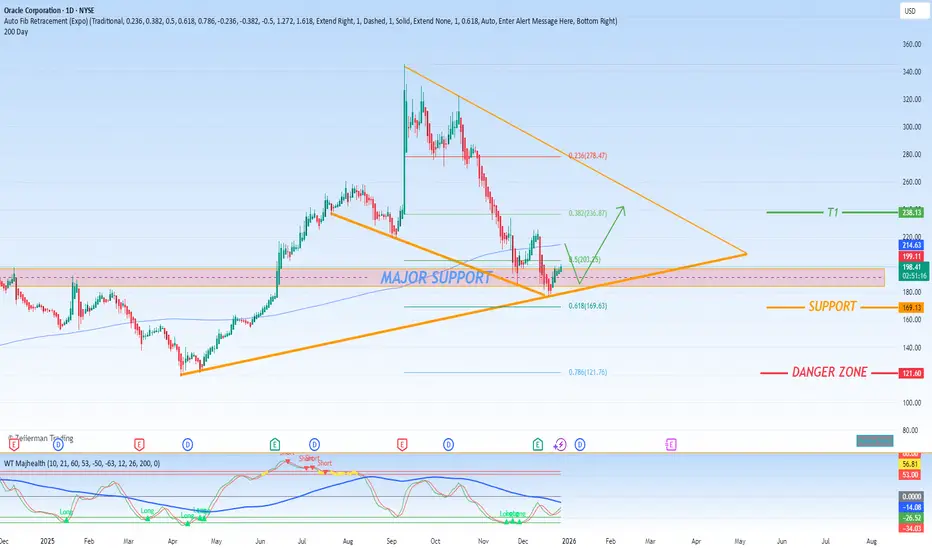
Oracle Corporation (NYSE: ORCL), a legacy tech giant undergoing a radical transformation, finds itself at a critical juncture. Its shares have been under intense pressure, trading down approximately 43% from their September 2025 all-time high. This sell-off reflects a palpable investor anxiety: skepticism over the company's ability to convert an unprecedented wave of capital expenditure into near-term profits, and concern over the burgeoning debt required to fund its ambitious artificial intelligence (AI) infrastructure buildout. However, a closer examination reveals a company with unparalleled forward revenue visibility, a disciplined and margin-focused growth strategy, and a valuation that may have excessively priced in worst-case scenarios. This combination creates a compelling, albeit high-stakes, investment opportunity for patient capital.
The Crown Jewel: Unprecedented Multiyear Revenue Visibility
The most formidable pillar of the bull case is Oracle's staggering backlog, officially termed Remaining Performance Obligations (RPO). As of Q2 FY2026, this figure stands at $523 billion—a 433% year-over-year increase. This is not merely a speculative pipeline; it represents signed, long-term cloud infrastructure contracts with the world's most demanding technology companies, including Nvidia and Meta Platforms.
The scale of this backlog is almost surreal, dwarfing even the company's own elevated FY2026 revenue guidance of $67 billion. It provides exceptional multiyear visibility and de-risks the top-line trajectory in a way few public companies can claim. Critically, the near-term conversion is already accelerating: the portion of RPO expected to be recognized within the next 12 months grew 40% year-over-year, up from 25% in the prior quarter. Management has quantified this, anticipating $4 billion of incremental revenue in FY2027 from the new contracts added in the latest quarter alone. This isn't hope; it's contracted future revenue waiting for data center capacity to come online.
Disciplined Execution: Pursuing Growth with Margin Guardrails
Contrary to the narrative of reckless spending, Oracle is demonstrating notable capital discipline. The company is not pursuing "growth at any cost." It strategically signs massive contracts only when key operational prerequisites are locked in: secured land and power availability, favorable supply economics for critical components like GPUs, and confirmed engineering capacity to build and manage the infrastructure.
Furthermore, Oracle has provided a clear profitability target for its AI endeavor: gross profit margins of 30% to 40% for its AI data centers. This focus on unit economics is crucial. It signals that Oracle intends for its cloud infrastructure business (OCI) to be a high-margin engine, not a loss-leading scale play. This margin framework provides a future lens through which to model the immense earnings potential as the $523 billion RPO gradually converts.
Navigating the Capital Challenge: Innovative Financing and Debt Concerns
The elephant in the room is funding. Building a global AI cloud network requires monumental capital expenditure. While debt has increased, Oracle's management is proactively exploring innovative, off-balance-sheet funding structures to limit borrowing and preserve financial flexibility. These include arrangements like customer-owned chips and supplier-leased chips, which would significantly reduce Oracle's upfront cash outlays. This creative approach to financing a capex super-cycle is a critical differentiator and helps mitigate one of the market's primary fears.
Nevertheless, risks persist. The debt load is substantial, and investor concerns are compounded by uncertainties surrounding key clients like OpenAI and their ability to fund their own massive compute bills. The specter of an "AI bubble" burst that could leave Oracle with stranded, underutilized assets is a valid macro risk that cannot be dismissed.
Valuation & Technical Analysis: Mapping the Risk/Reward
From both a fundamental and technical perspective, the current price appears to discount an excessive amount of pessimism.
Fundamental Valuation: At approximately 24-29x forward earnings, Oracle's multiple is reasonable for a company with its growth profile and unparalleled contracted backlog. It sits at a discount to many pure-play cloud and AI peers, especially considering the revenue certainty its RPO provides.
Technical Perspective & Key Levels:
The steep decline has brought the stock into a zone where long-term value and technical support converge, defining a clear risk/reward framework:
Initial Support & Rally Point at ~$169.63 (0.618 Fibonacci): This level represents a key Fibonacci retracement zone and a logical area for the stock to stabilize and attempt a reversal. Holding here would suggest the recent sell-off was a deep but healthy correction within a longer-term uptrend.
Major Support & Strategic Value Zone at ~$121.76 (0.786 Fibonacci): This deeper level represents a more extreme bear-case scenario. A decline to this area would likely coincide with peak fears of an AI downturn or a significant execution stumble. For long-term believers, this zone would represent a potentially historic buying opportunity, as it would price in catastrophic assumptions about contract cancellations and margin collapse.
Take-Profit Target at ~$236.87 (0.382 Fibonacci Retracement of the Fall): A return to this area represents the first major technical hurdle and a logical profit-taking zone for a recovery trade. Achieving this target would imply a regaining of market confidence, supported by concrete quarterly evidence of RPO conversion and margin progress. It frames a significant upside potential from current levels.
Final Assessment: A High-Conviction, High-Stakes Recovery Bet
Oracle presents a classic contrarian opportunity. The market is fixated on the near-term costs and risks of its AI odyssey, overlooking the sheer magnitude and quality of its secured future revenue stream. The company is not building on speculation; it is building to fulfill already-signed contracts with industry titans.
While execution risks around debt, client concentration, and macro AI cycles are real, the current valuation and technical setup suggest these risks are overwhelmingly reflected in the price. The path forward will be volatile, likely oscillating between the $169 support and the $237 target as quarterly results provide proof points of execution.
For investors with a multi-year horizon and the fortitude to withstand volatility, Oracle at these levels offers a compelling bet on a foundational player in the AI infrastructure layer. It is a wager that the company's unmatched backlog, disciplined margin targets, and innovative financing will ultimately translate into a powerful earnings growth story that the market is currently unwilling to see.
The Crown Jewel: Unprecedented Multiyear Revenue Visibility
The most formidable pillar of the bull case is Oracle's staggering backlog, officially termed Remaining Performance Obligations (RPO). As of Q2 FY2026, this figure stands at $523 billion—a 433% year-over-year increase. This is not merely a speculative pipeline; it represents signed, long-term cloud infrastructure contracts with the world's most demanding technology companies, including Nvidia and Meta Platforms.
The scale of this backlog is almost surreal, dwarfing even the company's own elevated FY2026 revenue guidance of $67 billion. It provides exceptional multiyear visibility and de-risks the top-line trajectory in a way few public companies can claim. Critically, the near-term conversion is already accelerating: the portion of RPO expected to be recognized within the next 12 months grew 40% year-over-year, up from 25% in the prior quarter. Management has quantified this, anticipating $4 billion of incremental revenue in FY2027 from the new contracts added in the latest quarter alone. This isn't hope; it's contracted future revenue waiting for data center capacity to come online.
Disciplined Execution: Pursuing Growth with Margin Guardrails
Contrary to the narrative of reckless spending, Oracle is demonstrating notable capital discipline. The company is not pursuing "growth at any cost." It strategically signs massive contracts only when key operational prerequisites are locked in: secured land and power availability, favorable supply economics for critical components like GPUs, and confirmed engineering capacity to build and manage the infrastructure.
Furthermore, Oracle has provided a clear profitability target for its AI endeavor: gross profit margins of 30% to 40% for its AI data centers. This focus on unit economics is crucial. It signals that Oracle intends for its cloud infrastructure business (OCI) to be a high-margin engine, not a loss-leading scale play. This margin framework provides a future lens through which to model the immense earnings potential as the $523 billion RPO gradually converts.
Navigating the Capital Challenge: Innovative Financing and Debt Concerns
The elephant in the room is funding. Building a global AI cloud network requires monumental capital expenditure. While debt has increased, Oracle's management is proactively exploring innovative, off-balance-sheet funding structures to limit borrowing and preserve financial flexibility. These include arrangements like customer-owned chips and supplier-leased chips, which would significantly reduce Oracle's upfront cash outlays. This creative approach to financing a capex super-cycle is a critical differentiator and helps mitigate one of the market's primary fears.
Nevertheless, risks persist. The debt load is substantial, and investor concerns are compounded by uncertainties surrounding key clients like OpenAI and their ability to fund their own massive compute bills. The specter of an "AI bubble" burst that could leave Oracle with stranded, underutilized assets is a valid macro risk that cannot be dismissed.
Valuation & Technical Analysis: Mapping the Risk/Reward
From both a fundamental and technical perspective, the current price appears to discount an excessive amount of pessimism.
Fundamental Valuation: At approximately 24-29x forward earnings, Oracle's multiple is reasonable for a company with its growth profile and unparalleled contracted backlog. It sits at a discount to many pure-play cloud and AI peers, especially considering the revenue certainty its RPO provides.
Technical Perspective & Key Levels:
The steep decline has brought the stock into a zone where long-term value and technical support converge, defining a clear risk/reward framework:
Initial Support & Rally Point at ~$169.63 (0.618 Fibonacci): This level represents a key Fibonacci retracement zone and a logical area for the stock to stabilize and attempt a reversal. Holding here would suggest the recent sell-off was a deep but healthy correction within a longer-term uptrend.
Major Support & Strategic Value Zone at ~$121.76 (0.786 Fibonacci): This deeper level represents a more extreme bear-case scenario. A decline to this area would likely coincide with peak fears of an AI downturn or a significant execution stumble. For long-term believers, this zone would represent a potentially historic buying opportunity, as it would price in catastrophic assumptions about contract cancellations and margin collapse.
Take-Profit Target at ~$236.87 (0.382 Fibonacci Retracement of the Fall): A return to this area represents the first major technical hurdle and a logical profit-taking zone for a recovery trade. Achieving this target would imply a regaining of market confidence, supported by concrete quarterly evidence of RPO conversion and margin progress. It frames a significant upside potential from current levels.
Final Assessment: A High-Conviction, High-Stakes Recovery Bet
Oracle presents a classic contrarian opportunity. The market is fixated on the near-term costs and risks of its AI odyssey, overlooking the sheer magnitude and quality of its secured future revenue stream. The company is not building on speculation; it is building to fulfill already-signed contracts with industry titans.
While execution risks around debt, client concentration, and macro AI cycles are real, the current valuation and technical setup suggest these risks are overwhelmingly reflected in the price. The path forward will be volatile, likely oscillating between the $169 support and the $237 target as quarterly results provide proof points of execution.
For investors with a multi-year horizon and the fortitude to withstand volatility, Oracle at these levels offers a compelling bet on a foundational player in the AI infrastructure layer. It is a wager that the company's unmatched backlog, disciplined margin targets, and innovative financing will ultimately translate into a powerful earnings growth story that the market is currently unwilling to see.

Declinazione di responsabilità
Le informazioni e le pubblicazioni non sono intese come, e non costituiscono, consulenza o raccomandazioni finanziarie, di investimento, di trading o di altro tipo fornite o approvate da TradingView. Per ulteriori informazioni, consultare i Termini di utilizzo.
Declinazione di responsabilità
Le informazioni e le pubblicazioni non sono intese come, e non costituiscono, consulenza o raccomandazioni finanziarie, di investimento, di trading o di altro tipo fornite o approvate da TradingView. Per ulteriori informazioni, consultare i Termini di utilizzo.