
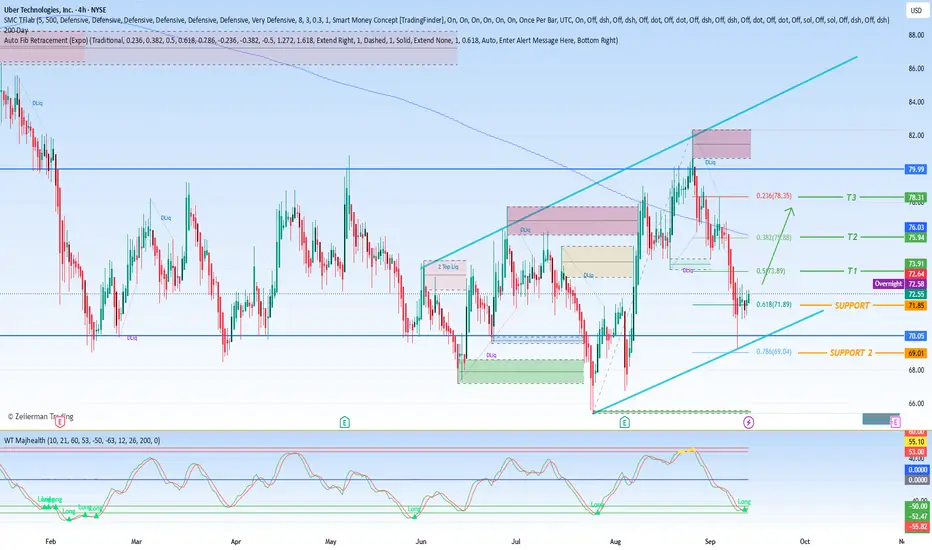
Uber Technologies (UBER) generates free cash flow equal to roughly 6.8% of its market value every year. For the median S&P 500 company, that figure sits at about 4.5%. A gap that wide normally tells you something important: the market may be pricing Uber as though its business is expected to shrink, or at least as though its cash generation is not expected to remain this strong. But Uber is not shrinking. Its revenue grew 16.7% over the trailing twelve months. That creates a puzzle. If the cash is real and the business is still growing, why does the market appear to value that cash so cautiously? The answer may come down to a different question: not whether Uber produces cash, but who ultimately gets it.
Where Does Uber’s Cash Actually Come From?
It does not come from unusually fat margins. Uber is fundamentally a marketplace business. It takes a cut of the activity that moves across its platform, whether that activity involves rides, delivery, or other services. Its economics depend on volume, take rates, frequency, and the ability to keep both sides of the marketplace engaged. Uber does not need to own the cars or employ every driver to generate revenue, but it does need to keep transactions flowing and defend its position against competitors.
One example of how Uber tries to widen its appeal is Wait & Save, its lower-cost product in the United States. Wait & Save lets riders trade time against price: if they are willing to wait a little longer, they can pay less. That can make Uber more accessible to price-sensitive customers, encourage more trips, and improve utilization across the network. It can also pressure revenue per trip, which means the strategy only works if the extra volume and efficiency more than offset the lower price.
The Scale Numbers Are Doing the Heavy Lifting
The latest results suggest that Uber’s volume growth is translating into real financial leverage. Gross bookings grew 22% year over year to more than $58 billion in the June 2026 quarter. Management says that growth fed through into operating leverage: non-GAAP earnings per share rose 35%, and trailing twelve-month free cash flow surpassed $10 billion for the first time. That combination matters. It suggests Uber is not simply buying growth with unsustainable discounts. Instead, it is expanding the top line while also converting more of that revenue into cash.
Operating leverage is the key idea here. When a marketplace grows, many costs do not rise at the same pace as revenue. Technology, platform development, and corporate overhead can be spread across a larger base of transactions. If Uber can keep adding gross bookings without letting costs scale just as quickly, more of each additional dollar can fall to the bottom line. That is what management appears to be emphasizing: growth is not coming at the expense of profitability.
So Why the Wide Free Cash Flow Yield?
A high free cash flow yield can mean several things. It can signal that a stock is cheap. It can also signal that investors doubt the durability of those cash flows. In Uber’s case, the market may be asking whether today’s cash generation can survive competition, regulatory pressure, labor disputes, insurance costs, or heavy reinvestment in new areas such as autonomous vehicles and expansion into additional markets.
There is also the question of capital allocation. Free cash flow belongs to the business, but shareholders only benefit directly if that cash is returned through buybacks or dividends, used to pay down obligations, or reinvested at attractive returns. If Uber instead spends the cash defending its marketplace, subsidizing riders, offering incentives to drivers, or funding expensive new initiatives, then the cash may never show up in shareholders’ pockets in a meaningful way. In that case, the stock could look cheap on a cash flow basis while still failing to deliver the returns that the yield seems to promise.
The Real Question Is Not Growth Alone
Uber’s cash generation is real, and it is growing. The company is not shrinking, and its revenue and bookings trends point to a business with momentum. But the market’s relatively low valuation against free cash flow suggests that investors want proof on two fronts: that the cash flow is durable, and that it will eventually accrue to shareholders rather than being consumed by competition, regulation, or reinvestment.
So the question is not simply whether Uber stock is cheap. The deeper question is who gets the cash. If management can sustain growth, preserve operating leverage, and return excess cash to shareholders, the current free cash flow yield may look like a genuine bargain. If the cash is continually spent to defend and expand the business, then the discount may be less of an opportunity and more of a warning.
Where Does Uber’s Cash Actually Come From?
It does not come from unusually fat margins. Uber is fundamentally a marketplace business. It takes a cut of the activity that moves across its platform, whether that activity involves rides, delivery, or other services. Its economics depend on volume, take rates, frequency, and the ability to keep both sides of the marketplace engaged. Uber does not need to own the cars or employ every driver to generate revenue, but it does need to keep transactions flowing and defend its position against competitors.
One example of how Uber tries to widen its appeal is Wait & Save, its lower-cost product in the United States. Wait & Save lets riders trade time against price: if they are willing to wait a little longer, they can pay less. That can make Uber more accessible to price-sensitive customers, encourage more trips, and improve utilization across the network. It can also pressure revenue per trip, which means the strategy only works if the extra volume and efficiency more than offset the lower price.
The Scale Numbers Are Doing the Heavy Lifting
The latest results suggest that Uber’s volume growth is translating into real financial leverage. Gross bookings grew 22% year over year to more than $58 billion in the June 2026 quarter. Management says that growth fed through into operating leverage: non-GAAP earnings per share rose 35%, and trailing twelve-month free cash flow surpassed $10 billion for the first time. That combination matters. It suggests Uber is not simply buying growth with unsustainable discounts. Instead, it is expanding the top line while also converting more of that revenue into cash.
Operating leverage is the key idea here. When a marketplace grows, many costs do not rise at the same pace as revenue. Technology, platform development, and corporate overhead can be spread across a larger base of transactions. If Uber can keep adding gross bookings without letting costs scale just as quickly, more of each additional dollar can fall to the bottom line. That is what management appears to be emphasizing: growth is not coming at the expense of profitability.
So Why the Wide Free Cash Flow Yield?
A high free cash flow yield can mean several things. It can signal that a stock is cheap. It can also signal that investors doubt the durability of those cash flows. In Uber’s case, the market may be asking whether today’s cash generation can survive competition, regulatory pressure, labor disputes, insurance costs, or heavy reinvestment in new areas such as autonomous vehicles and expansion into additional markets.
There is also the question of capital allocation. Free cash flow belongs to the business, but shareholders only benefit directly if that cash is returned through buybacks or dividends, used to pay down obligations, or reinvested at attractive returns. If Uber instead spends the cash defending its marketplace, subsidizing riders, offering incentives to drivers, or funding expensive new initiatives, then the cash may never show up in shareholders’ pockets in a meaningful way. In that case, the stock could look cheap on a cash flow basis while still failing to deliver the returns that the yield seems to promise.
The Real Question Is Not Growth Alone
Uber’s cash generation is real, and it is growing. The company is not shrinking, and its revenue and bookings trends point to a business with momentum. But the market’s relatively low valuation against free cash flow suggests that investors want proof on two fronts: that the cash flow is durable, and that it will eventually accrue to shareholders rather than being consumed by competition, regulation, or reinvestment.
So the question is not simply whether Uber stock is cheap. The deeper question is who gets the cash. If management can sustain growth, preserve operating leverage, and return excess cash to shareholders, the current free cash flow yield may look like a genuine bargain. If the cash is continually spent to defend and expand the business, then the discount may be less of an opportunity and more of a warning.

Declinazione di responsabilità
Le informazioni e le pubblicazioni non sono intese come, e non costituiscono, consulenza o raccomandazioni finanziarie, di investimento, di trading o di altro tipo fornite o approvate da TradingView. Per ulteriori informazioni, consultare i Termini di utilizzo.
Declinazione di responsabilità
Le informazioni e le pubblicazioni non sono intese come, e non costituiscono, consulenza o raccomandazioni finanziarie, di investimento, di trading o di altro tipo fornite o approvate da TradingView. Per ulteriori informazioni, consultare i Termini di utilizzo.