
War costs money.
It seems the US Government remains flash with the cash despite a near $39 trillion dollars of debt. Where does the money come from to fund the conflict?
International lenders? Unlikely. Many international lenders are unwinding US treasury positions.
The US Tax payer? Not really a popular option with mid-term elections coming up.
Where will the money come from? Wars are expensive, before, during and after. Right now the US Government would pick a fight with its own reflection. So where does the money come from?
Stealth tax.
One of the largest wealth transfers in history is on the verge of getting underway. That is the transfer of purchasing power from one set of hands to the next. Are you going to be a provider of cash or a beneficiary? Decide now.
While retail traders and investors exit the equity market waiting for “the crash” that’ll never come, others increase exposure to precious metals after a 400% rally in price in less than 10 years.
“The dollar is about to crash”
Easily the most misunderstood narrative circulating the internet at the moment.
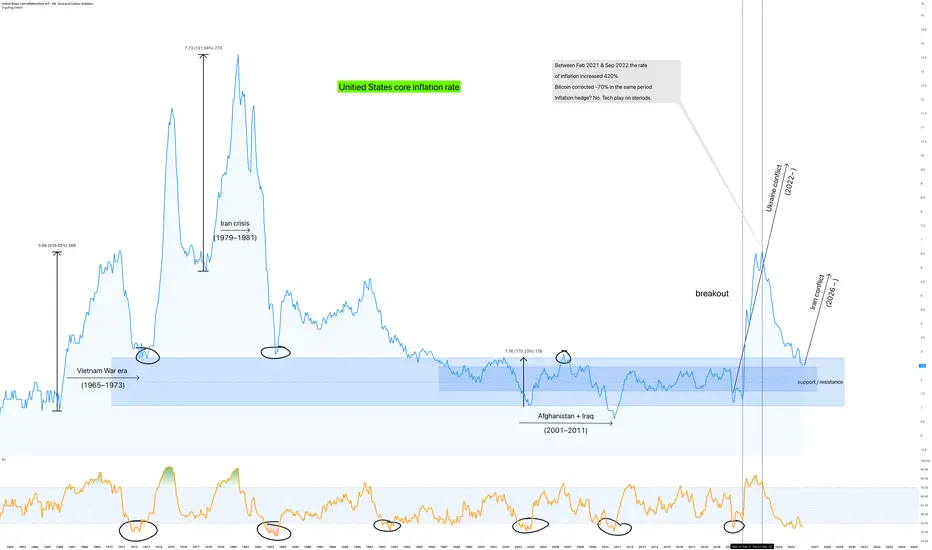
On the above monthly the chart core US inflation rate is shown. You’ll notice how inflation soared each time the US increased its involvement in overseas conflict.
What I want you see on the above chart is how inflation soared during periods of intense US conflict. This was the result of dollar devaluation. That’s how the conflicts were funded. The devaluation period to come is mostly likely begun as the FED purchases debt.
Devaluation means inflation, lots of it. Most people don’t see it coming until it’s too late. Most will not realise realise they’re paying for the conflict by working more hours for less pay than they did the day before.
** Military conflict correlates with inflation mainly when it’s financed by monetising debt or occurs alongside independent supply shock, not simply by virtue of happening.**
How do YOU benefit?
Be invested.
Gold / Silver is not an investment, it’s an insurance. Be invested in businesses that are generating a profit generating revenue. Be invested in companies that are undervalued oversold yet turning a profit. Hint, Open AI isn’t one of them.
Inflation to sky rocket
I know, an unpopular statement. It causes followers to hit the “un-follow” button and exit the chat quicker than a whippet with a bum full of dynamite. That’s fine, but it does not make the facts of the chart less relevant.
Overlayed on the main chart below is the S&P 500 (black) and Dow Jones industrial average index (Green). Did those markets crash or rally during the conflict?
No. They rallied. Not just a little bit, but a lot.

Do you remember this post?
“S&P 500 to 10,000 inside the next 4 years - December 2025”
Read it carefully.
This is not an endorsement of the US Stock market or expected strengthening of the US economy to come. A 10k S&P 500 in a handful of years is no different to a 7k S&P 500 today if the dollar drops in value by about 30% (roughly 40–43% cumulative inflation).
Wait what 30-40% cumulative inflation?!
Yeah you read the right, hence the part from me to you, be invested. Don’t be a typical retail trader hoarding cash or shiny precious metals waiting for armageddon. This is the wealth transfer, from cash holders to asset holders.
Ww
=============================================================
Disclaimer
As always, these are personal views and shared for educational purposes only. They do not constitute financial advice. Please do your own research and manage risk accordingly.
It seems the US Government remains flash with the cash despite a near $39 trillion dollars of debt. Where does the money come from to fund the conflict?
International lenders? Unlikely. Many international lenders are unwinding US treasury positions.
The US Tax payer? Not really a popular option with mid-term elections coming up.
Where will the money come from? Wars are expensive, before, during and after. Right now the US Government would pick a fight with its own reflection. So where does the money come from?
Stealth tax.
One of the largest wealth transfers in history is on the verge of getting underway. That is the transfer of purchasing power from one set of hands to the next. Are you going to be a provider of cash or a beneficiary? Decide now.
While retail traders and investors exit the equity market waiting for “the crash” that’ll never come, others increase exposure to precious metals after a 400% rally in price in less than 10 years.
“The dollar is about to crash”
Easily the most misunderstood narrative circulating the internet at the moment.
On the above monthly the chart core US inflation rate is shown. You’ll notice how inflation soared each time the US increased its involvement in overseas conflict.
What I want you see on the above chart is how inflation soared during periods of intense US conflict. This was the result of dollar devaluation. That’s how the conflicts were funded. The devaluation period to come is mostly likely begun as the FED purchases debt.
Devaluation means inflation, lots of it. Most people don’t see it coming until it’s too late. Most will not realise realise they’re paying for the conflict by working more hours for less pay than they did the day before.
** Military conflict correlates with inflation mainly when it’s financed by monetising debt or occurs alongside independent supply shock, not simply by virtue of happening.**
How do YOU benefit?
Be invested.
Gold / Silver is not an investment, it’s an insurance. Be invested in businesses that are generating a profit generating revenue. Be invested in companies that are undervalued oversold yet turning a profit. Hint, Open AI isn’t one of them.
Inflation to sky rocket
I know, an unpopular statement. It causes followers to hit the “un-follow” button and exit the chat quicker than a whippet with a bum full of dynamite. That’s fine, but it does not make the facts of the chart less relevant.
Overlayed on the main chart below is the S&P 500 (black) and Dow Jones industrial average index (Green). Did those markets crash or rally during the conflict?
No. They rallied. Not just a little bit, but a lot.
Do you remember this post?
“S&P 500 to 10,000 inside the next 4 years - December 2025”
Read it carefully.
This is not an endorsement of the US Stock market or expected strengthening of the US economy to come. A 10k S&P 500 in a handful of years is no different to a 7k S&P 500 today if the dollar drops in value by about 30% (roughly 40–43% cumulative inflation).
Wait what 30-40% cumulative inflation?!
Yeah you read the right, hence the part from me to you, be invested. Don’t be a typical retail trader hoarding cash or shiny precious metals waiting for armageddon. This is the wealth transfer, from cash holders to asset holders.
Ww
=============================================================
Disclaimer
As always, these are personal views and shared for educational purposes only. They do not constitute financial advice. Please do your own research and manage risk accordingly.
Nota
"First week of Iran war cost U.S. about $11.3 billion, Pentagon tells lawmakers"Military officials told members of Congress in a briefing this week that the U.S.'s war with Iran cost around $11.3 billion in roughly its first week, according to sources familiar with the meeting.
That figure is a low-end estimate and does not include the build-up costs of moving assets into place ahead of the operation's start on Feb. 28.
The estimate was first reported by The New York Times.
Sen. Chris Coons, the top Democrat on the Senate subcommittee that handles defense appropriations, told reporters Wednesday: "I expect that the total operating number is significantly above that."
He said it would be a "fair guess" that the war's daily cost exceeds $1.5 billion, though it varies day-to-day depending on military operations. The cost of replacing the munitions that have been used in the war is probably "already well beyond $10 billion," he said.
========================
Source:
cbsnews.com/live-updates/iran-war-us-israel-strait-of-hormuz-ship-attacks-persian-gulf-drones-missiles/
The dollar printing press flywheels will soon sound like the washer on a spin cycle.
Nota
Inflation printing strong bullish divergence.US government spending billions of dollars per day on a war they can't stop.
Dollar holders, this is not the moment to be in cash. You were warned.
Trade attivo
If you grab this chart, apply some basic support and resistance. The annual moving average even.. you'll notice something. Past resistance has become support.What does this mean? Read the idea.
Highlights:
1) The rate of inflation is very likely to increase. Towards 6% YoY.
2) Do not sit in cash, especially dollars. Be invested. Dips are opportunities.
Nota
Quotes from the house that is white with the golden ballroom.The "Two to Three Days" Estimate (Late February)
Just as the initial joint U.S.-Israeli strikes (Operation Epic Fury) were launching, Trump told Israeli reporter Barak Ravid in a phone interview that he could wrap things up almost immediately
source:
britannica.com/event/2026-Iran-war
The "Four to Five Weeks" Projection (Early March)
"As the scale of the conflict grew, Trump adjusted his public timeline to just over a month."
Source:
theguardian.com/us-news/2026/mar/02/trump-war-iran
They say the hardest part of a 3-4 day war is the first 4 months.
All the while, guess which direction inflation is taking?
Read main idea if you don't know.

Declinazione di responsabilità
Le informazioni e le pubblicazioni non sono intese come, e non costituiscono, consulenza o raccomandazioni finanziarie, di investimento, di trading o di altro tipo fornite o approvate da TradingView. Per ulteriori informazioni, consultare i Termini di utilizzo.
Declinazione di responsabilità
Le informazioni e le pubblicazioni non sono intese come, e non costituiscono, consulenza o raccomandazioni finanziarie, di investimento, di trading o di altro tipo fornite o approvate da TradingView. Per ulteriori informazioni, consultare i Termini di utilizzo.