

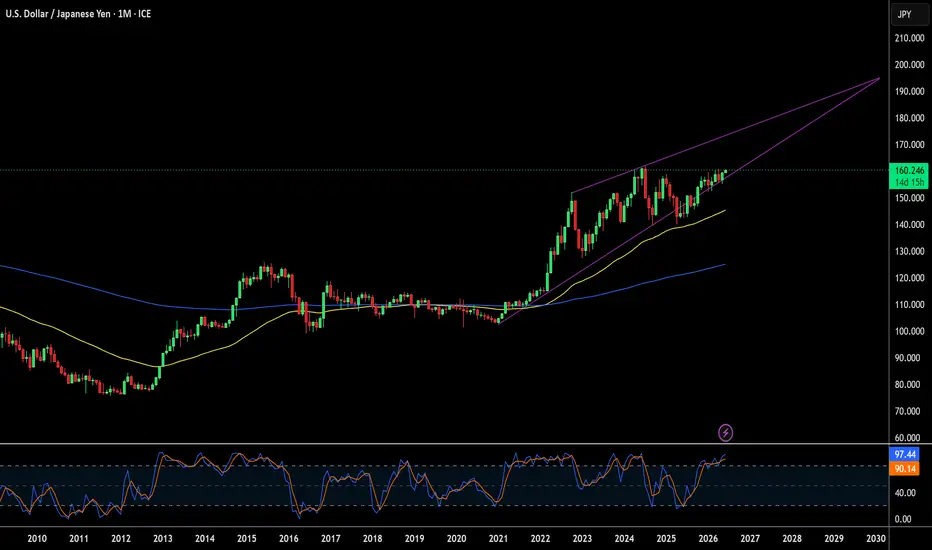
The USD/JPY pair currently rests at a critical structural juncture near the 160 level, driven by an intense monetary tug-of-war between Tokyo and Washington. The Bank of Japan’s historic decision to hike its benchmark rate to a 31-year high of 1.0% marks a decisive end to decades of ultra-loose policy, forced by a sharp 6.3% spike in wholesale inflation. However, this hawkish pivot faces a strong counterweight in the resilience of the U.S. economy, where headline inflation running at 4.2% keeps Treasury yields elevated. This persistent interest rate differential continues to anchor the pair near 160, testing the limits of Japan’s tightening efforts.
Exogenous geopolitical shifts have simultaneously provided a vital relief valve for Japan's resource-scarce economy. The preliminary peace agreement with Iran has successfully reopened the strategic Strait of Hormuz, driving global oil prices lower and easing import-driven inflationary pressures on Tokyo. Crucially, the BoJ demonstrated profound institutional stability during this transition. Despite the sudden hospitalization of Governor Kazuo Ueda, the leadership executed the historic rate hike flawlessly, signaling to global markets that Japan's monetary normalization path remains unshakeable.
From an analytical standpoint, removing peripheral commentary regarding technology, cybersecurity, and algorithmic patenting sharpens the focus on what truly drives this market: macro liquidity and corporate hedging. The real operational story lies in how multinational corporations and global banks are adapting their business models to deploy sophisticated derivatives against this extreme volatility. Ultimately, the 160 yen barrier is the definitive fault line reflecting whether Japan can successfully exit stagnation, or if high U.S. capital costs will continue to dominate the global currency landscape.
Exogenous geopolitical shifts have simultaneously provided a vital relief valve for Japan's resource-scarce economy. The preliminary peace agreement with Iran has successfully reopened the strategic Strait of Hormuz, driving global oil prices lower and easing import-driven inflationary pressures on Tokyo. Crucially, the BoJ demonstrated profound institutional stability during this transition. Despite the sudden hospitalization of Governor Kazuo Ueda, the leadership executed the historic rate hike flawlessly, signaling to global markets that Japan's monetary normalization path remains unshakeable.
From an analytical standpoint, removing peripheral commentary regarding technology, cybersecurity, and algorithmic patenting sharpens the focus on what truly drives this market: macro liquidity and corporate hedging. The real operational story lies in how multinational corporations and global banks are adapting their business models to deploy sophisticated derivatives against this extreme volatility. Ultimately, the 160 yen barrier is the definitive fault line reflecting whether Japan can successfully exit stagnation, or if high U.S. capital costs will continue to dominate the global currency landscape.

The5ers Funding Forex Traders & Growth Program. Get Funded with up to $2.56M
We Trade Forex - Come Join Us!
the5ers.com
We Trade Forex - Come Join Us!
the5ers.com
Declinazione di responsabilità
Le informazioni e le pubblicazioni non sono intese come, e non costituiscono, consulenza o raccomandazioni finanziarie, di investimento, di trading o di altro tipo fornite o approvate da TradingView. Per ulteriori informazioni, consultare i Termini di utilizzo.
The5ers Funding Forex Traders & Growth Program. Get Funded with up to $2.56M
We Trade Forex - Come Join Us!
the5ers.com
We Trade Forex - Come Join Us!
the5ers.com
Declinazione di responsabilità
Le informazioni e le pubblicazioni non sono intese come, e non costituiscono, consulenza o raccomandazioni finanziarie, di investimento, di trading o di altro tipo fornite o approvate da TradingView. Per ulteriori informazioni, consultare i Termini di utilizzo.