
With headlines shifting away from U.S. strike risks against Iran and refocusing on Greenland acquisition threats—alongside EU opposition and tariff rhetoric—put option volume surged above calls. This occurred amid an overall decline in both volume and open interest in crude oil options, according to CME data for contracts expiring March 2026.
As long as headlines remain detached from short-term supply disruption risks, early 2026 oversupply narratives are expected to dominate, in alignment with tariff risks.
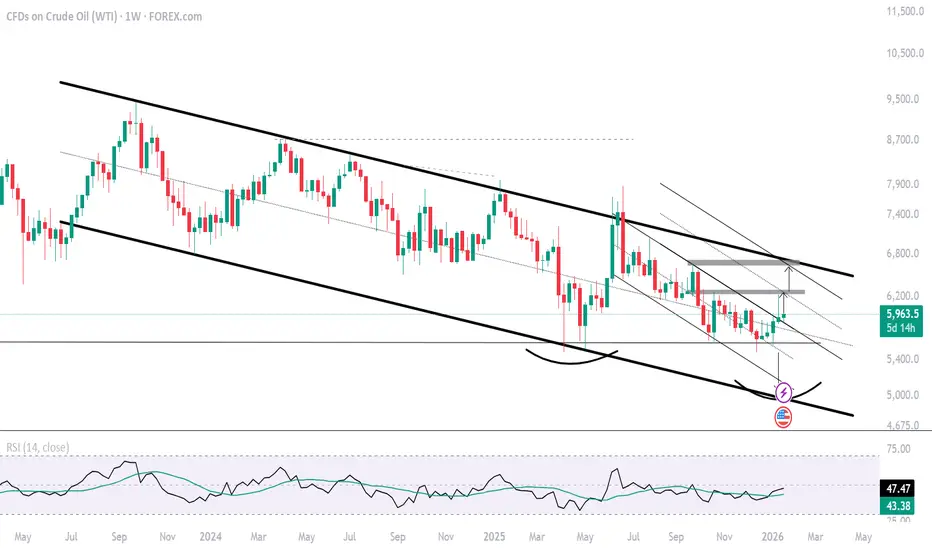
From a weekly perspective, crude prices continue to trade below a key resistance level and under the RSI 50 neutral threshold, reflecting neutral-bearish momentum until a decisive breakout materializes on both price and momentum indicators.
The key level remains the 62.20 high, reached during U.S.–Iran escalation risks. This level also aligns with the mid-zone of a duplicated descending channel, extending between the highs of June 2025 and the lows of December 2025.
A decisive hold above this level would be expected to extend gains toward the upper boundary of the broader downtrend channel in place since 2023, targeting:
• 64.70 (upper channel boundary since June 2026)
• 66.90 (upper channel boundary since 2023)
• These projections are derived using Fibonacci extensions measured between the April 2025 lows, June 2025 highs, and December 2025 lows.
The primary trend bias remains bearish, consistent with structural oversupply risks, unless a sustained hold above the highlighted resistance levels emerges to shift the dominant narrative.
On the downside, 58 and 55 remain critical support levels. A break below these zones could expose the lower boundary of the long-term channel dating back to September 2023, at 53 and 49, offering another potential dip-buying opportunity
- Razan Hilal, CMT
As long as headlines remain detached from short-term supply disruption risks, early 2026 oversupply narratives are expected to dominate, in alignment with tariff risks.
From a weekly perspective, crude prices continue to trade below a key resistance level and under the RSI 50 neutral threshold, reflecting neutral-bearish momentum until a decisive breakout materializes on both price and momentum indicators.
The key level remains the 62.20 high, reached during U.S.–Iran escalation risks. This level also aligns with the mid-zone of a duplicated descending channel, extending between the highs of June 2025 and the lows of December 2025.
A decisive hold above this level would be expected to extend gains toward the upper boundary of the broader downtrend channel in place since 2023, targeting:
• 64.70 (upper channel boundary since June 2026)
• 66.90 (upper channel boundary since 2023)
• These projections are derived using Fibonacci extensions measured between the April 2025 lows, June 2025 highs, and December 2025 lows.
The primary trend bias remains bearish, consistent with structural oversupply risks, unless a sustained hold above the highlighted resistance levels emerges to shift the dominant narrative.
On the downside, 58 and 55 remain critical support levels. A break below these zones could expose the lower boundary of the long-term channel dating back to September 2023, at 53 and 49, offering another potential dip-buying opportunity
- Razan Hilal, CMT

Declinazione di responsabilità
Le informazioni e le pubblicazioni non sono intese come, e non costituiscono, consulenza o raccomandazioni finanziarie, di investimento, di trading o di altro tipo fornite o approvate da TradingView. Per ulteriori informazioni, consultare i Termini di utilizzo.
Declinazione di responsabilità
Le informazioni e le pubblicazioni non sono intese come, e non costituiscono, consulenza o raccomandazioni finanziarie, di investimento, di trading o di altro tipo fornite o approvate da TradingView. Per ulteriori informazioni, consultare i Termini di utilizzo.