
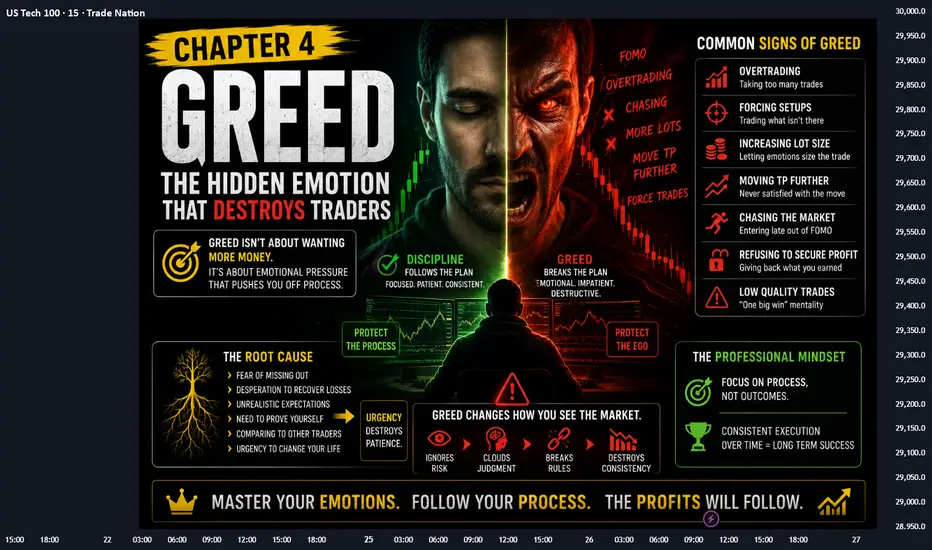
Greed is one of the most misunderstood emotions in trading.
Most traders think greed simply means:
“Wanting too much money.”
But Chapter 4 explains that greed is deeper than that.
Greed is often an emotional reaction driven by:
fear of missing out,
desperation,
overconfidence,
insecurity,
impatience,
or the need to recover losses quickly.
Greed pushes traders away from process and into emotional decision-making.
Common Signs of Greed
Greed often appears as:
overtrading
forcing setups
increasing lot sizes emotionally
moving take profits further
chasing the market
refusing to secure profits
taking low-quality trades for “one big win”
The dangerous part?
Greed usually feels justified in the moment.
It disguises itself as:
confidence,
ambition,
conviction,
or “trusting the setup.”
But in reality, greed often weakens discipline and destroys consistency.
The Root Cause of Greed
One of the strongest lessons from this chapter:
Greed is usually connected to emotional pressure around money.
Examples:
wanting to recover losses fast
trying to prove yourself
unrealistic income expectations
comparing yourself to other traders
desperation to change your financial situation quickly
This creates urgency.
And urgency destroys patience.
Why Greed Is Dangerous
Greed changes how traders see the market.
Instead of objectively reading price action, traders begin:
seeing setups that are not there,
ignoring risk,
abandoning their rules,
and emotionally forcing opportunities.
Execution becomes emotional instead of strategic.
The Professional Mindset
Professional traders understand:
The goal is NOT to make the most money possible on one trade.
The goal is:
Consistent execution over time.
Greed focuses on outcomes.
Professionals focus on process.
Key Lesson
Greed is not solved by “trying harder” to be disciplined.
It is solved by removing the emotional pressure creating the greed in the first place.
When expectations become realistic,
confidence becomes stable,
and process becomes the focus…
greed naturally loses power.
Final Thought
The market rewards patience far more than emotional urgency.
Many traders are not losing because their strategy is bad.
They are losing because greed causes them to abandon the strategy completely.
Master the process first.
The profits follow later.
Most traders think greed simply means:
“Wanting too much money.”
But Chapter 4 explains that greed is deeper than that.
Greed is often an emotional reaction driven by:
fear of missing out,
desperation,
overconfidence,
insecurity,
impatience,
or the need to recover losses quickly.
Greed pushes traders away from process and into emotional decision-making.
Common Signs of Greed
Greed often appears as:
overtrading
forcing setups
increasing lot sizes emotionally
moving take profits further
chasing the market
refusing to secure profits
taking low-quality trades for “one big win”
The dangerous part?
Greed usually feels justified in the moment.
It disguises itself as:
confidence,
ambition,
conviction,
or “trusting the setup.”
But in reality, greed often weakens discipline and destroys consistency.
The Root Cause of Greed
One of the strongest lessons from this chapter:
Greed is usually connected to emotional pressure around money.
Examples:
wanting to recover losses fast
trying to prove yourself
unrealistic income expectations
comparing yourself to other traders
desperation to change your financial situation quickly
This creates urgency.
And urgency destroys patience.
Why Greed Is Dangerous
Greed changes how traders see the market.
Instead of objectively reading price action, traders begin:
seeing setups that are not there,
ignoring risk,
abandoning their rules,
and emotionally forcing opportunities.
Execution becomes emotional instead of strategic.
The Professional Mindset
Professional traders understand:
The goal is NOT to make the most money possible on one trade.
The goal is:
Consistent execution over time.
Greed focuses on outcomes.
Professionals focus on process.
Key Lesson
Greed is not solved by “trying harder” to be disciplined.
It is solved by removing the emotional pressure creating the greed in the first place.
When expectations become realistic,
confidence becomes stable,
and process becomes the focus…
greed naturally loses power.
Final Thought
The market rewards patience far more than emotional urgency.
Many traders are not losing because their strategy is bad.
They are losing because greed causes them to abandon the strategy completely.
Master the process first.
The profits follow later.

Pubblicazioni correlate
Declinazione di responsabilità
Le informazioni e le pubblicazioni non sono intese come, e non costituiscono, consulenza o raccomandazioni finanziarie, di investimento, di trading o di altro tipo fornite o approvate da TradingView. Per ulteriori informazioni, consultare i Termini di utilizzo.
Pubblicazioni correlate
Declinazione di responsabilità
Le informazioni e le pubblicazioni non sono intese come, e non costituiscono, consulenza o raccomandazioni finanziarie, di investimento, di trading o di altro tipo fornite o approvate da TradingView. Per ulteriori informazioni, consultare i Termini di utilizzo.