
On May 27, 2026, the Depository Trust & Clearing Corporation — the backbone of US capital markets, processing $4.7 quadrillion in securities transactions annually and holding $114 trillion in custody — announced it would tokenize DTC-custodied assets on the Stellar network, targeting H1 2027 deployment. The working group includes BlackRock, Goldman Sachs, JPMorgan, Morgan Stanley, and Bank of America. This is not a pilot. This is Wall Street choosing its rails.
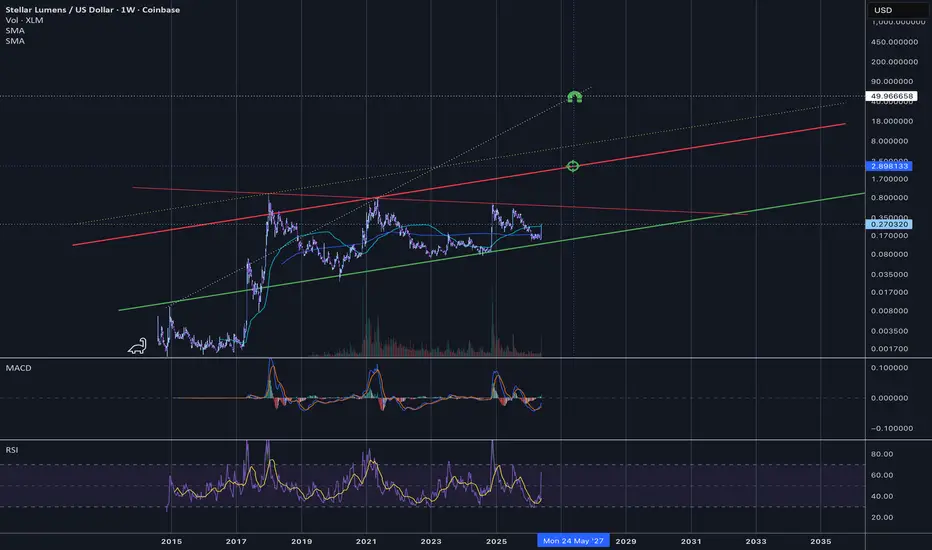
XLM responded with an 80%+ candle in a single week, breaking out of a multi-year compression pattern. The chart is set up for two targets: $2.90 at the red upper channel boundary, and $50 at the outer dotted macro extension — both within the 2027 window as the DTCC integration goes live. The quantitative model below shows why those targets may be deeply conservative.
The Origin Story Most People Forget:
Stellar was not built from scratch. It was created by Jed McCaleb, co-founder of Ripple, using the same foundational codebase that powers XRP — the fastest, lowest-cost settlement protocol in crypto. The original DNA is the same: sub-5-second finality, fractions-of-a-cent fees, and a consensus mechanism built for institutional-grade financial infrastructure, not consumer speculation.
Where Ripple went enterprise-first with a closed partner network, McCaleb took the same engine and built an open, permissionless, compliance-first public chain. A decade of quiet, deliberate development for exactly one purpose: to be the settlement rail that regulated finance could actually use.
Stellar Development Foundation CEO Denelle Dixon said it herself on the day of the DTCC announcement: "Our network was built for this moment."
She was not wrong.
Why DTCC Chose Stellar Over Everyone Else
DTCC's selection criteria were explicit: compliance-minded architecture, transaction throughput, low-cost operations, and proven track record with institutional assets onchain. Ethereum was passed over entirely. Solana was passed over. The SEC's December 2025 No-Action Letter authorizing DTCC's tokenization service specifically requires that token movement be restricted to registered wallets — a capability Stellar handles natively at the base layer because tokens are first-class primitives on the network, not smart contracts bolted on top. DTCC can force token transfers or burns in cases of fraud or error. You cannot do that on Ethereum.
The other network DTCC selected was Canton — a private, institution-only L1. For the public blockchain leg of the world's most important tokenization program, they chose Stellar.
The Quantitative Case: How Do You Price $4.7 Quadrillion?
Using the Equation of Exchange (MV = PQ), we can model what XLM must be worth if Stellar captures a meaningful share of DTCC's settlement flow:
Required XLM Price = (DTCC Volume × Stellar Share × Net Settlement Rate) ÷ (Velocity × Circulating Supply)
The two most critical variables in this model:
1. Net Settlement Rate — DTCC processed ~$4.7 quadrillion gross in 2025, but nets approximately 98% of trades before final settlement. Only the residual actually needs to move on-chain. This single assumption swings the price estimate by orders of magnitude.
2. Stellar's Share — DTCC's stated strategy is building across multiple L1 and L2 networks, with Canton already handling Treasuries and Chainlink handling orchestration. Stellar will not get 100% of the flow.
Three Scenarios:
► Conservative — 5% Stellar share, 2% net settlement rate, velocity 200
→ Required XLM price: ~$7.83 (~46× from $0.17)
► Base Case — 15% Stellar share, 5% net settlement rate, velocity 100
→ Required XLM price: ~$117.50 (~691× from $0.17)
► Aggressive — 30% Stellar share, 10% net settlement rate, velocity 50
→ Required XLM price: ~$940 (~5,500× from $0.17)
Important caveat: XLM fees are 0.00001 XLM per transaction. Even at a billion daily transactions, fee-driven demand is negligible (~$170/day). The price thesis lives entirely in the velocity/collateral model, not fee burns. XLM must be held as working capital to settle transactions — the higher the volume flowing through Stellar, the more XLM must be locked in motion at any given time.
The $50 chart target corresponds roughly to a conservative-to-base scenario. The $940 scenario is the aggressive case but requires only 30% share and 10% net settlement — neither assumption is outlandish if Stellar becomes the dominant public chain leg of DTCC's infrastructure.
The Macro Setup
The weekly log channel has contained every major move in XLM's history. Price is breaking out of the lower bound of the inner channel after a multi-year base, MACD histogram curling from deeply negative territory, RSI at ~62 confirming early expansion phase. The god candle off the DTCC announcement is the first structural confirmation that the market is beginning to price this thesis.
Fundamental Accelerants:
• DTCC limited production trades begin July 2026, full commercial launch October 2026
• Stellar integration live H1 2027 — Russell 1000 stocks, major ETFs, US Treasuries
• $2B+ in tokenized RWAs already on Stellar as of Q1 2026, up 72% YoY
• GENIUS Act (stablecoins) and CLARITY Act (market structure) both accelerate institutional onchain adoption
• XLM has been processing real cross-border payments for a decade — not a new chain with a promise, an operational network getting a $114 trillion volume mandate
Targets: $2.90 (red channel) → $50 (outer extension) → $940 (aggressive MV=PQ scenario)
Invalidation: Weekly close back below the green channel lower rail negates the breakout.
Not financial advice. Technical analysis and quantitative modeling only.
XLM responded with an 80%+ candle in a single week, breaking out of a multi-year compression pattern. The chart is set up for two targets: $2.90 at the red upper channel boundary, and $50 at the outer dotted macro extension — both within the 2027 window as the DTCC integration goes live. The quantitative model below shows why those targets may be deeply conservative.
The Origin Story Most People Forget:
Stellar was not built from scratch. It was created by Jed McCaleb, co-founder of Ripple, using the same foundational codebase that powers XRP — the fastest, lowest-cost settlement protocol in crypto. The original DNA is the same: sub-5-second finality, fractions-of-a-cent fees, and a consensus mechanism built for institutional-grade financial infrastructure, not consumer speculation.
Where Ripple went enterprise-first with a closed partner network, McCaleb took the same engine and built an open, permissionless, compliance-first public chain. A decade of quiet, deliberate development for exactly one purpose: to be the settlement rail that regulated finance could actually use.
Stellar Development Foundation CEO Denelle Dixon said it herself on the day of the DTCC announcement: "Our network was built for this moment."
She was not wrong.
Why DTCC Chose Stellar Over Everyone Else
DTCC's selection criteria were explicit: compliance-minded architecture, transaction throughput, low-cost operations, and proven track record with institutional assets onchain. Ethereum was passed over entirely. Solana was passed over. The SEC's December 2025 No-Action Letter authorizing DTCC's tokenization service specifically requires that token movement be restricted to registered wallets — a capability Stellar handles natively at the base layer because tokens are first-class primitives on the network, not smart contracts bolted on top. DTCC can force token transfers or burns in cases of fraud or error. You cannot do that on Ethereum.
The other network DTCC selected was Canton — a private, institution-only L1. For the public blockchain leg of the world's most important tokenization program, they chose Stellar.
The Quantitative Case: How Do You Price $4.7 Quadrillion?
Using the Equation of Exchange (MV = PQ), we can model what XLM must be worth if Stellar captures a meaningful share of DTCC's settlement flow:
Required XLM Price = (DTCC Volume × Stellar Share × Net Settlement Rate) ÷ (Velocity × Circulating Supply)
The two most critical variables in this model:
1. Net Settlement Rate — DTCC processed ~$4.7 quadrillion gross in 2025, but nets approximately 98% of trades before final settlement. Only the residual actually needs to move on-chain. This single assumption swings the price estimate by orders of magnitude.
2. Stellar's Share — DTCC's stated strategy is building across multiple L1 and L2 networks, with Canton already handling Treasuries and Chainlink handling orchestration. Stellar will not get 100% of the flow.
Three Scenarios:
► Conservative — 5% Stellar share, 2% net settlement rate, velocity 200
→ Required XLM price: ~$7.83 (~46× from $0.17)
► Base Case — 15% Stellar share, 5% net settlement rate, velocity 100
→ Required XLM price: ~$117.50 (~691× from $0.17)
► Aggressive — 30% Stellar share, 10% net settlement rate, velocity 50
→ Required XLM price: ~$940 (~5,500× from $0.17)
Important caveat: XLM fees are 0.00001 XLM per transaction. Even at a billion daily transactions, fee-driven demand is negligible (~$170/day). The price thesis lives entirely in the velocity/collateral model, not fee burns. XLM must be held as working capital to settle transactions — the higher the volume flowing through Stellar, the more XLM must be locked in motion at any given time.
The $50 chart target corresponds roughly to a conservative-to-base scenario. The $940 scenario is the aggressive case but requires only 30% share and 10% net settlement — neither assumption is outlandish if Stellar becomes the dominant public chain leg of DTCC's infrastructure.
The Macro Setup
The weekly log channel has contained every major move in XLM's history. Price is breaking out of the lower bound of the inner channel after a multi-year base, MACD histogram curling from deeply negative territory, RSI at ~62 confirming early expansion phase. The god candle off the DTCC announcement is the first structural confirmation that the market is beginning to price this thesis.
Fundamental Accelerants:
• DTCC limited production trades begin July 2026, full commercial launch October 2026
• Stellar integration live H1 2027 — Russell 1000 stocks, major ETFs, US Treasuries
• $2B+ in tokenized RWAs already on Stellar as of Q1 2026, up 72% YoY
• GENIUS Act (stablecoins) and CLARITY Act (market structure) both accelerate institutional onchain adoption
• XLM has been processing real cross-border payments for a decade — not a new chain with a promise, an operational network getting a $114 trillion volume mandate
Targets: $2.90 (red channel) → $50 (outer extension) → $940 (aggressive MV=PQ scenario)
Invalidation: Weekly close back below the green channel lower rail negates the breakout.
Not financial advice. Technical analysis and quantitative modeling only.

Declinazione di responsabilità
Le informazioni e le pubblicazioni non sono intese come, e non costituiscono, consulenza o raccomandazioni finanziarie, di investimento, di trading o di altro tipo fornite o approvate da TradingView. Per ulteriori informazioni, consultare i Termini di utilizzo.
Declinazione di responsabilità
Le informazioni e le pubblicazioni non sono intese come, e non costituiscono, consulenza o raccomandazioni finanziarie, di investimento, di trading o di altro tipo fornite o approvate da TradingView. Per ulteriori informazioni, consultare i Termini di utilizzo.