Prop Firm Rules Overlay by Puravida Edge
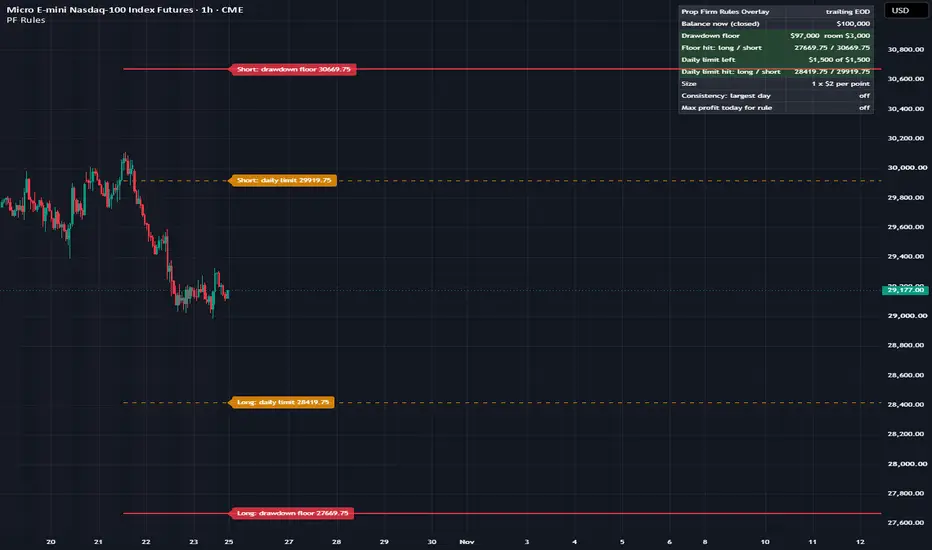
Prop Firm Rules Overlay draws the prices that matter on a prop firm account: where a position hits the daily loss limit and where it hits the drawdown floor, for a long and a short entry at the same time. It also keeps a consistency-rule counter.
What it shows
- Drawdown floor: trailing end-of-day (floor follows the highest end-of-day balance and locks once it reaches the starting balance) or static (fixed below the starting balance). The table shows the floor in USD, the room above it, and the price at which the open position would reach it.
- Daily loss limit: remaining room for today based on realized P&L, and the price at which the position would use it up.
- Consistency rule: the largest single day as a share of total profit, and the maximum profit today that keeps the rule intact.
- Colors: green when there is room, yellow below 25 percent of the limit, red when a limit is reached.
How to use it
When you add the indicator, a window asks for the account figures and your position; TradingView cannot read your account, so these are entered by hand: starting balance, max drawdown, daily loss limit, the balance at the last end of day, the highest end-of-day balance (trailing model), realized P&L today, and the position size. When the indicator is added, click the last bar of the chart to set the entry price, then fill in your prop account in the Inputs window. For a position already open, change the entry price to your fill price. Update the state inputs once a day, before the session.
Point value is taken from the symbol. For CFD or forex symbols enter the USD value of a 1-point move for 1 lot in the "Value of 1 point for 1 unit" input.
Limits
- It is a calculator drawn on the chart, not a live account monitor. Figures are only as current as the inputs.
- Two drawdown models are covered: end-of-day trailing and static. Intraday trailing is not modeled.
- No alerts, no orders, no external data.

Systematic strategies for funded accounts → puravidaedge.com/tv
Declinazione di responsabilità
Le informazioni e le pubblicazioni non sono intese come, e non costituiscono, consulenza o raccomandazioni finanziarie, di investimento, di trading o di altro tipo fornite o approvate da TradingView. Per ulteriori informazioni, consultare i Termini di utilizzo.