Aggiornato
Winchester 10X1T Mountains Up Pro
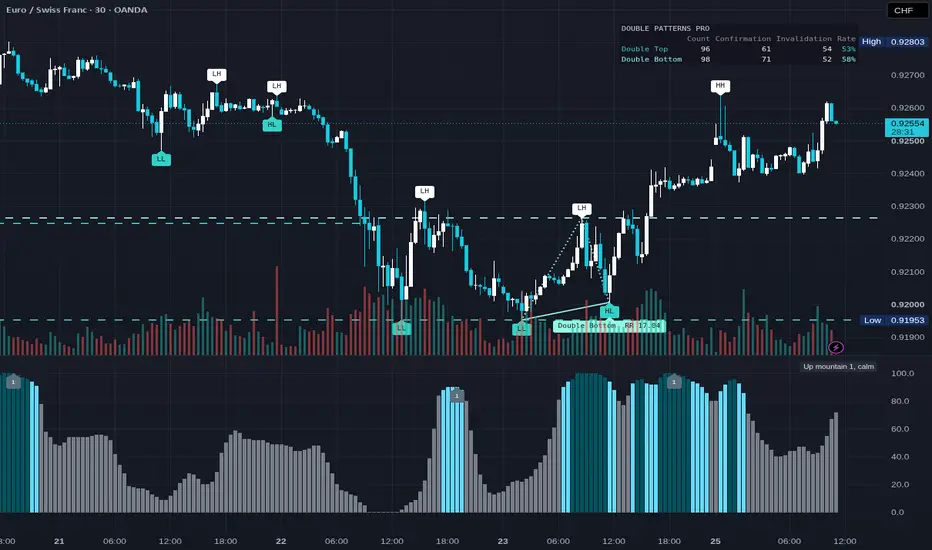
Mountains Up Pro measures upward pressure and draws it as mountains. In the Winchester 10X1T method it marks the final upward push before a top based reversal, so you can see when a move is building, when it peaks and when it is running out of steam.
How it is calculated. Two two-pole smoothers run on hl2, a fast one (12) and a slow one (48). The upward gap between them is the pressure. This gap is ranked from 0 to 100 against its own last 100 bars, and that rank is the mountain you see. A bar only counts when the fast smoother is really above the slow one. Because the gap is ranked against its own history, a mountain means the same thing on forex, gold, indices and crypto, whether the market is quiet or wild.
Mountain rules. Everything is judged on closed bars only, so a mountain does not appear and vanish while a bar is still open. A mountain starts when the rank reaches the mountain level (87). It only ends when pressure falls back into the neutral zone (50). A dip that stays above neutral belongs to the same mountain, so one push is never counted twice. Mountains are numbered in a row at their apex, and a downward mountain on the other side starts the count again. The second mountain in a row is the one the 10X1T method waits for.
Colours. Grey when calm, light blue from the mountain level, deep teal from the peak level (95). There are no shades in between, a bar is either calm or a signal.
Exhaustion. From the second mountain on, the script compares two things at the end of each mountain: the highest price and the apex gap measured in ATR. If price went higher than at the previous mountain but the apex gap was smaller, the label shows EX. Price still pushes, the pressure behind it is fading.
Alerts. Upward mountain started, second upward mountain, upward push past the apex, and upward exhaustion. A small status line in the corner shows the current phase (calm, building, past apex, or a dip inside the same mountain), and the data window shows the pressure gap in ATR, the mountain number and the phase.
How to use it. Read it after the environment and the structure are clear, for example after a double top. The mountains tell you about pressure and timing, they are not a buy or sell signal on their own. A separate script, Mountains Down Pro, reads downward pressure the same way.
Credits. The two-pole smoother follows the public SuperSmoother formula by John F. Ehlers. The gap ranking, the mountain rules, the numbering and the exhaustion check are our own work.
Note di rilascio
Version 2.0. The mountains now match the classic 10X1T Mountains study candle for candle, value for value and colour for colour. Version 1.0 used a different pressure calculation and missed some mountains that sit just above the warning level, so students saw different mountains than on the classic study. That is fixed.How it is calculated now. Two Laguerre filters by John F. Ehlers run on hl2, a fast one (gamma 0.3) and a slow one (gamma 0.7). Their percentage gap is ranked from 0 to 100 against the last 100 bars. A bar from the warning level (85) is part of a mountain, and from the extreme level (95) it gets the peak colour. Numbering and exhaustion are judged on closed bars only.
What stays. Mountains are numbered at their apex, and a new mountain is only counted after pressure fell back to the neutral zone (50). The status line and the alerts stay, and the classic alert UPWARD or DOWNWARD PRESSURE ALERT is back for anyone who used it on the classic study. The exhaustion mark EX now compares the pressure gap at the apex: price went further than at the previous mountain, but the pressure behind it was lower.
If your chart still shows the old values, remove the indicator once and add it again from the community scripts. The default settings are the classic ones, so please reset changed inputs to default.
Credits. The Laguerre PPO percentile rank idea was published open source by TheLark and ChrisMoody, the Laguerre filter is by John F. Ehlers. The mountain rules, the numbering, the exhaustion check and the status line are our own work.

Declinazione di responsabilità
Le informazioni e le pubblicazioni non sono intese come, e non costituiscono, consulenza o raccomandazioni finanziarie, di investimento, di trading o di altro tipo fornite o approvate da TradingView. Per ulteriori informazioni, consultare i Termini di utilizzo.
Declinazione di responsabilità
Le informazioni e le pubblicazioni non sono intese come, e non costituiscono, consulenza o raccomandazioni finanziarie, di investimento, di trading o di altro tipo fornite o approvate da TradingView. Per ulteriori informazioni, consultare i Termini di utilizzo.