OPEN-SOURCE SCRIPT
Price Structure Zones with Trend Filter Signals
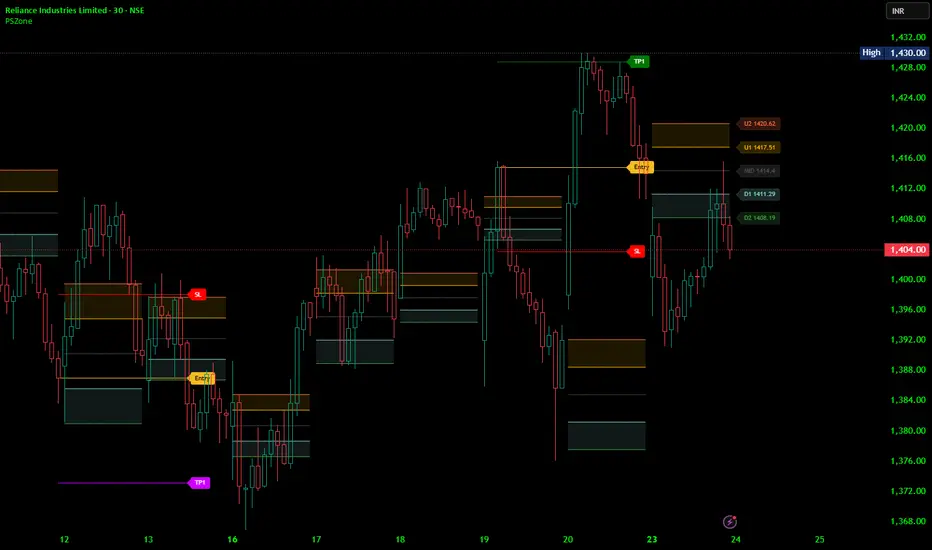
What the script is
This is a two-engine trading system combining two independent but complementary methodologies:
Engine 1 — Camarilla Pivot Zones (the "map")
Camarilla pivots are price levels derived from the previous period's High, Low, and Close. They act like a gravitational grid — price tends to bounce between these levels intraday. There are 5 resistance levels (U1–U5) above the previous close and 5 support levels (D1–D5) below it. The formulas are fixed constants from Franklin Ochoa's Secrets of a Pivot Boss.
Engine 2 — Momentum/ADX Filter + Range Filter (the "trigger")
The ADX (Average Directional Index) measures trend strength, not direction. When ADX is below your threshold, the market is consolidating/ranging. The script then applies a Range Filter — a smoothed band around price — to detect the precise moment price breaks out of that consolidation. That breakout becomes your entry signal, complete with SL and TP levels.
How to read each level:
U1 / D1 & U2 / D2 — Minor friction zones. Price often pauses or wicks here but doesn't reverse hard. Not great for entries; good for partial profit-taking.
U3 / D3 — The "decision zone." Price respecting U3 (failing to break above) is a short signal; price holding D3 (bouncing off support) is a long signal. These are your primary reversal trade zones.
U4 / D4 — The breakout threshold. A clean daily close above U4 = strong bullish momentum. Below D4 = strong bearish momentum. These are your breakout continuation entries.
U5 / D5 — Extreme exhaustion / spike targets. Rarely reached but useful as hard TP or warning zones when reached intraday.
How to trade the signals-
Two distinct trade setups exist:
Setup A — Reversal trade at U3/D3
When price approaches U3 from below and the ADX signal fires short (range filter steps down), that is a high-probability short. Entry at the close of the signal bar, SL above U4, TP1 at U1/MID, TP2 at D1. The reverse logic applies at D3 for longs. This is the bread-and-butter setup — it works best in ranging/sideways markets.
Setup B — Breakout trade above U4 / below D4
When price breaks and closes above U4 with the ADX signal firing long, that is a momentum continuation trade. This one requires the ADX to have been low (consolidating) before the breakout — the script's cooldown and range detection ensure you're catching the first pop out of compression, not a late chase.
How SL and TP are calculated by the script:
The risk levels are multiples of the Band Radius (a smoothed ATR-like measure). By default: SL = 0.4× band radius, TP1 = 0.5× band radius, TP2 = 1.0× band radius. This gives you roughly a 1.25:1 reward-to-risk on TP1 — conservative and achievable. TP2 is disabled by default; enable it for trending markets.
Best timeframes:
The pivot resolution (currently set to Daily "D") is independent of your chart timeframe. Here's how to think about it:
Pivot resolution "D" (Daily pivots) works best on:
5-minute to 30-minute charts for intraday scalping and day trading
1-hour charts for intraday swing entries
These are the most commonly used Camarilla applications
Pivot resolution "W" (Weekly pivots) works best on:
1-hour to 4-hour charts
Good for swing traders holding 2–5 days
Pivot resolution "M" (Monthly pivots) works best on:
Daily charts
Good for position traders holding weeks to months
Practical tips:
Confluence is everything. The best trades happen when the ADX signal fires exactly at a U3 or D3 level. An ADX signal in the middle of nowhere between levels is lower quality — skip it or reduce size.
Avoid trading through major news. The script has no awareness of fundamental events. If a signal fires 10 minutes before a Budget/central bank/RBI announcement, stand aside.
The cooldown bar setting (default 20) prevents re-entry too soon after a signal. On faster timeframes (5m), you may want to reduce it to 8–12. On 4H/Daily, increase it to 30–50.
On Indian markets specifically (NSE/BSE): Daily pivots on a 15-minute chart work very well for Nifty 50, Bank Nifty, and individual large-cap stocks. The 9:15–10:00 opening range often sets the tone, and U3/D3 levels tend to act as strong intraday magnets. Watch for the first ADX signal after 10:00 AM IST when the opening volatility has settled.
Past statistical behavior does not guarantee future results — use as context, not as a signal in isolation. Enjoy !!
This is a two-engine trading system combining two independent but complementary methodologies:
Engine 1 — Camarilla Pivot Zones (the "map")
Camarilla pivots are price levels derived from the previous period's High, Low, and Close. They act like a gravitational grid — price tends to bounce between these levels intraday. There are 5 resistance levels (U1–U5) above the previous close and 5 support levels (D1–D5) below it. The formulas are fixed constants from Franklin Ochoa's Secrets of a Pivot Boss.
Engine 2 — Momentum/ADX Filter + Range Filter (the "trigger")
The ADX (Average Directional Index) measures trend strength, not direction. When ADX is below your threshold, the market is consolidating/ranging. The script then applies a Range Filter — a smoothed band around price — to detect the precise moment price breaks out of that consolidation. That breakout becomes your entry signal, complete with SL and TP levels.
How to read each level:
U1 / D1 & U2 / D2 — Minor friction zones. Price often pauses or wicks here but doesn't reverse hard. Not great for entries; good for partial profit-taking.
U3 / D3 — The "decision zone." Price respecting U3 (failing to break above) is a short signal; price holding D3 (bouncing off support) is a long signal. These are your primary reversal trade zones.
U4 / D4 — The breakout threshold. A clean daily close above U4 = strong bullish momentum. Below D4 = strong bearish momentum. These are your breakout continuation entries.
U5 / D5 — Extreme exhaustion / spike targets. Rarely reached but useful as hard TP or warning zones when reached intraday.
How to trade the signals-
Two distinct trade setups exist:
Setup A — Reversal trade at U3/D3
When price approaches U3 from below and the ADX signal fires short (range filter steps down), that is a high-probability short. Entry at the close of the signal bar, SL above U4, TP1 at U1/MID, TP2 at D1. The reverse logic applies at D3 for longs. This is the bread-and-butter setup — it works best in ranging/sideways markets.
Setup B — Breakout trade above U4 / below D4
When price breaks and closes above U4 with the ADX signal firing long, that is a momentum continuation trade. This one requires the ADX to have been low (consolidating) before the breakout — the script's cooldown and range detection ensure you're catching the first pop out of compression, not a late chase.
How SL and TP are calculated by the script:
The risk levels are multiples of the Band Radius (a smoothed ATR-like measure). By default: SL = 0.4× band radius, TP1 = 0.5× band radius, TP2 = 1.0× band radius. This gives you roughly a 1.25:1 reward-to-risk on TP1 — conservative and achievable. TP2 is disabled by default; enable it for trending markets.
Best timeframes:
The pivot resolution (currently set to Daily "D") is independent of your chart timeframe. Here's how to think about it:
Pivot resolution "D" (Daily pivots) works best on:
5-minute to 30-minute charts for intraday scalping and day trading
1-hour charts for intraday swing entries
These are the most commonly used Camarilla applications
Pivot resolution "W" (Weekly pivots) works best on:
1-hour to 4-hour charts
Good for swing traders holding 2–5 days
Pivot resolution "M" (Monthly pivots) works best on:
Daily charts
Good for position traders holding weeks to months
Practical tips:
Confluence is everything. The best trades happen when the ADX signal fires exactly at a U3 or D3 level. An ADX signal in the middle of nowhere between levels is lower quality — skip it or reduce size.
Avoid trading through major news. The script has no awareness of fundamental events. If a signal fires 10 minutes before a Budget/central bank/RBI announcement, stand aside.
The cooldown bar setting (default 20) prevents re-entry too soon after a signal. On faster timeframes (5m), you may want to reduce it to 8–12. On 4H/Daily, increase it to 30–50.
On Indian markets specifically (NSE/BSE): Daily pivots on a 15-minute chart work very well for Nifty 50, Bank Nifty, and individual large-cap stocks. The 9:15–10:00 opening range often sets the tone, and U3/D3 levels tend to act as strong intraday magnets. Watch for the first ADX signal after 10:00 AM IST when the opening volatility has settled.
Past statistical behavior does not guarantee future results — use as context, not as a signal in isolation. Enjoy !!
Script open-source
Nello spirito di TradingView, l'autore di questo script lo ha reso open source, in modo che i trader possano esaminarne e verificarne la funzionalità. Complimenti all'autore! Sebbene sia possibile utilizzarlo gratuitamente, ricordiamo che la ripubblicazione del codice è soggetta al nostro Regolamento.

Declinazione di responsabilità
Le informazioni e le pubblicazioni non sono intese come, e non costituiscono, consulenza o raccomandazioni finanziarie, di investimento, di trading o di altro tipo fornite o approvate da TradingView. Per ulteriori informazioni, consultare i Termini di utilizzo.
Script open-source
Nello spirito di TradingView, l'autore di questo script lo ha reso open source, in modo che i trader possano esaminarne e verificarne la funzionalità. Complimenti all'autore! Sebbene sia possibile utilizzarlo gratuitamente, ricordiamo che la ripubblicazione del codice è soggetta al nostro Regolamento.
Declinazione di responsabilità
Le informazioni e le pubblicazioni non sono intese come, e non costituiscono, consulenza o raccomandazioni finanziarie, di investimento, di trading o di altro tipo fornite o approvate da TradingView. Per ulteriori informazioni, consultare i Termini di utilizzo.