OPEN-SOURCE SCRIPT
Aggiornato RPFXBYDAN Liquidity Sweep Cascade [SMC]
# Publication settings
**Publish this open-source, not invite-only/closed-source.** Every concept used here (liquidity sweeps, CISD, FVG, order blocks, kill zones, SMT divergence) is public-domain ICT/SMC terminology, not proprietary logic — TradingView's moderators specifically hold closed-source and invite-only scripts to a much higher bar (you have to justify what's unique enough to hide, and why it's worth paying for). Open-source sidesteps that requirement entirely and is the safer, more defensible choice for a script built from publicly-known building blocks combined in an original way.
# Title
RPFXBYDAN Liquidity Sweep Cascade [SMC]
# Description
**Why these pieces are combined (not a mashup for its own sake)**
Each concept here exists to solve a specific failure mode of using it alone. A liquidity sweep by itself is noise — most swing highs/lows get taken out without reversing. Requiring a CISD (a shift in orderflow) after the sweep filters out sweeps that don't actually reverse. Requiring the entry to land inside a Fair Value Gap in the discount/premium half of the range filters out CISDs that reverse but leave a bad entry price. None of these three alone is a tradeable signal; the combination is the point.
The three-tier structure exists because a signal on one timeframe alone doesn't tell you if you're trading with or against the bigger picture. Tier 1 establishes the higher-timeframe liquidity/imbalance context. Tier 2 only starts hunting once Tier 1 completes, confirming the reaction on a mid-timeframe inside a session kill zone. Tier 3 only starts once Tier 2 completes, and is the only tier that produces a real stop/target — it's the culmination of the other two agreeing, not an independent signal. That sequential gating (each tier consumed by exactly one attempt from the tier above it) is the original mechanism in this script, not the individual concepts themselves.
SMT divergence and Inverse FVG tracking are optional add-ons layered on top of that same gated engine, off by default, for traders who already use those specific confluences.
**What this is**
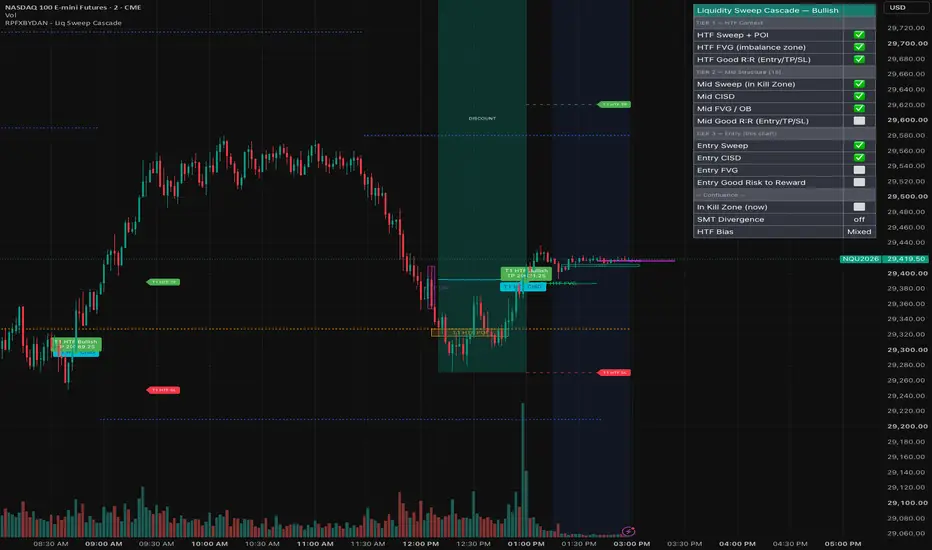
A three-tier Smart Money Concepts checklist that only flags a setup once liquidity, structure, and risk all line up across three timeframes:
- **Tier 1 – HTF Context**: a higher-timeframe liquidity sweep reacting into an HTF imbalance (your Point of Interest).
- **Tier 2 – Mid Structure**: inside a session/kill-zone window, a mid-timeframe (default 15m) sweep, shift in orderflow (CISD), and Fair Value Gap / order block — only evaluated once Tier 1 has completed.
- **Tier 3 – Entry**: on your chart's own timeframe, a sweep, CISD, and FVG (or a confirmed Inverse FVG retest if no fresh FVG appears) — only evaluated once Tier 2 has completed. This is the only tier with a defined stop, a fixed R-multiple take-profit, and a Risk:Reward gate.
Optional confluence layers: SMT divergence against a correlated symbol (e.g. ES vs NQ), and an HTF directional bias readout.
A live table shows exactly which of the checklist items are satisfied, tier by tier, so you can see why a setup is or isn't "complete" instead of guessing.
**How to use it**
1. Set Tier 1's HTF input to something meaningfully higher than your chart (e.g. 4H/Daily if you trade 5m-15m).
2. Set Tier 2's mid-timeframe input (default 15m).
3. Enable the kill zone(s) you actually trade (New York AM is on by default).
4. Optionally set a correlated symbol for SMT divergence.
5. Watch the table: green checks across all three tiers plus R:R = a completed setup. Alerts fire automatically on completion (bullish and bearish are separate alert conditions).
**Limitations (read before trusting a green table)**
- This is a deterministic, rule-based approximation of a discretionary trading concept. Every judgment call in the code — how CISD is defined, where the 50% discount/premium line sits, how SMT divergence is measured — is this author's interpretation, not a universally agreed-upon standard.
- Higher-timeframe values only update when that HTF candle closes, by design, so they can lag price intentionally.
- Bar Replay does not render this script's drawings/table live (a TradingView platform limitation with drawing objects, not a bug in the script) — use a live or normal historical chart to watch it work.
- No indicator predicts the future. Backtest and forward-test on your own instrument and timeframe before risking real money. Nothing here is financial advice.
Note di rilascio
Changelog for this update:Added Simple Mode: a toggleable alternate trigger where a 15m SMT divergence, followed by a swing sweep, followed by a 15m Shift, gates a 1-minute 2:1 R:R entry — runs independently of the existing HTF→Mid→Entry cascade.
Fixed a bug where Simple Mode's Shift level re-scanned itself every bar instead of locking in at the sweep, which was silently preventing the sequence from ever confirming.
Fixed a one-shot gate bug in the main cascade where a single failed sweep attempt permanently blocked that tier until an entirely new parent cycle began — this was the main cause of long stretches with no signals.
SMT divergence now computes on its own configurable timeframe instead of the chart's native timeframe.
Added trade outcome tracking: completed signals now show "stopped out" or "target hit" based on what actually happened, instead of sitting on the chart looking unresolved.
Fixed unbounded label buildup (old signals were never cleared, only boxes/lines were).
Added a toggle to hide Tier 1/2 visuals entirely, cutting chart clutter down to just the actionable entry tier.
Redesigned the Entry/SL/TP display: a fixed always-readable panel plus on-chart labels that draw once when a signal fires and sit in the blank margin to the right — no longer chase the current bar or overlap other markers.
Suppressed the "TAKE" banner for failed/incomplete attempts — it now only announces real, actionable signals.
Renamed to "RPFXBYDAN Liquidity Sweep Cascade [SMC]".
Note di rilascio
Fixed alerts silently failing to fire on fast, single-candle moves — alerts now trigger the instant a signal confirms instead of depending on a value that could reset before the bar closes. Alert messages also now include the actual Entry/SL/TP prices.Reworked the Entry/SL/TP display: each level now gets its own on-chart label (Entry, Stop Loss, Take Profit) drawn once when a signal fires and placed in the blank margin to the right, plus a fixed reference panel — neither moves or gets redrawn afterward, so nothing chases price or piles up over time.
Removed the large "TAKE" banner for failed/incomplete attempts — it only announces real, actionable signals now.
Tier 1/2 background context can be hidden by default so the chart shows only the actionable entry signal.
Note di rilascio
Trade panel overhaul: fixed the panel getting permanently stuck on "No active trade" even after real signals fired (it was reading a flag that resets before the display could catch it — now reads a persistent field instead). Panel now also shows which tier (T1/T2/T3) produced the trade, added a timestamp + "bars ago" so you can tell exactly when a shown trade fired, and added a staleness cutoff so an old closed trade won't keep sitting next to current price looking like it just happened.Note di rilascio
Added alert for T1 and T2 entriesScript open-source
Nello spirito di TradingView, l'autore di questo script lo ha reso open source, in modo che i trader possano esaminarne e verificarne la funzionalità. Complimenti all'autore! Sebbene sia possibile utilizzarlo gratuitamente, ricordiamo che la ripubblicazione del codice è soggetta al nostro Regolamento.

Declinazione di responsabilità
Le informazioni e le pubblicazioni non sono intese come, e non costituiscono, consulenza o raccomandazioni finanziarie, di investimento, di trading o di altro tipo fornite o approvate da TradingView. Per ulteriori informazioni, consultare i Termini di utilizzo.
Script open-source
Nello spirito di TradingView, l'autore di questo script lo ha reso open source, in modo che i trader possano esaminarne e verificarne la funzionalità. Complimenti all'autore! Sebbene sia possibile utilizzarlo gratuitamente, ricordiamo che la ripubblicazione del codice è soggetta al nostro Regolamento.
Declinazione di responsabilità
Le informazioni e le pubblicazioni non sono intese come, e non costituiscono, consulenza o raccomandazioni finanziarie, di investimento, di trading o di altro tipo fornite o approvate da TradingView. Per ulteriori informazioni, consultare i Termini di utilizzo.